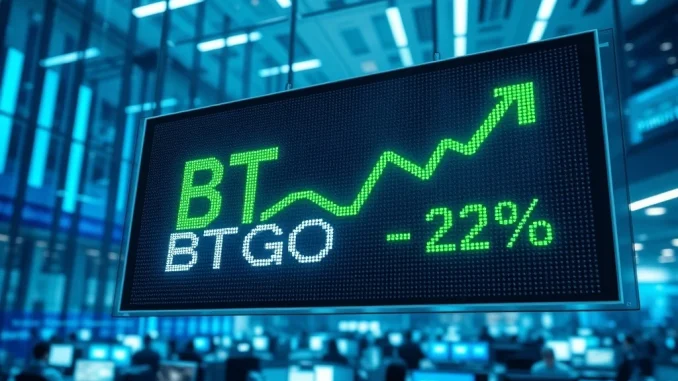
In a landmark event for the digital asset industry, BitGo Holdings Inc. (BTGO) witnessed its stock price skyrocket by 25% on its inaugural day of public trading on January 22, 2025. This powerful debut, reported by CoinDesk, saw shares leap from their initial public offering (IPO) price of $18 to an opening bell price of $22.43. Consequently, the premier cryptocurrency custody and security firm achieved an approximate market valuation of $2 billion. This surge represents more than just a successful IPO; it signals a pivotal shift in mainstream financial market acceptance of core blockchain infrastructure providers.
Analyzing the BitGo Stock Debut
The 25% first-day gain for BitGo stock significantly outperforms the average IPO pop. Historically, according to data from University of Florida finance professor Jay Ritter, the average first-day return for U.S. IPOs typically ranges between 10% and 15%. Therefore, BitGo’s performance indicates exceptionally strong investor demand. This demand likely stems from BitGo’s established position as a foundational service provider in the cryptocurrency ecosystem. The company secures over $100 billion in digital assets for more than 1,500 institutional clients globally. Furthermore, the successful listing provides a much-needed liquidity event for early investors and employees. It also establishes a public market benchmark for other crypto-native infrastructure companies considering a similar path.
The Road to a Public Listing
BitGo’s journey to this public milestone involved several strategic steps. Initially founded in 2013, the company pioneered multi-signature cryptocurrency wallets. It later expanded into institutional-grade custody, prime brokerage, and staking services. A previous attempt to go public via a merger with a special purpose acquisition company (SPAC) was terminated in 2022. However, the company persisted, refining its business model and achieving consistent revenue growth. The decision to pursue a traditional IPO, rather than another SPAC route or direct listing, suggests a desire for the rigor and credibility associated with a standard regulatory filing process with the Securities and Exchange Commission (SEC).
Broader Context and Market Impact
The triumphant BitGo stock launch occurs within a specific financial and regulatory climate. Firstly, it follows a period of renewed institutional interest in digital assets, driven by the approval of spot Bitcoin Exchange-Traded Funds (ETFs) in the United States. These ETFs require secure, regulated custodians like BitGo. Secondly, the event provides a positive counter-narrative to the volatility often associated with crypto markets. It demonstrates that businesses building the underlying financial rails for digital assets can achieve stable, high valuations based on enterprise fundamentals. Moreover, the listing could catalyze a wave of similar public offerings from other crypto infrastructure firms in areas like trading, data analytics, and compliance.
Key factors driving investor confidence include:
- Recurring Revenue Model: Custody fees provide predictable, subscription-like income.
- Regulatory Compliance: BitGo holds key licenses like a New York Trust Charter.
- Institutional Client Base: A diverse roster reduces dependency on any single market segment.
- Technology Moats: Its proprietary custody technology and insurance frameworks are significant barriers to entry for competitors.
The Tokenization Angle: Ondo Finance’s Role
Adding a layer of innovative financial engineering to this story, decentralized finance (DeFi) protocol Ondo Finance (ONDO) had previously announced the launch of a tokenized version of BitGo’s stock. This development bridges traditional equity markets with the on-chain world. Essentially, Ondo plans to hold the actual BitGo shares in a legal trust and issue representative tokens on a blockchain, like Ethereum. These tokens would allow global, 24/7 trading of a synthetic BitGo equity position without requiring a traditional brokerage account. This pre-IPO announcement may have fueled additional interest from the digital-native investment community, anticipating easier access to the stock’s performance through a familiar, tokenized format.
Expert Perspectives on the Valuation
Financial analysts point to several comparable companies when assessing BitGo’s $2 billion valuation. Traditional financial custody giants like Bank of New York Mellon (BK) and State Street (STT) trade at valuations based on their assets under custody (AUC). While BitGo’s $100+ billion AUC is smaller, its growth rate in the nascent digital asset sector is exponentially higher. Another comparison is to publicly traded crypto exchanges like Coinbase (COIN). However, BitGo’s business model is arguably less exposed to trading volume volatility and more akin to a ‘picks and shovels’ provider for the entire industry. This defensive positioning likely contributed to the premium investors were willing to pay on day one.
| Company | Ticker | IPO Date | First Day Gain | Key Sector |
|---|---|---|---|---|
| BitGo Holdings Inc. | BTGO | Jan 22, 2025 | 25% | Crypto Infrastructure |
| Arm Holdings | ARM | Sep 2023 | 25% | Semiconductor IP |
| Instacart | CART | Sep 2023 | 12% | Grocery Technology |
| Klaviyo | KVYO | Sep 2023 | 23% | Marketing Automation |
Conclusion
The remarkable 25% surge in BitGo stock on its first trading day is a multifaceted event with deep implications. It validates the financial viability of cryptocurrency infrastructure businesses. It also provides a trusted, publicly traded vehicle for institutional capital to gain exposure to the growth of digital asset security and services. The concurrent development of a tokenized stock version by Ondo Finance further highlights the converging worlds of traditional and decentralized finance. Ultimately, BitGo’s successful IPO sets a new precedent, proving that companies providing essential, regulated services at the intersection of blockchain and finance can not only survive but thrive in the public market spotlight. This debut may well be remembered as the moment crypto infrastructure came of age on Wall Street.
FAQs
Q1: What was BitGo’s IPO price and first-day opening price?
A1: BitGo set its initial public offering (IPO) price at $18 per share. On its first day of trading, January 22, 2025, the stock opened at $22.43, representing an immediate 25% gain from the IPO price.
Q2: What is BitGo’s primary business, and why is it significant?
A2: BitGo is a leading provider of cryptocurrency custody, security, and financial services for institutional clients. Its significance lies in securing over $100 billion in digital assets, acting as a critical, regulated trust layer that enables larger institutions to safely participate in the digital asset economy.
Q3: How does Ondo Finance’s tokenized stock relate to BitGo’s IPO?
A3: Prior to the IPO, Ondo Finance announced plans to create a tokenized version of BitGo stock. This involves holding the real shares in a trust and issuing representative tokens on a blockchain. It allows for decentralized, global trading of synthetic BitGo equity, bridging public markets with DeFi.
Q4: What does a $2 billion valuation mean for BitGo?
A4: A $2 billion market capitalization, achieved through its public listing, provides BitGo with increased credibility, a currency (its stock) for potential acquisitions, and liquidity for shareholders. It also establishes a public benchmark for valuing other crypto service companies.
Q5: What are the risks associated with investing in a stock like BitGo?
A5: Key risks include regulatory changes impacting cryptocurrency custody, competition from both traditional finance and new crypto-native firms, the inherent volatility of the broader digital asset market which can affect client activity, and execution risks as the company scales its operations globally.