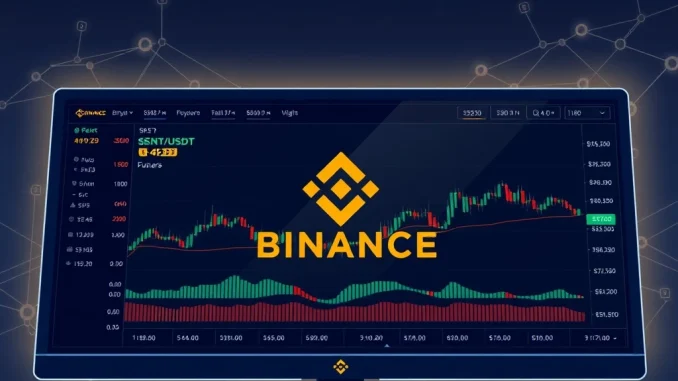
Global cryptocurrency exchange Binance has strategically announced the listing of SENT/USDT perpetual futures contracts, scheduled for 1:00 p.m. UTC on January 22, 2025, marking another significant expansion in its derivatives offerings with support for up to 40x leverage. This development arrives during a period of increasing institutional and retail interest in cryptocurrency derivatives, particularly as traditional finance continues exploring digital asset exposure through regulated instruments. Consequently, Binance’s move represents both a response to market demand and a proactive shaping of the derivatives landscape.
Binance SENT Futures: Technical Specifications and Market Context
Binance will launch the SENT/USDT perpetual futures contract with several key technical parameters. The contract will utilize USDT as the margin and settlement currency, aligning with the exchange’s standardized derivatives framework. Significantly, the offering includes leverage options up to 40x, providing traders with amplified exposure while requiring sophisticated risk management protocols. The listing follows Binance’s established pattern of gradually expanding its perpetual futures portfolio, which now encompasses hundreds of trading pairs across various market capitalizations.
Market data from January 2025 indicates growing derivatives trading volume across major exchanges, with perpetual futures consistently capturing the majority share. According to recent cryptocurrency market structure reports, derivatives now account for approximately 60-70% of total crypto trading volume globally. Binance maintains its position as the largest derivatives venue by volume, making each new listing a potentially market-moving event. The SENT token, prior to this announcement, primarily traded in spot markets on several mid-tier exchanges.
Understanding Perpetual Futures Mechanics
Perpetual futures contracts, unlike traditional futures, lack an expiration date. Traders maintain positions indefinitely, provided they meet margin requirements. These instruments utilize a funding rate mechanism to tether the contract price to the underlying spot asset. Typically, funding payments occur every eight hours between long and short position holders. For instance, when the funding rate is positive, longs pay shorts, encouraging price convergence. This structure makes perpetual futures particularly popular for both speculative trading and hedging strategies in volatile cryptocurrency markets.
The Strategic Rationale Behind Derivatives Expansion
Binance’s decision to list SENT perpetual futures follows a clear strategic pattern observed throughout 2024. The exchange consistently adds derivatives for assets demonstrating sufficient liquidity, developer activity, and community engagement. This approach serves multiple purposes. First, it provides existing SENT holders with sophisticated financial instruments for risk management. Second, it attracts professional traders and algorithmic trading firms seeking new opportunities. Finally, it enhances overall market depth and price discovery for the SENT asset.
Industry analysts note that derivatives listings often precede increased institutional interest. A 2024 report from CryptoCompare highlighted that assets with active derivatives markets typically experience improved liquidity profiles in their spot markets. Moreover, the availability of leverage allows for more complex trading strategies, including basis trading and volatility arbitrage. These activities contribute to more efficient markets, although they also introduce additional risk factors that regulators frequently monitor.
Recent regulatory developments have also influenced exchange strategies. In response to evolving global standards, Binance has implemented enhanced risk controls for high-leverage products. These include tiered margin requirements, position limits for retail users, and improved liquidation engines. The 40x leverage offered on SENT futures will likely be available only to users who pass specific knowledge assessments and risk acknowledgments, reflecting industry-wide moves toward responsible leverage offering.
Comparative Analysis with Competing Platforms
When examining derivatives offerings across major platforms, Binance’s approach shows distinct characteristics. The table below compares key features of perpetual futures listings on leading exchanges as of early 2025:
| Exchange | Typical Max Leverage | Funding Interval | Margin Currency |
|---|---|---|---|
| Binance | Up to 125x (varies by pair) | 8 Hours | USDT, BUSD, Crypto |
| Bybit | Up to 100x | 8 Hours | USDT, USDC |
| OKX | Up to 100x | 8 Hours | USDT, Crypto |
| Deribit | Up to 100x | 8 Hours | USDC, USDT |
Binance’s 40x leverage for SENT futures positions this listing in the mid-range of available leverage, suggesting a calibrated approach for this specific asset. This leverage level balances opportunity with risk management, especially important for newer or lower-market-cap assets entering the derivatives space.
Market Impact and Trader Implications
The introduction of SENT perpetual futures will likely produce several immediate market effects. Historically, derivatives listings generate increased trading volume for the underlying asset. This volume surge often comes from both directional speculation and market-neutral strategies. Additionally, the presence of a perpetual futures market typically improves spot market liquidity through arbitrage activities. Market makers can exploit price differences between spot and futures markets, thereby tightening bid-ask spreads.
For SENT token holders, the listing provides new utility and financial tools. Holders can now implement hedging strategies to protect against downside volatility while maintaining token ownership. They can also engage in yield-enhancing activities like basis trading. However, traders must understand the specific risks associated with leveraged derivatives. These risks include:
- Liquidation risk: High leverage increases vulnerability to liquidation during price swings
- Funding cost risk: Sustained positions incur periodic funding payments
- Counterparty risk: Although minimized on major exchanges, platform risk remains
- Volatility risk: Cryptocurrency markets experience extreme price fluctuations
Professional trading firms typically employ sophisticated risk management systems when engaging with such instruments. Retail traders, conversely, should thoroughly educate themselves before utilizing high leverage. Binance’s educational resources, including simulated trading environments and detailed documentation, provide essential learning tools ahead of the January 22 launch.
Regulatory Considerations and Compliance Framework
The regulatory landscape for cryptocurrency derivatives continues evolving throughout 2025. Major jurisdictions have implemented varying approaches. The European Union’s Markets in Crypto-Assets (MiCA) regulation establishes specific requirements for derivatives providers. Similarly, the United Kingdom’s Financial Conduct Authority maintains strict rules on cryptocurrency derivatives for retail consumers. Binance, operating globally, must navigate this complex patchwork of regulations.
In practice, this means the SENT perpetual futures product may not be available to users in certain jurisdictions. The exchange typically employs geofencing and user verification to enforce compliance. Furthermore, Binance has enhanced its risk warnings and educational requirements for leveraged trading products. These measures reflect industry trends toward greater consumer protection and regulatory alignment. Market observers note that compliant derivatives expansion strengthens the overall cryptocurrency ecosystem by attracting institutional participants who require regulated environments.
Technical Infrastructure and Platform Readiness
Supporting new derivatives listings requires robust technical infrastructure. Binance’s trading engine processes millions of transactions per second with sub-millisecond latency. The exchange utilizes a distributed system architecture to ensure reliability during volatile market conditions. For the SENT futures launch, engineers will conduct extensive load testing to ensure system stability. Additionally, the platform’s risk management systems automatically monitor positions and execute liquidations when necessary to maintain market integrity.
The matching engine employs a price-time priority algorithm, ensuring fair order execution. Advanced trading features will be available for SENT futures, including:
- Multiple order types (limit, market, stop-loss, take-profit)
- Cross margin and isolated margin modes
- Real-time position monitoring and P&L calculation
- API access for algorithmic trading
- Mobile trading functionality
These features cater to diverse trading strategies, from simple directional bets to complex multi-leg positions. The availability of API access is particularly important for institutional traders and quantitative funds that automate their strategies. Historical data shows that API trading accounts for a significant portion of derivatives volume on major exchanges, highlighting the importance of robust technical infrastructure.
Conclusion
Binance’s listing of SENT/USDT perpetual futures represents a strategic expansion in the cryptocurrency derivatives landscape. The January 22, 2025 launch, featuring up to 40x leverage, provides traders with new instruments for speculation and risk management. This development follows established patterns of derivatives growth while adapting to evolving regulatory requirements. Market participants should approach these leveraged products with appropriate education and risk management. Ultimately, the Binance SENT futures listing contributes to market maturation by increasing financial instrument diversity and improving overall liquidity. As cryptocurrency markets continue evolving, such derivatives expansions will likely play crucial roles in connecting digital assets with traditional finance.
FAQs
Q1: What are perpetual futures contracts?
Perpetual futures are derivative contracts without expiration dates that track an underlying asset’s price. They use a funding mechanism to maintain price alignment with spot markets, with payments typically occurring every eight hours between traders.
Q2: What time exactly will Binance list SENT perpetual futures?
Binance will list SENT/USDT perpetual futures at precisely 1:00 p.m. UTC on January 22, 2025. Trading will commence immediately after the listing process completes.
Q3: What is the maximum leverage available for SENT futures?
The SENT/USDT perpetual futures contract will support leverage up to 40x. However, available leverage may vary based on user tier, jurisdiction, and risk parameters set by Binance.
Q4: How do funding rates work for perpetual futures?
Funding rates are periodic payments between long and short position holders designed to tether the futures price to the spot price. Rates are determined by the price difference between the perpetual contract and the underlying spot market.
Q5: What are the main risks of trading leveraged futures?
Primary risks include liquidation during price volatility, ongoing funding costs, platform risk, and market risk. Traders should employ strict risk management, including stop-loss orders and position sizing appropriate to their capital.
Q6: Will SENT futures be available to all Binance users globally?
Availability may be restricted in certain jurisdictions due to regulatory requirements. Users should check Binance’s official announcements and their account permissions to determine product availability in their region.