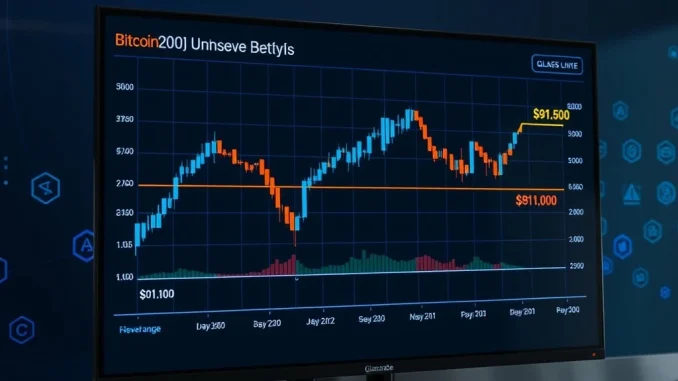
Global cryptocurrency markets face a critical juncture as Bitcoin demonstrates concerning consolidation patterns that could signal extended stagnation. According to comprehensive analysis from leading on-chain analytics firm Glassnode, Bitcoin currently trades within a tightly defined range between $81,100 and $98,400. This technical formation suggests the digital asset may experience prolonged sideways movement without significant catalysts to break established resistance levels. Market participants now closely monitor these developments as they assess potential implications for broader digital asset valuations and investor strategies.
Bitcoin Price Analysis Reveals Critical Resistance Zones
Glassnode’s latest market intelligence report provides detailed examination of Bitcoin’s current technical positioning. The firm identifies $98,400 as a particularly significant resistance level corresponding to the short-term holder (STH) cost basis. This metric represents the average acquisition price for investors who purchased Bitcoin within approximately the last 155 days. Consequently, selling pressure consistently emerges near this psychological threshold as short-term holders seek to realize profits or minimize losses. Furthermore, Glassnode analysts emphasize that even a breakthrough above $98,000 would encounter substantial supply concentration around the $100,000 mark. Historical data indicates this round-number resistance has repeatedly demonstrated strength across multiple market cycles.
Market structure analysis reveals several critical factors influencing Bitcoin’s current range-bound behavior. First, exchange inflow metrics show increased movement of coins to trading platforms as prices approach resistance levels. Second, network activity demonstrates moderate transaction volume without the explosive growth typically associated with major bull market advances. Third, derivative market positioning indicates cautious sentiment among institutional participants. These combined factors create an environment where sustained upward momentum faces significant headwinds. Glassnode’s assessment concludes that meaningful breakout potential remains limited without distinct recovery in demand fundamentals across both spot and derivative markets.
Understanding Short-Term Holder Dynamics and Market Impact
Short-term holder behavior represents a crucial component of Glassnode’s analytical framework. These market participants typically exhibit higher sensitivity to price movements compared to long-term holders who demonstrate stronger conviction through accumulation strategies. The STH cost basis at $98,400 functions as both technical resistance and psychological barrier. When Bitcoin approaches this level, short-term holders frequently initiate selling activity to secure profits or prevent potential losses. This collective action creates self-reinforcing resistance that requires substantial buying pressure to overcome. Historical patterns indicate that sustained trading above the STH cost basis often precedes more significant bullish phases as selling pressure diminishes.
Comparative Analysis of Previous Consolidation Periods
Glassnode’s research team contextualizes current market conditions through comparison with historical consolidation phases. Previous extended sideways movements in Bitcoin’s price action have typically resolved in decisive directional moves. For instance, the 2018-2019 accumulation period lasted approximately 15 months before initiating the subsequent bull market. Similarly, the 2020 consolidation phase preceding the COVID-19 crash recovery spanned several months. Current market structure shares characteristics with these historical precedents, particularly regarding compressed volatility and declining trading volume. However, analysts caution against direct historical comparisons due to Bitcoin’s evolving market maturity and increased institutional participation.
The following table illustrates key metrics from Glassnode’s analysis:
| Metric | Current Value | Significance |
|---|---|---|
| Price Range Boundaries | $81,100 – $98,400 | Primary trading channel |
| STH Cost Basis Resistance | $98,400 | Key psychological level |
| Major Supply Zone | ~$100,000 | Historical resistance concentration |
| Realized Price Support | $81,100 | Network-wide cost basis |
Glassnode’s methodology combines multiple on-chain indicators to assess market health. The firm analyzes:
- Exchange Net Position Change: Measures net inflows/outflows from exchanges
- Realized Cap HODL Waves: Tracks coin maturation across different age bands
- MVRV Z-Score: Evaluates whether Bitcoin is over/undervalued relative to realized value
- Spent Output Profit Ratio (SOPR): Indicates whether coins are moving at profit or loss
Market Structure Implications for 2025 Trading Environment
The current trading range between $81,100 and $98,400 carries significant implications for market participants. Range-bound conditions typically benefit certain trading strategies while challenging others. Swing traders and market makers often thrive in such environments through mean reversion approaches. Conversely, trend-following strategies and momentum traders face difficult conditions without clear directional bias. Glassnode’s analysis suggests that breakout attempts above $98,400 will likely encounter substantial selling pressure from both short-term holders and the broader supply concentration around $100,000. This resistance structure may necessitate multiple testing attempts before any sustainable breakthrough occurs.
Institutional positioning data provides additional context for the current market environment. Futures open interest remains elevated but shows limited directional bias in recent weeks. Options market skew indicates balanced sentiment between puts and calls at the $100,000 strike price. Spot exchange-traded fund flows demonstrate modest accumulation patterns without the explosive growth witnessed during previous bull market phases. These factors collectively suggest that professional investors maintain cautious optimism while awaiting clearer directional signals. Glassnode’s assessment emphasizes that sustained institutional participation represents a prerequisite for meaningful demand recovery and subsequent price appreciation.
Technical and Fundamental Convergence in Price Analysis
Glassnode’s approach integrates both technical chart patterns and fundamental on-chain metrics. This convergence provides more robust analysis than either methodology independently. Technically, Bitcoin faces descending volume profile highs and compressed Bollinger Bands indicating reduced volatility. Fundamentally, network activity metrics show moderate growth in active addresses and transaction counts without parabolic expansion. The divergence between price action and network fundamentals suggests either impending catch-up or continued consolidation. Glassnode analysts note that previous bull markets typically featured strong alignment between price appreciation and network growth metrics before sustained advances.
Potential Catalysts for Range Resolution
While Glassnode’s analysis emphasizes the likelihood of prolonged sideways movement, the firm also identifies potential catalysts that could alter this trajectory. Macroeconomic developments represent the most significant external factor, particularly regarding monetary policy decisions from major central banks. Additionally, regulatory clarity in key jurisdictions could stimulate institutional participation. Technological advancements within the Bitcoin ecosystem, including layer-2 scaling solutions and institutional infrastructure improvements, may enhance network utility and demand fundamentals. Finally, traditional market correlations or decouplings could influence capital flows into digital assets. Glassnode maintains that any sustainable breakout will require fundamental improvements in network demand metrics rather than purely technical factors.
The following factors could potentially catalyze range resolution:
- Macroeconomic Policy Shifts: Changes in interest rate expectations or quantitative tightening/tightening
- Institutional Adoption Waves: Major corporate or sovereign wealth fund allocations
- Regulatory Developments: Clearer frameworks in major markets like the United States or European Union
- Network Upgrade Activation: Implementation of significant protocol improvements
- Traditional Market Correlations: Shifts in relationship with equities, bonds, or commodities
Conclusion
Glassnode’s comprehensive Bitcoin price analysis presents a cautious outlook for near-term market direction. The digital asset appears trapped within a defined range between $81,100 and $98,400, with multiple resistance layers limiting upside potential. The short-term holder cost basis at $98,400 and broader supply concentration around $100,000 create substantial barriers to meaningful breakout attempts. Market participants should prepare for potentially prolonged sideways movement absent significant improvements in demand fundamentals. While historical precedents suggest such consolidation phases often precede major directional moves, timing and catalyst identification remain challenging. Glassnode’s data-driven approach provides valuable framework for navigating current market conditions with appropriate risk management strategies.
FAQs
Q1: What does Glassnode mean by “short-term holder cost basis”?
Glassnode defines short-term holders as addresses holding Bitcoin for approximately 155 days or less. The cost basis represents the average acquisition price for these coins, currently calculated at $98,400. This level functions as psychological resistance because holders often sell near their purchase price to realize profits or prevent losses.
Q2: How long could Bitcoin remain in this sideways trading range?
While precise timing remains uncertain, Glassnode’s analysis suggests potentially prolonged consolidation based on current market structure. Historical precedents show Bitcoin has experienced sideways movements lasting several months to over a year during previous market cycles before resolving in decisive directional moves.
Q3: What would constitute a “meaningful breakout” according to Glassnode’s analysis?
A meaningful breakout would require sustained trading above the $100,000 resistance level with accompanying improvements in on-chain demand metrics. Glassnode emphasizes that technical breaks alone prove insufficient without fundamental support from increased network activity, exchange outflow dominance, and improved market structure indicators.
Q4: How does Glassnode’s analysis differ from traditional technical analysis?
Glassnode specializes in on-chain analytics, examining blockchain data rather than just price charts. This includes analyzing coin movements between wallets, exchange flows, holder behavior patterns, and network activity metrics. This fundamental approach provides additional context beyond purely technical chart patterns.
Q5: What should investors consider during prolonged sideways movement?
During range-bound conditions, investors should focus on risk management, position sizing, and time horizon alignment. Glassnode’s analysis suggests strategies like dollar-cost averaging may prove effective, while traders might implement range-bound approaches. All participants should monitor on-chain metrics for early signs of demand recovery or breakdown below support levels.