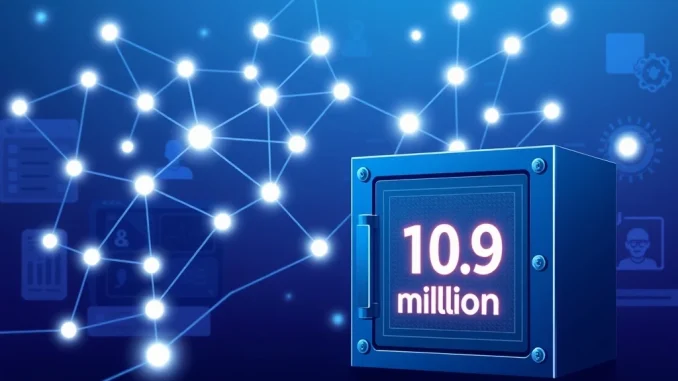
In a decisive move demonstrating remarkable confidence, the Web3 social infrastructure platform Uxlink has committed its entire team allocation of 10.9 million UXLINK tokens to long-term staking, effectively locking away 1.09% of the total supply during a critical market period. This strategic decision, announced on March 15, 2025, from the company’s Singapore headquarters, represents one of the most substantial team commitment signals in recent Web3 history and follows the recent token unlock during Campaign Season 6. Consequently, the platform’s leadership has explicitly stated its belief that UXLINK remains severely undervalued relative to its ambitious development roadmap, positioning this action as both a financial and philosophical statement about the project’s future trajectory.
UXLINK Staking Decision Transforms Token Distribution Dynamics
The Uxlink team’s commitment to stake 10,937,500 UXLINK tokens fundamentally alters the circulating supply dynamics of the project’s native cryptocurrency. This substantial allocation, representing precisely 1.09% of the total 1 billion token supply, recently became available during the platform’s Campaign Season 6 unlock event. Moreover, this team staking action increases the total staked token amount across the entire ecosystem to 31,428,692 UXLINK, which now constitutes 3.1% of the total supply. Importantly, this move follows similar commitments from strategic investors who staked approximately 10 million UXLINK during the same unlock window. Therefore, the combined staking activities from Season 6 alone total 21,248,219 tokens, representing about 2% of the entire supply entering locked, long-term positions.
Industry analysts frequently monitor team token allocation behavior as a critical indicator of project confidence. Typically, team and advisor tokens vest over multi-year schedules, providing early contributors with liquidity. However, choosing to re-lock these tokens through staking mechanisms demonstrates a voluntary extension of commitment beyond contractual obligations. According to blockchain transparency platforms, the Uxlink team allocation followed a standard four-year vesting schedule with a one-year cliff. The decision to stake rather than diversify or sell upon unlock represents a notable deviation from common industry patterns observed across numerous Web3 projects during similar maturation phases.
Comparative Analysis of Team Token Commitments
To contextualize the scale of this commitment, we can examine comparable actions across the Web3 landscape. The table below illustrates recent team staking announcements from prominent projects:
| Project | Date | Team Tokens Staked | Percentage of Supply | Market Context |
|---|---|---|---|---|
| Uxlink | March 2025 | 10.9M UXLINK | 1.09% | Post-Unlock Period |
| Project A (SocialFi) | January 2025 | 5.2M Tokens | 0.65% | Mainnet Launch |
| Protocol B (DeFi) | November 2024 | 8.1M Tokens | 0.81% | Token Generation Event |
| Network C (Gaming) | September 2024 | 3.7M Tokens | 0.37% | Post-Funding Round |
As evidenced by this comparative data, Uxlink’s commitment ranks among the most substantial relative percentage moves recently recorded. Such actions typically aim to achieve several strategic objectives:
- Supply Reduction Pressure: Removing tokens from immediate circulation can positively impact supply-demand economics.
- Signaling Alignment: Demonstrating that team incentives remain directly tied to long-term protocol success.
- Governance Participation: Staked tokens often carry voting rights, ensuring team involvement in future governance.
- Network Security Enhancement: Increasing the total value staked improves proof-of-stake network security.
Strategic Investor Support Amplifies Staking Momentum
Parallel to the team’s decision, Uxlink’s strategic investors have demonstrated congruent confidence by staking approximately 10 million UXLINK tokens during the recent unlock period. These institutional and venture capital partners, whose identities remain partially confidential due to standard privacy agreements, collectively control significant portions of the early allocation. Their concurrent staking decision suggests a unified front regarding the token’s valuation and the project’s roadmap execution. Furthermore, this investor behavior provides external validation, indicating that sophisticated market participants with extensive due diligence capabilities share the core team’s assessment of fundamental undervaluation.
The mechanics of Uxlink’s staking program involve locking tokens in smart-contract-governed vaults for flexible durations. Participants typically earn staking rewards denominated in UXLINK, creating a yield-generating mechanism while supporting network operations. According to the platform’s published documentation, staking also confers governance rights, allowing participants to vote on protocol upgrades, treasury allocations, and partnership decisions. This design intentionally aligns long-term token holders with the platform’s developmental direction, creating a stakeholder ecosystem rather than a speculative trading community.
Understanding the “Undervalued” Thesis and Roadmap Context
Uxlink’s leadership has explicitly framed this staking decision around their conviction that UXLINK trades at a significant discount to its intrinsic value. Their public statements reference the project’s roadmap, which they characterize as merely at its “starting point.” Key upcoming milestones that presumably justify this valuation assessment include:
- Social Infrastructure Expansion: Scaling the underlying social graph protocol to support mass adoption.
- AI Agent Integration: Launching autonomous AI agents capable of facilitating complex social and transactional interactions.
- Cross-Chain Interoperability: Enabling seamless asset and data movement across multiple blockchain networks.
- Developer Ecosystem Growth: Onboarding third-party applications built atop the Uxlink social layer.
Market analysts note that social infrastructure projects often face longer validation cycles than purely financial DeFi protocols. The value accrual depends on user adoption, network effects, and developer activity—metrics that accumulate gradually rather than instantaneously. Consequently, early-stage valuation metrics may not fully capture potential future utility. Uxlink’s team appears to be betting that current market prices reflect a myopic view, overlooking the platform’s potential to become a fundamental social layer for the emerging Web3 ecosystem.
Broader Implications for Web3 Social Platform Economics
This staking event occurs within a rapidly evolving sector known as SocialFi, which merges social media dynamics with decentralized finance mechanics. The space has witnessed explosive growth since 2023, yet remains characterized by high volatility and experimental tokenomic models. Uxlink’s approach emphasizes long-term stability and aligned incentives, contrasting with some projects that prioritize short-term liquidity and trading volume. By voluntarily restricting their own liquidity, the team effectively commits to a multi-year horizon for value realization, potentially attracting a different investor profile focused on fundamental growth rather than speculative trading.
Additionally, the increasing total staked percentage—now at 3.1% of supply—directly impacts the token’s economic security model. In proof-of-stake and delegated proof-of-stake systems, a higher staked ratio generally correlates with greater network resilience against certain attacks, as malicious actors would need to acquire a larger, more expensive portion of the staked supply to compromise consensus. While Uxlink utilizes a hybrid model incorporating social verification, increased staking still positively contributes to overall system robustness. This creates a virtuous cycle where confidence begets security, which in turn fosters further confidence.
Regulatory observers also note that proactive staking by teams and investors may receive favorable interpretation under emerging digital asset frameworks. Authorities in jurisdictions like the European Union and Singapore increasingly distinguish between utility-driven token models and purely speculative instruments. Actions that demonstrate long-term platform building and user value creation, such as extended token lock-ups, can help position a project within more sustainable regulatory categories. Uxlink’s Singapore base places it within a forward-thinking regulatory environment that recognizes such nuances.
Historical Precedents and Market Response Patterns
Examining historical precedents reveals varied market responses to similar team staking announcements. In some cases, such actions preceded significant price appreciation as markets interpreted the signal as a strong bullish indicator. In other instances, the impact was more muted, with price action remaining correlated to broader market trends. Key factors influencing the outcome typically include:
- Credibility of the Team: Established teams with strong track records generate more impactful signals.
- Clarity of Roadmap: Well-articulated future milestones help markets assess the undervaluation thesis.
- Market Conditions: Macro cryptocurrency trends often overshadow project-specific news.
- Communication Strategy: Transparent, detailed explanations tend to foster greater trust than vague announcements.
Early market data following Uxlink’s announcement shows increased trading volume and reduced sell-side pressure on exchanges, suggesting that market participants are processing this signal positively. However, sustained impact will likely depend on subsequent execution against the referenced roadmap. The true test will be whether the platform can deliver on its promised social infrastructure and AI agent capabilities, thereby justifying the team’s expressed confidence and converting skeptical observers into believers.
Conclusion
The UXLINK staking decision by the Uxlink team represents a profound commitment to their Web3 social vision, transforming 10.9 million tokens from potential sell pressure into long-term network support. This action, combined with strategic investor participation, increases the total staked supply to 3.1% and sends a clear signal about perceived undervaluation relative to the project’s ambitious roadmap. As the platform advances its social infrastructure and AI agent development, this team alignment through UXLINK staking establishes a foundation of shared incentives between creators, investors, and future users. The ultimate validation will emerge from execution, but this decisive move undoubtedly positions Uxlink as a project betting overwhelmingly on its own long-term success.
FAQs
Q1: What percentage of the total UXLINK supply did the team stake?
The Uxlink team staked 10,937,500 UXLINK tokens, representing exactly 1.09% of the total 1 billion token supply.
Q2: How does this staking affect the total amount of UXLINK currently staked?
This decision increases the total staked UXLINK to 31,428,692 tokens, or 3.1% of the total supply, up from previous levels.
Q3: Why did Uxlink’s team decide to stake their entire allocation?
The team stated they believe UXLINK is severely undervalued relative to their development roadmap and wanted to demonstrate long-term commitment aligned with their social infrastructure and AI agent launch plans.
Q4: Did investors also participate in staking during the unlock period?
Yes, strategic investors staked approximately 10 million UXLINK tokens during the same Campaign Season 6 unlock window, bringing the total Season 6 staking to over 21 million tokens.
Q5: What is the significance of staking in proof-of-stake networks?
Staking tokens helps secure the network, often provides governance rights, typically generates yield rewards, and reduces immediate selling pressure by locking tokens in smart contracts for specified periods.
Q6: Where is Uxlink based and when was this announcement made?
Uxlink operates from Singapore, and the staking announcement was made public on March 15, 2025, following the Campaign Season 6 token unlock.