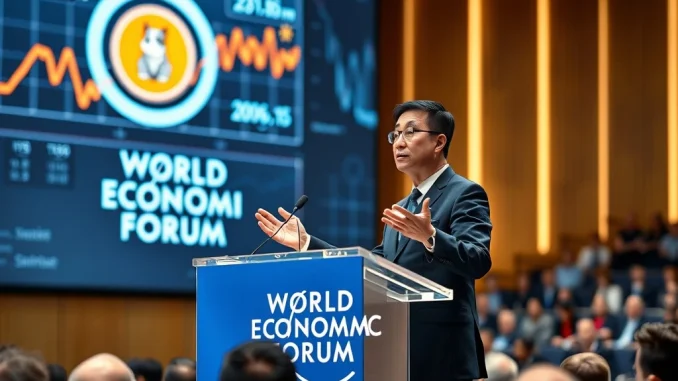
In a pivotal address that sent ripples through the financial technology sector, Binance founder Changpeng Zhao delivered a crucial warning about the speculative nature of memecoins during the 2026 World Economic Forum annual meeting in Davos, Switzerland. Speaking on January 18, 2026, Zhao provided a stark assessment of the cryptocurrency landscape, suggesting that only assets with deep cultural roots, like Dogecoin, possess genuine potential for long-term viability. Furthermore, he predicted a dramatic decline in physical bank branches within the coming decade, driven by rapid advancements in blockchain and digital identity verification systems.
CZ’s Davos Warning on Memecoin Longevity
Changpeng Zhao, commonly known as CZ, framed his comments within the broader context of market maturity and investor protection. His analysis at the prestigious global forum carries significant weight due to his firsthand experience building one of the world’s largest cryptocurrency exchanges. Consequently, his perspective offers a unique blend of entrepreneurial insight and market observation. Zhao specifically highlighted the inherent volatility and speculative mania that often surrounds newly launched memecoins, which typically lack fundamental utility or sustainable development roadmaps.
Industry data consistently supports this cautious outlook. For instance, a 2025 study by the Crypto Asset Research Institute analyzed over 15,000 memecoins launched in the previous three years. The research revealed a staggering 94% failure rate within the first twelve months. Moreover, these assets frequently exhibit extreme price volatility, with drawdowns exceeding 90% being commonplace. This pattern underscores the high-risk nature of investments in projects driven primarily by social media trends rather than technological innovation or real-world use cases.
- Speculative Nature: Most memecoins derive value from community sentiment and online virality rather than underlying technology or economic models.
- High Attrition Rate: Historical data shows an overwhelming majority of meme-based cryptocurrencies fail to maintain relevance or liquidity beyond initial hype cycles.
- Regulatory Scrutiny: Global financial watchdogs, including the SEC and FCA, have increasingly issued warnings about the investor risks associated with highly speculative digital assets.
Dogecoin’s Cultural Foundation and Survival Potential
In contrast to the broader memecoin category, CZ identified Dogecoin (DOGE) as a notable exception with legitimate prospects for endurance. His reasoning centered on the asset’s unique and enduring cultural foundation, which transcends its origins as a lighthearted joke. Originally created in 2013 by software engineers Billy Markus and Jackson Palmer, Dogecoin has evolved into a persistent internet phenomenon with a dedicated global community. This cultural staying power, according to analysts, provides a form of network effect that many newer memecoins struggle to replicate.
Furthermore, Dogecoin benefits from several tangible advantages that bolster its case for longevity. It operates on a secure, proven blockchain derived from Litecoin, which ensures reliable transaction processing. Additionally, its low transaction fees and fast settlement times have fostered practical adoption for micro-tipping and charitable fundraising. Notably, high-profile endorsements from figures like Elon Musk have integrated DOGE into mainstream discourse, further cementing its cultural relevance. However, experts caution that cultural relevance alone does not guarantee financial stability, pointing to the coin’s own history of significant price fluctuations.
The Expert Angle on Crypto Cultural Capital
Dr. Anya Petrova, a financial sociologist at the University of Zurich, published research in 2024 examining ‘crypto cultural capital.’ Her work explains why certain assets like Dogecoin demonstrate resilience. “When a digital asset becomes embedded in online culture, it acquires a form of social utility,” Petrova states. “This utility—whether for community identity, humor, or collective action—can create a demand floor independent of pure speculative trading. Dogecoin’s use in tipping content creators and funding charitable causes, like the 2014 Jamaican bobsled team campaign, exemplifies this principle.” This analysis provides academic context for CZ’s observation, suggesting that cultural integration can be a legitimate, though unconventional, pillar of value.
The Impending Transformation of Traditional Banking
Beyond memecoins, CZ’s second major prediction at Davos focused on the structural future of banking. He forecasted a significant reduction in the number of physical bank branches globally within the next ten years. This shift, he argued, will be propelled by two converging technological forces: blockchain infrastructure and advanced Know Your Customer (KYC) systems. Blockchain technology enables secure, transparent, and instantaneous peer-to-peer transactions, reducing the need for physical intermediaries. Simultaneously, digital KYC and identity verification platforms are becoming increasingly sophisticated, allowing for fully remote and compliant customer onboarding.
This transition aligns with existing data on banking trends. The World Bank reported in 2025 that branch networks in developed economies had already contracted by over 25% in the preceding decade. Meanwhile, investment in fintech and digital banking platforms has skyrocketed. The following table illustrates the contrasting trajectories:
| Metric | Traditional Branch Banking (Trend) | Digital/Blockchain Banking (Trend) |
|---|---|---|
| Physical Locations | Steady Decline (-3% to -5% annually) | Not Applicable (Digital-First) |
| Customer Onboarding Cost | High (In-person verification) | Low (Automated digital KYC) |
| Transaction Settlement Time | 1-3 Business Days (Standard) | Near-Instant (Blockchain) |
| Global Accessibility | Geographically Limited | Borderless (Internet Access) |
Banking executives acknowledge this inevitable digital migration. In a recent panel, Clara Schmidt, CEO of EuroFinance Group, remarked, “The branch of the future will not be a place for routine transactions. Instead, it will evolve into a hub for complex advisory services, while blockchain handles the efficiency of payments and settlements.” This evolution suggests a hybrid model rather than a complete disappearance, but the overall footprint of physical infrastructure is poised to shrink dramatically.
Conclusion
Changpeng Zhao’s remarks at the 2026 World Economic Forum provide a compelling, experience-driven framework for understanding two critical financial evolutions. First, his warning on memecoin longevity underscores the importance of fundamental value and cultural integration in the volatile cryptocurrency market, with Dogecoin presented as a case study in resilience. Second, his prediction about the decline of physical banking highlights the irreversible impact of blockchain and digital identity technology on global finance. Together, these insights paint a picture of a financial landscape where sustainability depends on either deep utility or deep cultural roots, and where digital infrastructure relentlessly reshapes traditional institutions. The key takeaway for investors and industry observers is the necessity of distinguishing between fleeting speculation and enduring innovation.
FAQs
Q1: What exactly did CZ say about memecoins at Davos?
Changpeng Zhao stated that most memecoins are highly speculative and unlikely to survive in the long term. He emphasized that only a few, like Dogecoin, which have a strong cultural foundation, show potential for long-term viability.
Q2: Why does CZ think Dogecoin might survive when other memecoins won’t?
CZ pointed to Dogecoin’s strong and enduring cultural foundation as its key differentiator. Unlike many memecoins created purely for speculation, DOGE has evolved beyond its meme origins to develop a dedicated community and practical use cases, such as tipping and donations, which contribute to its staying power.
Q3: What was CZ’s prediction regarding traditional banks?
He predicted that the number of physical bank branches will decrease significantly within the next 10 years. This change will be driven by advancements in blockchain technology, which facilitates secure digital transactions, and improved digital Know Your Customer (KYC) systems that enable remote onboarding.
Q4: How does blockchain technology contribute to the predicted decline of bank branches?
Blockchain enables secure, transparent, and fast peer-to-peer transactions without the need for a central intermediary like a physical bank branch for processing. This reduces the necessity for localized physical infrastructure for basic financial services.
Q5: Are CZ’s views on memecoins widely shared by other experts?
Many financial analysts and regulators share concerns about the speculative nature of memecoins. Warnings about high failure rates and volatility are common in regulatory communications. However, the specific emphasis on cultural capital as a factor for survival, as highlighted with Dogecoin, is a more nuanced take that blends financial and sociological analysis.