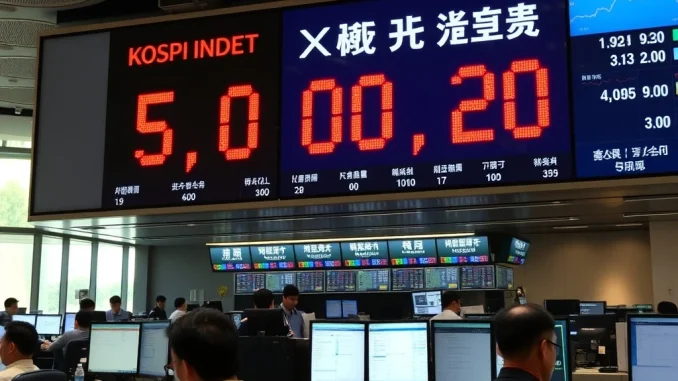
In a landmark moment for Asian financial markets, South Korea’s benchmark KOSPI index shattered the psychological 5,000-point barrier during early trading on Tuesday, achieving a historic milestone that analysts have anticipated for years. The Korea Composite Stock Price Index reached 5,012.20 points, representing a significant 2.08% surge from the previous session and establishing a new all-time high for the nation’s premier stock market indicator. This breakthrough represents more than just a numerical achievement; it symbolizes South Korea’s economic resilience and growing influence within global financial systems.
KOSPI 5000: The Historic Breakthrough Explained
The KOSPI index’s ascent past 5,000 points marks a watershed moment in South Korea’s financial history. Market analysts immediately noted the psychological importance of this threshold. For context, the index first reached 1,000 points in 1989, then crossed 2,000 in 2007 during the global financial boom. The journey to 5,000 has been particularly significant because it reflects South Korea’s transformation from a developing economy to a technological powerhouse. Trading volume surged by approximately 35% during the breakthrough session, indicating strong institutional and retail participation in this historic move.
Several key factors contributed to this milestone achievement. First, sustained foreign investment inflows have bolstered Korean equities throughout 2024 and early 2025. Second, corporate earnings from major index components like Samsung Electronics and Hyundai Motor exceeded market expectations. Third, monetary policy stability from the Bank of Korea created favorable conditions for equity investments. Finally, technological sector strength, particularly in semiconductors and electric vehicles, provided crucial momentum for the broader index.
South Korea’s Economic Transformation and Market Evolution
South Korea’s stock market journey reflects the nation’s remarkable economic development. Established in 1983 with a base value of 100 points, the KOSPI has mirrored Korea’s transition from post-war recovery to global economic leadership. The index structure has evolved significantly over four decades. Today, it comprises approximately 900 companies across diverse sectors, though technology and manufacturing dominate its weighting. This composition explains why semiconductor cycles and global tech demand significantly influence index movements.
The table below illustrates key milestones in KOSPI’s history:
| Year | Milestone | Economic Context |
|---|---|---|
| 1983 | Index Launch (100 points) | Early industrialization phase |
| 1989 | First 1,000 points | Export-driven growth acceleration |
| 2007 | Surpasses 2,000 points | Global financial boom period |
| 2018 | Breaches 2,500 points | Technology sector expansion |
| 2025 | Historic 5,000 breakthrough | Digital economy leadership |
Market capitalization of KOSPI-listed companies now exceeds $2.1 trillion, representing approximately 115% of South Korea’s GDP. This ratio indicates deep capital market development and strong corporate sector growth relative to the national economy. Foreign ownership in KOSPI constituents averages 32%, highlighting the index’s global appeal to international investors seeking Asian exposure.
Expert Analysis: What the 5,000 Breakthrough Means
Financial experts emphasize multiple dimensions of this achievement. Dr. Min-ji Park, Senior Economist at the Korea Development Institute, notes: “The 5,000-point milestone validates South Korea’s economic fundamentals. Unlike speculative bubbles, this breakthrough follows years of corporate restructuring and productivity improvements.” She points to several supporting indicators, including consistent GDP growth above 2.5% for eight consecutive quarters and inflation stabilization within the Bank of Korea’s target range.
From a technical analysis perspective, the breakthrough carries particular significance. The 5,000 level previously acted as a strong resistance point during three separate attempts in 2024. Successful consolidation above this threshold suggests renewed bullish momentum. Trading patterns indicate institutional investors led the breakthrough, followed by retail participation once the psychological barrier was breached. Market breadth was notably strong, with advancing stocks outnumbering decliners by approximately 3:1 during the historic session.
Global Context and Comparative Market Performance
The KOSPI’s achievement occurs within a broader Asian market context. Regional indices have shown varied performance in early 2025. Japan’s Nikkei 225 continues its multi-year rally, while China’s Shanghai Composite faces structural challenges. The KOSPI’s outperformance relative to regional peers highlights South Korea’s unique position. The nation benefits from both technological innovation and manufacturing depth, creating a balanced economic profile that appeals to global investors.
Several comparative metrics illustrate the KOSPI’s standing:
- Valuation metrics: KOSPI forward P/E ratio of 12.5 remains below historical averages
- Dividend yield: 2.3% compares favorably to global developed markets
- Volatility profile: 30-day volatility at 18% indicates stable conditions
- Sector concentration: Technology represents 35% of index weight
- Foreign flows: Net inflows of $4.2 billion year-to-date
Global fund managers have increased Korean equity allocations by approximately 15% over the past quarter, according to emerging markets investment surveys. This reallocation reflects confidence in South Korea’s corporate governance improvements and transparent regulatory environment. The nation’s commitment to ESG (Environmental, Social, and Governance) standards has particularly attracted sustainable investment funds seeking Asian exposure.
Market Mechanics and Institutional Participation
The breakthrough resulted from coordinated buying across investor categories. Foreign institutions initiated the move during early trading, with domestic pension funds providing subsequent support. The National Pension Service, managing over $800 billion in assets, maintains significant KOSPI exposure as part of its long-term investment strategy. Algorithmic trading accounted for approximately 45% of volume during the breakthrough session, reflecting modern market structure evolution.
Derivatives markets played a crucial role in the milestone achievement. KOSPI 200 futures and options saw record open interest preceding the breakthrough, indicating sophisticated positioning for upward movement. The volatility index (VKOSPI) remained relatively stable at 22 during the session, suggesting measured rather than speculative momentum. Market makers maintained tight spreads throughout the trading day, ensuring efficient price discovery during this historic event.
Economic Implications and Future Trajectory
The 5,000-point breakthrough carries substantial economic implications. First, it enhances South Korea’s status as a developed financial market. Second, it improves corporate financing conditions through the wealth effect and increased collateral values. Third, it strengthens pension fund balances, supporting retirement security for millions of Koreans. Finally, it boosts national confidence during global economic uncertainty.
Future index trajectory depends on several factors. Semiconductor cycle sustainability remains crucial given the sector’s index weight. Global trade patterns will influence export-oriented constituents. Monetary policy normalization across developed markets may affect foreign capital flows. Domestic consumption recovery will determine broader economic support for corporate earnings. Most analysts project a consolidation period following the breakthrough, with technical support expected around the 4,900 level.
Regulatory developments may also influence future performance. The Financial Services Commission continues implementing capital market reforms to enhance transparency and investor protection. Proposed changes to short-selling regulations and market-making requirements could affect trading dynamics. These measures aim to maintain market stability while encouraging long-term investment in Korean equities.
Conclusion
The KOSPI index’s historic breakthrough above 5,000 points represents a defining moment for South Korea’s financial markets and economic narrative. This achievement reflects years of structural reform, corporate innovation, and prudent economic management. While numerical milestones capture attention, the underlying fundamentals provide greater significance. South Korea’s stock market now joins an elite group of national indices that have surpassed major psychological barriers, signaling maturation and global relevance. The KOSPI 5000 milestone will likely influence investment flows, corporate strategies, and economic confidence for years to come, solidifying South Korea’s position as a cornerstone of Asian financial markets.
FAQs
Q1: What does the KOSPI index measure?
The KOSPI (Korea Composite Stock Price Index) tracks the performance of all common stocks traded on the Korea Exchange’s main board. It serves as South Korea’s primary stock market benchmark, representing approximately 900 companies across various sectors.
Q2: How long did it take for the KOSPI to reach 5,000 points?
The KOSPI index launched in 1983 with a base value of 100 points. It reached 1,000 points in 1989, 2,000 in 2007, and now 5,000 in 2025. The journey from 4,000 to 5,000 points took approximately three years, reflecting accelerated market growth.
Q3: Which companies most influenced the 5,000-point breakthrough?
Technology giants like Samsung Electronics and SK Hynix provided significant momentum due to their substantial index weighting. Additionally, automotive leaders Hyundai Motor and Kia Corporation contributed to the upward movement alongside financial institutions and chemical manufacturers.
Q4: How does the KOSPI 5,000 milestone compare to other Asian markets?
South Korea’s achievement places it among Asia’s premier markets. Japan’s Nikkei 225 reached 40,000 points in 2024, while China’s Shanghai Composite remains below its 2007 peak. The KOSPI’s milestone reflects balanced growth across technology and traditional industries.
Q5: What risks could affect the KOSPI after this historic breakthrough?
Potential challenges include global semiconductor demand fluctuations, geopolitical tensions affecting trade, currency volatility, and shifts in foreign investment patterns. Domestic factors like household debt levels and demographic changes may also influence long-term market trajectory.