In a landmark projection that underscores the accelerating convergence of traditional finance and blockchain technology, investment firm Ark Invest forecasts the market for tokenized real-world assets (RWA) will explode to a staggering $11 trillion by 2030. This forecast, detailed in a recent report from the firm led by prominent investor Cathie Wood, signals a profound shift in global capital markets. Currently valued at a mere $19 to $22 billion, the tokenized asset sector stands on the cusp of exponential growth, potentially reshaping how institutions and individuals own, trade, and manage value.
Tokenized Assets: From Niche Innovation to Trillion-Dollar Market
Tokenization refers to the process of converting rights to a real-world asset into a digital token on a blockchain. Consequently, this creates a digital representation of ownership that is divisible, easily transferable, and programmable. Ark Invest’s analysis suggests this technology will move far beyond its current experimental phase. The firm identifies two primary catalysts for this massive adoption curve: regulatory clarity and institutional-grade infrastructure.
Firstly, regulators worldwide are gradually developing frameworks for digital assets. For example, jurisdictions like the European Union with its MiCA regulation and Hong Kong with its licensing regime are creating clearer rules. Secondly, financial giants are building the necessary plumbing. Major banks, asset managers, and technology providers are developing secure custody solutions, trading platforms, and settlement systems designed for institutional participation.
The Current Landscape and Growth Trajectory
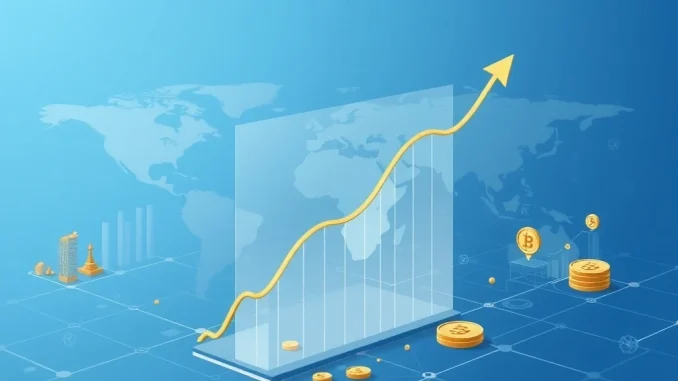
The contrast between the present and the projected future is stark. Today, the tokenization of assets like U.S. Treasury bonds, real estate funds, and private credit is pioneering the space. However, activity remains concentrated among early adopters and specialized funds. Ark Invest’s $11 trillion projection implies a compound annual growth rate (CAGR) of over 100% for nearly a decade. This growth trajectory mirrors the early internet’s disruptive path through industries like media and retail.
| Asset Class | Current Tokenized Examples | Potential for 2030 |
|---|---|---|
| Fixed Income | U.S. Treasuries, Money Market Funds | Global sovereign & corporate bonds |
| Real Estate | Commercial property fractions | Residential & commercial portfolios globally |
| Private Equity & Credit | Venture capital funds | Mainstream alternative asset access |
| Commodities | Gold, carbon credits | Oil, agricultural products, metals |
Regulatory Clarity as the Primary Catalyst
Ark Invest explicitly states that mass adoption hinges on established regulatory frameworks. Uncertainty has been a significant barrier for traditional finance. Therefore, definitive rules around investor protection, anti-money laundering (AML), and legal ownership are critical. The gradual maturation of regulatory approaches provides a roadmap for institutions. Meanwhile, industry consortia are actively engaging with policymakers to shape practical standards.
This regulatory evolution will likely unlock several key developments:
- Standardized Legal Structures: Clear definitions for digital security ownership and enforcement.
- Interoperability Protocols: Standards allowing tokens to move across different blockchain networks and traditional systems.
- Audit and Compliance Tools: Automated reporting and monitoring built into the token’s smart contract logic.
Building the Institutional-Grade Infrastructure
Parallel to regulatory progress, the development of robust infrastructure is paramount. Institutional participants require enterprise-level security, reliability, and integration with existing systems. Currently, a new financial stack is emerging to meet these demands. This stack includes regulated custodians offering digital asset safekeeping, prime brokers providing liquidity and lending, and trading venues with familiar order types and settlement.
Major financial technology firms and traditional market infrastructure providers are now deeply involved. Their participation lends credibility and accelerates development. Furthermore, the rise of permissioned blockchain networks and layer-2 scaling solutions addresses concerns about transaction privacy, speed, and cost. These technological advances make tokenization economically viable for a wider range of assets.
Bitcoin’s Parallel Ascent in Ark’s Vision
Notably, Ark Invest’s report contextualizes the tokenized asset boom within a broader digital asset transformation. The firm separately projects Bitcoin’s market capitalization could reach $16 trillion by 2030. This dual forecast paints a picture of a financial system where digital native stores of value like Bitcoin coexist with tokenized versions of traditional assets. Analysts see these trends as complementary rather than competitive.
Bitcoin could function as a decentralized base layer or settlement asset within this new ecosystem. Conversely, tokenized RWAs could bring immense liquidity and real-world utility onto blockchain networks. This symbiotic relationship may drive adoption for both asset classes. Ultimately, the combined value could represent a significant portion of global financial assets.
The Tangible Impact on Global Finance
The implications of an $11 trillion tokenized asset market are profound. This shift promises to increase market efficiency, enhance transparency, and democratize access to investment opportunities. For instance, fractional ownership through tokens could allow smaller investors to access asset classes like commercial real estate or private equity. These markets were previously inaccessible due to high minimum investments.
Operationally, blockchain-based settlement can reduce transaction times from days to minutes. It also cuts intermediary costs and minimizes reconciliation errors. For asset issuers, tokenization enables programmable features like automated dividend distributions and compliance checks. This programmability introduces a new dimension of functionality to financial instruments. The potential for 24/7 global markets also increases liquidity for traditionally illiquid assets.
Conclusion
Ark Invest’s $11 trillion projection for the tokenized asset market by 2030 is a powerful indicator of blockchain technology’s impending mainstream financial integration. The path from today’s $20 billion niche to a multi-trillion-dollar pillar of finance depends critically on evolving regulation and robust infrastructure. As these elements fall into place, tokenization of real-world assets promises to unlock unprecedented efficiency, accessibility, and innovation in global capital markets. This transition represents one of the most significant financial evolutions of the coming decade.
FAQs
Q1: What exactly are tokenized real-world assets (RWAs)?
Tokenized RWAs are digital tokens on a blockchain that represent ownership of a physical or traditional financial asset. Examples include tokens for real estate, government bonds, commodities, or private company shares.
Q2: Why does Ark Invest believe regulatory clarity is so important for growth?
Large institutional investors, like pension funds and banks, require clear legal frameworks before deploying significant capital. Regulatory certainty defines rules for custody, trading, taxation, and investor protection, reducing perceived risk.
Q3: How does tokenization benefit the average investor?
It enables fractional ownership, allowing investment in high-value assets with smaller amounts of capital. It also can increase liquidity for traditionally illiquid assets and potentially lower fees through reduced intermediary layers.
Q4: What is the difference between a tokenized asset and a cryptocurrency like Bitcoin?
Bitcoin is a native digital asset with value derived from its protocol and adoption. A tokenized asset is a digital representation of an existing off-chain asset, like a bond or property, whose value is tied to that underlying asset.
Q5: What are the biggest challenges facing the tokenized asset market?
Key challenges include fragmented and evolving global regulations, the need for seamless interoperability between different blockchain systems and traditional finance rails, and building widespread institutional and public trust in the technology.
Q6: Which real-world assets are most likely to be tokenized first at scale?
Financial instruments with clear legal structures and high liquidity needs, such as treasury bonds, money market funds, and listed equities, are leading candidates. Real estate and private equity may follow as frameworks mature.