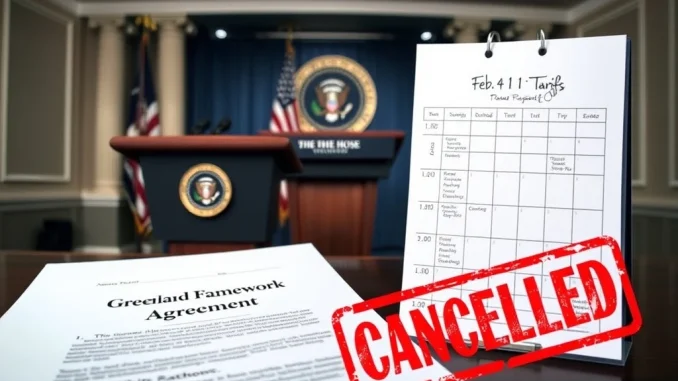
In a significant policy reversal that stunned trade analysts, President Donald Trump announced the cancellation of tariffs scheduled for February 1, 2025, directly linking the decision to a newly established framework for a future agreement regarding Greenland, developed in coordination with NATO Secretary General Mark Rutte. This unexpected move, first reported by Walter Bloomberg from Washington, D.C., represents a major pivot in U.S. economic and geopolitical strategy, intertwining trade policy with Arctic security interests in an unprecedented manner.
Trump Cancels February 1 Tariffs: The Immediate Announcement
President Trump made the tariff cancellation public following a closed-door meeting with NATO Secretary General Mark Rutte at the White House. The scheduled tariffs, which targeted a specific basket of European industrial goods and raw materials, had been a point of significant transatlantic tension for months. Consequently, markets reacted swiftly to the news. Furthermore, the President explicitly stated that the decision stemmed directly from productive discussions that yielded a “framework for a future agreement regarding Greenland.” This explicit linkage between tariff relief and Arctic diplomacy is a novel approach in modern statecraft.
The announcement immediately alleviated fears of a renewed trade dispute between the U.S. and key European allies. Previously, business groups had warned that the February 1 tariffs could disrupt supply chains and increase costs for manufacturers on both sides of the Atlantic. The framework, while not a final treaty, establishes agreed-upon principles for future cooperation on Greenland, which holds strategic importance due to its location and resources.
Understanding the Greenland Agreement Framework
The Greenland framework represents a diplomatic breakthrough after years of intermittent discussions. Greenland, an autonomous territory within the Kingdom of Denmark, possesses vast untapped mineral resources and occupies a crucial geostrategic position in the Arctic. Notably, the U.S. maintains its northernmost air base, Thule Air Base, on the island. The framework reportedly covers several key areas of mutual interest, creating a foundation for deeper collaboration.
- Resource Development & Investment: Guidelines for U.S. private sector investment in Greenland’s mining and energy sectors, with provisions for technology transfer and local employment.
- Security & Defense Cooperation: Enhanced NATO role in monitoring Arctic waterways, with potential upgrades to joint early-warning systems based in Greenland.
- Scientific & Environmental Research: A structured partnership for climate, geology, and marine biology studies in the rapidly changing Arctic environment.
This agreement-in-principle shifts the conversation from the Trump administration’s earlier, controversial interest in purchasing the island to a more conventional and multilateral partnership model. Experts suggest this framework could serve as a model for balancing great-power competition with allied cooperation in the region.
Expert Analysis: A Geopolitical and Economic Gambit
Dr. Anya Petrova, a Senior Fellow for Arctic Policy at the Center for Strategic and International Studies, provided context on the decision’s significance. “Linking tariff policy to Arctic security is a bold, unconventional maneuver,” Petrova stated. “It achieves multiple objectives simultaneously: it de-escalates a trade irritant with Europe, strengthens NATO’s cohesion by addressing a shared strategic frontier, and secures U.S. access to critical minerals without the political impossibility of an outright purchase.”
Petrova further explained that the framework likely addresses long-standing Danish and Greenlandic concerns about sovereignty and sustainable development, which had been obstacles in past discussions. By working through NATO and establishing a multilateral framework, the U.S. mitigates perceptions of unilateral overreach. The cancellation of the February 1 tariffs acts as a tangible confidence-building measure, demonstrating good faith as more detailed negotiations proceed.
The Timeline and Impact of the Tariff Decision
The now-cancelled February 1 tariffs were the latest in a series of trade measures initially announced in late 2024. Their suspension has immediate and wide-ranging consequences for global markets and diplomatic relations.
| Date | Event | Key Outcome |
|---|---|---|
| Oct 2024 | USTR proposes tariffs on EU goods. | Targeted aerospace parts, machinery, and certain minerals. |
| Dec 2024 | Final list published; effective date set for Feb 1, 2025. | European Commission vowed proportional retaliation. |
| Jan 15, 2025 | Trump-Rutte meeting at the White House. | Greenland framework discussions take center stage. |
| Jan 20, 2025 | Announcement of tariff cancellation. | Directly tied to “established framework” on Greenland. |
Economically, the reversal prevents an estimated $15 billion in additional annual costs for importers. Politically, it removes a major friction point ahead of the next NATO summit. The European Council President welcomed the decision as a “positive step for transatlantic economic stability and strategic partnership.” Market response was decisively positive, with the Euro strengthening against the dollar and related industrial stocks rising across European exchanges.
Broader Implications for U.S. Trade and Foreign Policy
This episode signals a potential evolution in the Trump administration’s trade strategy. While the use of tariffs as a negotiating tool remains, this instance shows a willingness to withdraw them in exchange for strategic geopolitical gains beyond pure trade concessions. The move integrates trade policy more fully with national security and foreign policy objectives—a concept often discussed but rarely executed with such direct linkage.
Additionally, the role of NATO as a facilitating body for this agreement is noteworthy. It reinforces the alliance’s relevance in non-Article 5 scenarios, encompassing economic security and resource competition. For Greenland and Denmark, the framework offers a path to economic development and heightened strategic importance while preserving autonomy. The success of this model could influence how the U.S. approaches similar challenges in other regions, potentially linking trade preferences to cooperation on issues like critical minerals or maritime security.
Conclusion
President Trump’s decision to cancel the February 1 tariffs following the establishment of a Greenland agreement framework with NATO marks a pivotal moment in interweaving economic and foreign policy. This move deftly averts a transatlantic trade dispute, bolsters Arctic security cooperation, and secures a foundation for future resource partnership. The Trump tariffs threat, therefore, served as leverage to achieve a broader strategic outcome, demonstrating a complex, realpolitik approach to statecraft. The success of this gambit will ultimately depend on the finalization of a concrete Greenland agreement and its long-term benefits for all parties involved.
FAQs
Q1: What tariffs did President Trump cancel?
A1: President Trump cancelled a set of tariffs on European industrial goods and raw materials that were scheduled to take effect on February 1, 2025. These tariffs had been announced by the U.S. Trade Representative in late 2024.
Q2: What is the “Greenland agreement framework” mentioned?
A2: It is a set of agreed-upon principles for future U.S.-Greenland cooperation, developed with NATO. The framework covers potential collaboration on resource development, security, and scientific research in the Arctic, but it is not a final, signed treaty.
Q3: Why is Greenland strategically important to the U.S. and NATO?
A3: Greenland is crucial due to its location in the Arctic, which is becoming more accessible and contested. It hosts the U.S. Thule Air Base for missile warning and space surveillance and is believed to hold vast deposits of rare earth minerals and other critical resources.
Q4: How did markets react to the news of the cancelled tariffs?
A4: Financial markets reacted positively. The Euro currency strengthened, and stocks for European companies in sectors that would have been taxed by the tariffs saw immediate gains. The move reduced uncertainty for global supply chains.
Q5: Does this mean the U.S. is no longer interested in buying Greenland?
A5: The framework agreement suggests a shift in strategy from the politically contentious idea of purchasing the island to a more traditional partnership model focused on investment and security cooperation, addressing the same strategic interests through diplomacy.