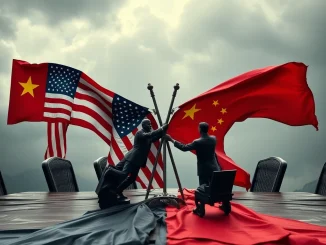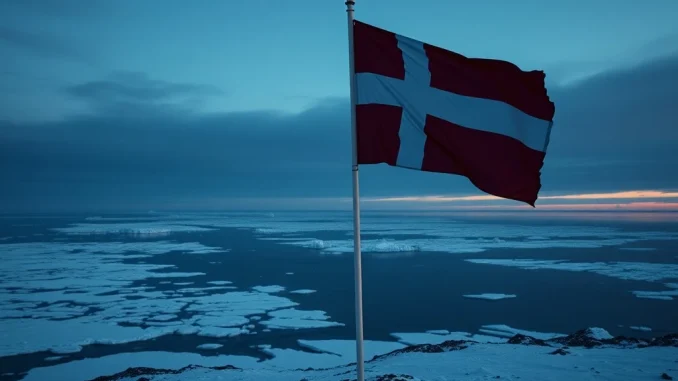
COPENHAGEN, Denmark – In a decisive move affirming national sovereignty, Danish Foreign Minister Lars Løkke Rasmussen has formally rejected a request from former U.S. President Donald Trump to negotiate the acquisition of Greenland. This rejection, reported by Walter Bloomberg, follows provocative comments Trump made at the World Economic Forum in Davos, Switzerland, where he framed the potential purchase as a protective measure for both Europe and the United States. Consequently, this incident reignites a complex historical debate while highlighting the escalating strategic importance of the Arctic region in global geopolitics.
Greenland Acquisition Request Meets Firm Diplomatic Rejection
The core of this diplomatic episode centers on a direct request from Donald Trump to the Danish government. Specifically, President Trump expressed a desire to initiate negotiations for the United States to purchase Greenland. However, Foreign Minister Rasmussen’s rejection was swift and unambiguous. Importantly, this is not the first time the United States has shown interest in the world’s largest island. For instance, in 1946, President Harry S. Truman offered Denmark $100 million in gold for Greenland. Denmark refused that offer as well, establishing a long-standing precedent.
Trump’s rationale, presented at Davos, argued that the U.S. possesses unique capabilities. He stated America could protect and develop Greenland for mutual benefit. Furthermore, he explicitly ruled out the use of military force, framing the proposal as a purely transactional negotiation. Nonetheless, the Danish response underscores a fundamental principle: Greenland is not a commodity for sale. The island enjoys extensive self-rule under the Kingdom of Denmark, and its foreign and security policy remains in Copenhagen’s hands.
Historical Context and Geopolitical Stakes in the Arctic
To understand the weight of Denmark’s rejection, one must examine Greenland’s strategic significance. The island commands a pivotal position in the North Atlantic and the Arctic. As climate change reduces sea ice, new shipping routes and access to vast natural resources are emerging. The table below outlines key strategic interests:
| Strategic Interest | Description | Key Players |
|---|---|---|
| Shipping Lanes | Northern Sea Route & Northwest Passage becoming more navigable. | Russia, China, USA, EU |
| Natural Resources | Estimated reserves of oil, gas, rare earth minerals, and uranium. | Global mining corporations |
| Military Positioning | Early-warning systems and force projection in the High North. | USA (Thule Air Base), NATO |
| Scientific Research | Climate study and Arctic environmental monitoring. | International scientific community |
Moreover, the United States maintains a critical military presence at Thule Air Base in northern Greenland. Established in 1951, it is the U.S. Space Force’s northernmost base and provides vital missile warning and space surveillance. Therefore, American security interests are already deeply embedded, making a territorial purchase politically redundant for many analysts. Conversely, Russia has been significantly modernizing its Arctic military capabilities, and China has declared itself a “near-Arctic state,” investing heavily in polar research and infrastructure projects.
Expert Analysis on Sovereignty and Diplomatic Norms
International relations scholars point to this event as a clash between transactional diplomacy and established norms of sovereignty. “The proposition to purchase a self-governing territory with a distinct cultural population fundamentally misunderstands modern international law,” stated Dr. Anika Jensen, a professor of Arctic geopolitics at the University of Copenhagen. “Denmark’s rejection was not merely a refusal of a deal; it was a reaffirmation that indigenous rights and territorial integrity are not negotiable in this manner.”
Furthermore, the episode tested the robust transatlantic alliance between the U.S. and Denmark. Diplomats note that while the request caused initial bewilderment, the alliance remains strong on shared security goals within NATO. The clear, principled response from Copenhagen actually served to prevent prolonged ambiguity. Subsequently, it allowed both nations to refocus on collaborative Arctic security initiatives rather than a divisive historical anomaly.
Economic and Local Implications for Greenland
The discussion about acquisition inevitably impacts Greenland’s 56,000 inhabitants, primarily indigenous Inuit. Greenland gained self-rule in 2009 and controls most domestic affairs. Its economy relies heavily on fishing and an annual block grant from Denmark. However, aspirations for full independence are tied to developing a sustainable economic base, potentially from mining and tourism.
- Local Political Reaction: Greenland’s government immediately dismissed the idea of a sale, emphasizing its right to self-determination.
- Economic Dilemma: The territory seeks foreign investment for development but fiercely guards its autonomy and environmental standards.
- Strategic Partnerships: Greenland engages with multiple partners, including the EU and China, for infrastructure projects, balancing influence carefully.
Consequently, any external proposal perceived as treating Greenland as a colonial asset triggers immediate resistance. The population’s cultural and political identity is inextricably linked to the land, making a commercial transaction morally and politically untenable. This sentiment was echoed unanimously across Greenland’s political spectrum following Trump’s comments.
Media Dynamics and Global Perception of the Event
The reporting by Walter Bloomberg brought this diplomatic exchange to global attention. Media coverage largely framed the request as an unconventional and anachronistic approach to foreign policy. Notably, the story generated significant digital engagement, reflecting public fascination with grand geopolitical concepts. However, serious analysis focused on the underlying trends it revealed:
Firstly, it highlighted how Arctic policy is moving to the forefront of great power competition. Secondly, it demonstrated the resilience of smaller states in upholding sovereignty against larger powers. Finally, it served as a case study in how domestic political narratives in one country can create unexpected diplomatic challenges for allies. The factual, neutral reporting of the rejection prevented the story from escalating into a major bilateral crisis.
Conclusion
Denmark’s rejection of the Greenland acquisition request represents a definitive moment in Arctic diplomacy. It firmly closed the door on a historical anomaly while asserting contemporary principles of sovereignty and self-determination. The episode, initiated by former President Trump’s comments at Davos, ultimately clarified the limits of transactional geopolitics. More importantly, it redirected focus to the real Arctic challenges: climate change, sustainable development, and cooperative security. Therefore, the lasting impact is not a failed real estate deal but a strengthened consensus that Greenland’s future will be decided by its people under the Danish realm, not by external purchase. The Greenland acquisition concept remains a footnote in history, overshadowed by the complex, collaborative effort required to govern the changing Arctic.
FAQs
Q1: Has the US ever tried to buy Greenland before?
A1: Yes. In 1946, President Harry S. Truman’s administration offered Denmark $100 million for Greenland. Denmark rejected that offer, just as it has rejected the recent request.
Q2: Why is Greenland strategically important?
A2: Greenland is crucial due to its location in the Arctic, which contains new shipping routes, vast natural resources like minerals and oil, and is key for military and satellite surveillance, notably hosting the U.S. Thule Air Base.
Q3: Does Greenland want independence from Denmark?
A3: Many in Greenland aspire to full independence, which is a legal option under its self-rule agreement. However, achieving economic self-sufficiency is seen as a necessary prerequisite before such a step.
Q4: How did Greenland’s local government react to the idea of a sale?
A4: The Government of Greenland uniformly and immediately rejected the notion, stating that the island was not for sale and emphasizing the right of its people to determine their own future.
Q5: What is the status of the U.S. military in Greenland now?
A5: The United States operates Thule Air Base under a 1951 defense agreement with Denmark. This arrangement continues unaffected by the rejected acquisition request, and the base remains a cornerstone of U.S. and NATO Arctic security.