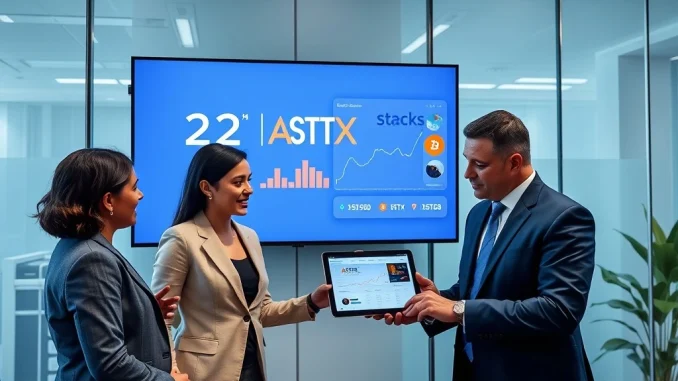
ZUG, Switzerland – February 2025. In a landmark move for institutional cryptocurrency access, 21Shares has officially launched ASTX, a pioneering exchange-traded product (ETP) for Stacks (STX). This innovative Stacks ETP uniquely incorporates automatic staking reward reinvestment, fundamentally bridging traditional finance with Bitcoin’s expanding layer-2 ecosystem. Consequently, the product eliminates technical barriers for major investors.
21Shares ASTX: A New Gateway to Bitcoin Layer-2 Investment
The Stacks blockchain, a prominent layer-2 solution for Bitcoin, enables smart contracts and decentralized applications. Traditionally, direct investment in its native STX token required managing private keys and navigating staking mechanics. However, 21Shares’ new ASTX product abstracts this complexity entirely. The ETP, listed on major European exchanges, provides a familiar security wrapper. Therefore, brokerage account holders can gain exposure through conventional channels.
According to the announcement from the Stacks ecosystem via X, the product automatically handles all underlying staking operations. This process continuously compounds rewards back into the fund’s assets. Importantly, this structure mirrors dividend-reinvesting equity ETFs but within the crypto staking paradigm. The launch signifies a maturation point for Bitcoin’s utility beyond a simple store of value.
Institutional Adoption and the ETP Advantage
Exchange-traded products like ASTX serve a critical function for regulated entities. Pension funds, asset managers, and corporate treasuries often face strict compliance and custody mandates. Direct ownership of cryptocurrencies can create insurmountable operational hurdles. Conversely, a listed ETP resides within existing legal and operational frameworks. Subsequently, 21Shares manages the underlying blockchain infrastructure, including secure custody and staking validation.
The Staking Reward Engine
The automatic staking mechanism represents the product’s core innovation. On the Stacks network, participants stake STX to secure the blockchain and earn Bitcoin (BTC) rewards. The ASTX ETP performs this function at scale on behalf of all shareholders. The accrued BTC rewards are then systematically sold for more STX tokens. This reinvestment strategy aims to enhance the ETP’s net asset value (NAV) over time, creating a potential yield-generating vehicle within a regulated wrapper.
| Feature | Direct STX Ownership | 21Shares ASTX ETP |
|---|---|---|
| Custody Responsibility | Investor-held private keys | Professional, insured custody by 21Shares |
| Staking Operation | Manual delegation & management | Fully automated & optimized |
| Regulatory Access | Complex for institutions | Familiar security structure |
| Tax Documentation | Investor-generated | Standardized financial reporting |
| Liquidity Access | Cryptocurrency exchanges | Traditional stock exchanges |
The Broader Impact on Bitcoin’s Ecosystem
This launch extends beyond a single product listing. It reflects a strategic validation of the Stacks protocol’s vision to bring programmability to Bitcoin. Historically, institutional capital flowed primarily into spot Bitcoin and Ethereum ETPs. Now, ASTX opens a dedicated channel for investment into Bitcoin’s application layer. This development could accelerate developer activity and user adoption on Stacks. Moreover, it sets a precedent for other Bitcoin layer-2 projects seeking regulated investment vehicles.
The trajectory of crypto ETPs shows consistent growth since the first Bitcoin products debuted. Data from 2024 indicated European-listed crypto ETPs held over $90 billion in assets. 21Shares, as a category leader, consistently identifies gaps in this market. Their existing suite includes products for Bitcoin, Ethereum, and other major assets. The addition of ASTX specifically targets the growing narrative around Bitcoin’s utility and yield generation.
Expert Analysis on Market Evolution
Financial analysts note this product arrives during a period of infrastructure convergence. Traditional finance (TradFi) and decentralized finance (DeFi) are creating hybrid solutions. A regulated ETP with an embedded DeFi staking mechanism exemplifies this trend. It provides the safety and familiarity of TradFi while capturing the innovative yield potential of DeFi. Consequently, products like ASTX could significantly lower the adoption curve for conservative capital. They mitigate perceived risks associated with direct blockchain interaction.
Conclusion
The launch of the 21Shares ASTX Stacks ETP marks a pivotal evolution in institutional cryptocurrency access. By combining a regulated exchange-traded product with automated staking reward reinvestment, it solves critical custody and operational challenges. This Stacks ETP not only offers a streamlined path to Bitcoin layer-2 exposure but also reinforces the maturation of the entire digital asset ecosystem. As Bitcoin continues to develop beyond its original premise, investment vehicles like ASTX will likely play an essential role in bridging the old and new financial worlds.
FAQs
Q1: What is the 21Shares ASTX ETP?
The 21Shares ASTX is an exchange-traded product that tracks the price of Stacks (STX). It automatically stakes the underlying assets to earn and reinvest Bitcoin rewards for shareholders, all within a regulated financial security.
Q2: How does the staking reward reinvestment work?
The ETP’s manager stakes the fund’s STX tokens on the Stacks network. Earned Bitcoin (BTC) rewards are automatically sold to purchase additional STX tokens. This increases the fund’s net asset value, benefiting all investors proportionally.
Q3: Who is the target investor for this Stacks ETP?
ASTX primarily targets institutional investors, wealth managers, and individuals with brokerage accounts who seek exposure to the Stacks protocol and Bitcoin layer-2 innovation but prefer not to handle direct cryptocurrency custody or staking operations.
Q4: On which exchanges is the ASTX ETP listed?
While the specific exchanges were not detailed in the initial announcement, 21Shares typically lists its ETPs on major European regulated exchanges such as SIX Swiss Exchange, Deutsche Börse Xetra, and Euronext.
Q5: How does this product differ from a spot Bitcoin ETP?
A spot Bitcoin ETP provides direct exposure to Bitcoin’s price. The ASTX Stacks ETP provides exposure to STX, which is a separate asset tied to the Stacks Bitcoin layer-2. It includes an additional yield component through staking, which pure Bitcoin ETPs do not offer.
Q6: What are the primary risks associated with the ASTX ETP?
Rights include the volatility of the underlying STX asset, execution risks in the staking and reward conversion process, regulatory changes in either jurisdiction, and the operational risks associated with the Stacks network itself.