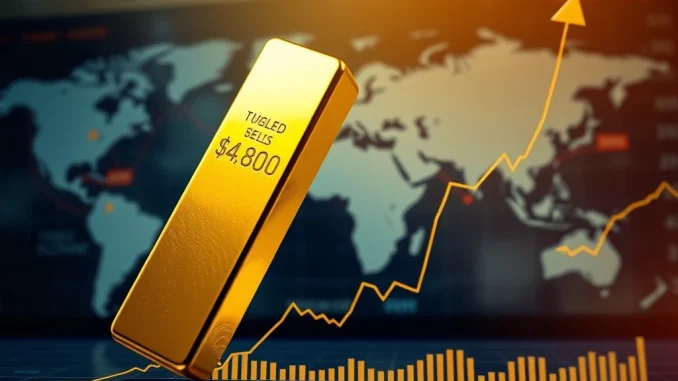
In a landmark moment for global financial markets, the spot price of gold has decisively broken through the $4,800 per ounce barrier, setting a stunning new all-time high. As of the latest trading data, the precious metal trades at $4,799.25, cementing a gain of approximately $500 since the start of the year. This unprecedented surge represents a fundamental shift in investor sentiment and macroeconomic dynamics, prompting deep analysis from market observers worldwide.
Gold Price Reaches Unprecedented Territory
The recent ascent past $4,800 per ounce marks a significant psychological and technical milestone. Consequently, analysts are scrutinizing the powerful confluence of factors driving this historic move. The rally adds to a multi-year bullish trend for the precious metal, which has consistently served as a barometer for global economic uncertainty. Furthermore, this price action demonstrates gold’s enduring role as a premier store of value during periods of market turbulence and currency debasement concerns.
Market data reveals a consistent upward trajectory throughout the current fiscal year. For instance, the metal has shown remarkable resilience against a backdrop of fluctuating bond yields and shifting central bank policies. The table below illustrates key price milestones in the recent rally:
| Date | Price (USD per oz) | Key Event/Context |
|---|---|---|
| Early January | ~$4,300 | Start of the year rally initiation |
| Mid-March | $4,550 | Break above previous consolidation zone |
| Late April | $4,720 | Surge on geopolitical tensions |
| Present Day | $4,799.25 | New all-time high established |
This price movement reflects not just speculative interest but also substantial physical and institutional demand. Major central banks, particularly in emerging economies, have continued their strategy of diversifying reserves away from traditional fiat currencies. Simultaneously, retail investment through exchange-traded funds (ETFs) and physical bars has provided consistent support.
Drivers Behind the Historic Precious Metals Rally
Several interconnected macroeconomic forces have converged to propel gold to these record levels. Primarily, persistent inflationary pressures, though moderating from previous peaks, continue to erode the purchasing power of fiat currencies. Investors, therefore, seek assets with intrinsic value as a long-term hedge. Additionally, geopolitical instability in several regions has amplified safe-haven flows into the metal.
Monetary policy expectations play a crucial role. Markets are currently anticipating a shift in the interest rate cycle among major central banks. Historically, gold performs well in environments where real yields—adjusted for inflation—are low or negative. The current macroeconomic setup appears to be creating precisely such an environment. Key drivers include:
- Central Bank Purchases: Record-level buying by institutions like the People’s Bank of China and the Reserve Bank of India.
- Currency Dynamics: Fluctuations in the US Dollar Index (DXY) influencing dollar-denominated commodity prices.
- Debt Concerns: Soaring global sovereign debt levels undermining confidence in government bonds.
- Technical Breakout: The breach of previous all-time highs triggering algorithmic and momentum-based buying.
Moreover, supply-side constraints in the mining sector have contributed to a tighter physical market. New gold discoveries are becoming rarer and more expensive to develop, limiting the potential for a rapid supply response to high prices. This structural deficit underpins the long-term bullish thesis for the commodity.
Expert Analysis on Market Implications
Financial historians and commodity strategists note that gold’s breakout often signals broader market transitions. Dr. Anya Sharma, Chief Commodities Strategist at Global Macro Advisors, states, “The breach of $4,800 is not an isolated event. It reflects deep-seated concerns about fiscal sustainability and currency stability. Historically, such breakouts precede prolonged periods where hard assets outperform financial assets.” Her analysis points to comparative data from the 1970s and early 2000s, where similar gold rallies correlated with significant shifts in capital allocation.
The impact extends beyond the gold market itself. Rising gold prices typically exert upward pressure on the entire precious metals complex, including silver, platinum, and palladium. They also affect mining company valuations, jewelry demand elasticity, and national trade balances for producing countries like Australia, Russia, and Canada. For portfolio managers, the rally reinforces the importance of strategic asset allocation that includes non-correlated assets to mitigate overall risk.
Comparative Performance and Future Trajectory
When measured against other major asset classes in 2024, gold’s performance has been notably robust. It has outpaced many global equity indices and has provided positive returns while some bond markets experienced volatility. This relative strength highlights its defensive characteristics. However, analysts caution that the pace of the ascent may lead to short-term consolidation or profit-taking.
Looking forward, market participants will monitor several key indicators. These include central bank commentary on interest rates, inflation data prints, and the physical demand from key consumer markets like India during upcoming festival seasons. The technical chart structure now suggests that the $4,800 level, once a major resistance point, could transform into a new support zone for future price advances. The fundamental backdrop, characterized by high debt levels and geopolitical fragmentation, appears supportive for continued long-term interest in the metal.
Conclusion
The gold price achieving a new all-time high above $4,800 per ounce marks a definitive chapter in financial market history. This move, driven by a complex mix of macroeconomic uncertainty, institutional demand, and technical momentum, underscores the metal’s timeless appeal. While short-term volatility is always possible, the structural factors supporting this gold price rally—including fiscal policies, currency dynamics, and safe-haven demand—appear firmly entrenched. Consequently, this milestone likely represents more than a fleeting peak; it signals a sustained reevaluation of gold’s role in a modern, diversified investment portfolio.
FAQs
Q1: What exactly does ‘spot gold’ price mean?
The spot price refers to the current market price for immediate delivery and payment of gold. It is the benchmark price for physical gold transactions and derivatives, constantly fluctuating based on global supply and demand.
Q2: How does a rising gold price affect the average consumer?
Consumers may see higher prices for gold jewelry and coins. It can also influence investment products like gold ETFs and retirement accounts that hold precious metals. Indirectly, it can signal broader economic concerns that may impact inflation and currency values.
Q3: Are there historical precedents for such a sharp gold rally?
Yes, notable periods include the late 1970s following the oil crisis and the 2008-2011 period after the global financial crisis. Both eras featured high inflation, economic uncertainty, and aggressive monetary stimulus, similar to some current drivers.
Q4: Does a strong gold price mean the stock market will perform poorly?
Not necessarily. While gold is often seen as a hedge, both asset classes can rise together in certain environments, such as during expansive monetary policy. However, extreme outperformance by gold can sometimes indicate rising risk aversion toward equities.
Q5: What are the main risks that could cause the gold price to fall from here?
Key risks include a significant and sustained rise in real interest rates, a major strengthening of the US dollar, a resolution of geopolitical tensions, or a sharp decline in physical demand from central banks and key consumer nations.