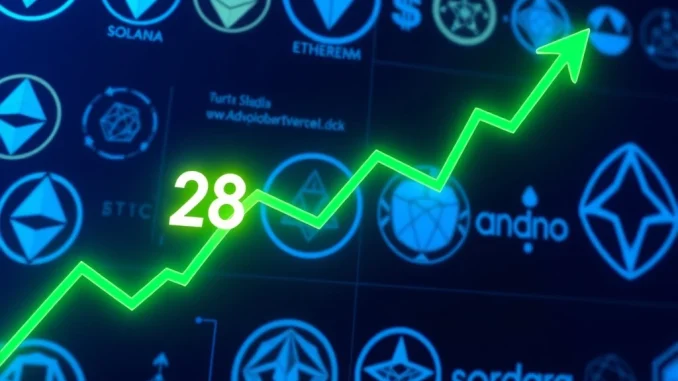
Global cryptocurrency markets observed a notable shift on March 21, 2025, as CoinMarketCap’s pivotal Altcoin Season Index climbed two points to reach 28. This incremental yet significant movement provides a crucial data point for investors analyzing the perennial tug-of-war between Bitcoin and the broader altcoin universe. Consequently, market participants are scrutinizing whether this marks the beginning of a broader trend or a temporary fluctuation in the complex digital asset ecosystem.
Decoding the Altcoin Season Index Rise
The Altcoin Season Index serves as a critical barometer for cryptocurrency market sentiment. Specifically, CoinMarketCap calculates this metric by comparing the 90-day price performance of the top 100 cryptocurrencies against Bitcoin. Importantly, the calculation excludes stablecoins and wrapped tokens to focus purely on speculative assets. A reading closer to 100 indicates a stronger altcoin season, which is officially declared when 75% of these top coins outperform Bitcoin over the three-month period. Therefore, the recent rise to 28, while still far from the threshold, suggests a measurable increase in altcoin momentum relative to the market leader.
Historically, altcoin seasons often follow periods of sustained Bitcoin strength, where capital eventually rotates into smaller-cap assets seeking higher returns. For instance, the last major altcoin season occurred in early 2021, when the index sustained readings above 75 for several weeks. Currently, the move from 26 to 28 may seem modest, but it represents a 7.7% increase in the index value in a single day. This movement warrants analysis within the context of recent market consolidation and evolving blockchain adoption trends.
Contextualizing the Current Cryptocurrency Landscape
To understand the index’s movement, one must examine the underlying market conditions. Over the past 90 days, Bitcoin has experienced relative stability following its post-halving price discovery phase. Meanwhile, several major altcoins have showcased resilience or modest gains driven by specific network upgrades and ecosystem growth. For example, Ethereum continues to see increased activity on its Layer 2 scaling solutions, while other smart contract platforms have announced significant technical roadmap milestones.
The following table compares key market metrics from the start of the 90-day period to the present, illustrating the environment in which the Altcoin Season Index operates:
| Metric | 90 Days Ago | Current (Approx.) |
| Bitcoin Dominance | 52.5% | 50.8% |
| Total Crypto Market Cap | $2.4 Trillion | $2.7 Trillion |
| Fear & Greed Index Average | 45 (Fear) | 58 (Greed) |
This data reveals a slight contraction in Bitcoin’s market share alongside overall market cap growth, creating fertile ground for altcoin appreciation. Additionally, improving sentiment, as measured by the Fear & Greed Index, often correlates with increased risk appetite, which typically benefits altcoins.
Expert Analysis on Market Structure
Market analysts emphasize that the index is a lagging indicator, reflecting performance that has already occurred. However, its rise can influence future trader psychology. According to data from previous cycles, sustained index growth above 30 often attracts more retail and institutional attention to altcoin projects. Furthermore, on-chain data providers note increased token movement and smart contract interactions on networks like Solana and Avalanche coinciding with the index’s rise. This suggests the metric may be capturing genuine, usage-driven momentum rather than mere speculative pumps.
The mechanics of capital rotation are also crucial. After significant Bitcoin rallies, investors frequently take profits and reallocate a portion into altcoins, a process that can gradually push the Altcoin Season Index higher. Current derivatives market data shows declining funding rates for major altcoins, indicating that leveraged long positions are not overheated. This potentially allows for healthier, more sustainable growth if the trend continues.
Historical Precedents and Future Implications
Examining historical data provides essential context for the current index level of 28. During the transition into the 2021 bull market, the index hovered between 20 and 40 for several months before a rapid ascent past the 75 threshold. Key triggers for that shift included:
- The rise of decentralized finance (DeFi): Yield farming generated massive demand for Ethereum and other smart contract tokens.
- Institutional diversification: After establishing Bitcoin positions, large funds began exploring Ethereum and other layer-1 assets.
- NFT boom: The non-fungible token explosion brought new users and capital into ecosystems beyond Bitcoin.
Today, similar catalysts may be forming. Real-world asset tokenization is gaining traction on several blockchains. Moreover, interoperability protocols are maturing, allowing value and data to flow more freely between networks. These fundamental developments could support a broader altcoin rally if they translate into increased network usage and valuation.
However, significant hurdles remain. Bitcoin’s upcoming developments, like further scaling solutions, could reclaim market attention. Additionally, macroeconomic factors such as interest rate decisions and regulatory clarity continue to impact the entire digital asset class. The Altcoin Season Index does not operate in a vacuum; it responds to these powerful external forces.
Conclusion
The Altcoin Season Index’s rise to 28 offers a quantifiable signal of shifting momentum within the cryptocurrency markets. While far from confirming a full altcoin season, this movement highlights increased performance from top altcoins relative to Bitcoin over the recent 90-day window. Market participants should monitor this index alongside on-chain activity, Bitcoin dominance, and broader financial indicators. Ultimately, the path to a reading of 75 remains long and uncertain, but the current trajectory provides a essential data point for navigating the complex and interconnected digital asset landscape. The index serves as a reminder that cryptocurrency markets are cyclical, and leadership can rotate based on innovation, adoption, and capital flows.
FAQs
Q1: What exactly does an Altcoin Season Index of 28 mean?
An index reading of 28 means that, based on the last 90 days of price performance, 28% of the conditions for an “altcoin season” have been met. It indicates a measurable but early stage where some altcoins are beginning to outperform Bitcoin, but the majority still lag behind.
Q2: How is the Altcoin Season Index calculated by CoinMarketCap?
CoinMarketCap calculates the index by comparing the 90-day price performance of the top 100 cryptocurrencies (excluding stablecoins and wrapped tokens) against Bitcoin’s performance over the same period. The percentage of coins outperforming Bitcoin is then scaled, with a reading of 100 representing a full season where 75% of coins have outperformed.
Q3: Has a true altcoin season been declared recently?
No. A formal “altcoin season” is only declared when the index sustains a reading above 75, meaning 75% of the top altcoins have outperformed Bitcoin over 90 days. The last confirmed season was in early 2021. The current level of 28 is considered a preliminary signal of shifting momentum.
Q4: Does a rising index guarantee that altcoins will continue to rise?
No, it does not guarantee future performance. The index is a lagging indicator, reflecting past price action. While it can influence market sentiment, future altcoin prices depend on numerous factors including Bitcoin’s trend, technological developments, regulatory news, and broader macroeconomic conditions.
Q5: Which altcoins are most influential in moving the Altcoin Season Index?
The index weighs all top 100 cryptocurrencies by market cap (excluding the stated filters). Therefore, the performance of the largest altcoins like Ethereum, BNB, Solana, and XRP has the most significant impact on the overall index movement due to their substantial weight in the calculation.
Q6: Should investors change their strategy based on this index?
The index is best used as one tool among many for market analysis. A rising index may suggest reviewing one’s portfolio for diversification opportunities, but it should not be the sole reason for investment decisions. Prudent strategy always considers risk tolerance, fundamental research, and long-term goals alongside technical metrics.