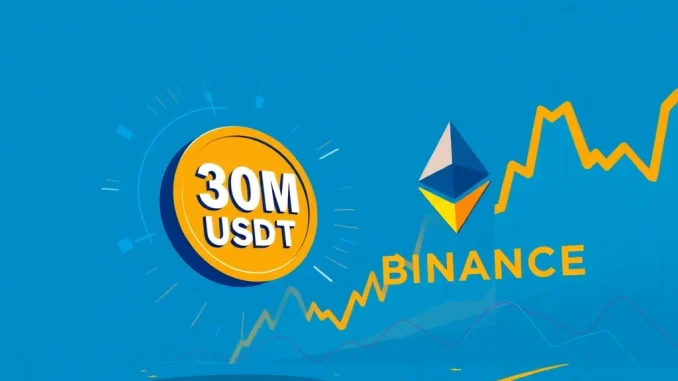
In a significant move highlighting institutional crypto strategy under pressure, Trend Research, a prominent subsidiary of LD Capital, has executed a substantial $30 million USDT transfer to Binance. This transaction, reported by AmberCN on November 28, 2025, follows a fresh borrowing from the Aave lending protocol and coincides with Ethereum’s price dipping below the firm’s critical average purchase threshold. The action provides a rare, transparent window into how major digital asset funds manage large, leveraged positions during market stress, offering crucial insights for the broader cryptocurrency ecosystem.
Trend Research’s Major Binance Deposit and Market Context
The core transaction involves Trend Research borrowing 30 million USDT from Aave and subsequently depositing the full amount into the Binance exchange. This maneuver is not an isolated event but rather a tactical decision within a much larger, ongoing accumulation strategy. The firm initiated its aggressive Ethereum acquisition campaign in November 2025, utilizing on-chain loans to build a massive position. Currently, Trend Research holds approximately 626,000 ETH, a stake valued at roughly $1.94 billion based on prevailing market prices.
However, the recent market downturn has placed this position under water. The firm’s average cost basis for its Ethereum holdings sits at $3,186 per token. With ETH’s price falling below this level, the portfolio now carries an estimated unrealized loss of $50 million. Consequently, the new liquidity injection via Aave and transfer to Binance is widely interpreted by analysts as a preparatory measure for several potential strategic responses. These could include covering margin requirements, funding further purchases to average down the cost basis, or providing collateral for additional derivative positions.
This activity underscores the intricate relationship between decentralized finance (DeFi) protocols like Aave and centralized exchanges (CEXs) like Binance. Major players routinely use DeFi as a liquidity engine, borrowing stablecoins against their volatile asset holdings, then moving that capital to exchanges for execution. The transparency of blockchain ledgers allows for real-time tracking of these moves, providing market signals that were previously unavailable in traditional finance.
Analyzing the Mechanics of On-Chain Leverage
Trend Research’s strategy exemplifies a sophisticated use of crypto-native financial tools. The process typically begins with depositing a high-value asset, like Ethereum, into a lending protocol as collateral. Aave, a leading money market protocol, allows users to borrow other assets against this collateral up to a specific loan-to-value (LTV) ratio. By borrowing USDT—a dollar-pegged stablecoin—the firm obtains liquid, non-volatile capital without needing to sell its core ETH holdings, thus avoiding immediate tax implications and maintaining exposure to potential upside.
The subsequent deposit to Binance is the critical execution step. Binance offers deep liquidity and a vast array of trading pairs and financial products. The transferred USDT could be deployed in several ways:
- Spot Market Purchases: Buying more ETH at lower prices to reduce the average entry cost.
- Futures or Perpetuals: Opening hedging positions to protect against further downside.
- Earn Products: Placing the USDT in yield-generating products while awaiting clearer market direction.
- Collateral for Exchange-Based Loans: Using the USDT as margin for further leveraged trading on the exchange itself.
This chain of actions reveals a calculated risk management approach. The firm is effectively using its existing ETH stack as a financial base to generate flexible capital, demonstrating a level of operational agility unique to the blockchain space. However, this strategy also compounds risk; if ETH’s price falls severely, it could trigger automatic liquidations of the collateral on Aave, forcing a sale and potentially exacerbating market declines.
Expert Perspective on Institutional Crypto Treasury Management
Analysts observing these on-chain flows note that Trend Research’s activity is a textbook case of active treasury management for a crypto fund. “Large funds don’t just buy and hold statically,” explains a veteran crypto fund manager who requested anonymity due to firm policy. “They dynamically manage their collateral and liquidity across multiple venues. A move like this—borrowing stablecoins against ETH and sending them to an exchange—is often a prelude to a defensive or averaging-down operation, especially when the core asset’s price breaches a key psychological level like the average cost.”
The timing is also significant. The broader crypto market in late 2025 continues to navigate macroeconomic headwinds, including interest rate policies and regulatory developments. Ethereum, in particular, faces its own network-specific dynamics around upgrades and adoption metrics. For a fund holding over 600,000 ETH, even minor price fluctuations represent multimillion-dollar swings in portfolio valuation, necessitating proactive and often visible on-chain maneuvers.
Implications for Ethereum and DeFi Market Stability
Trend Research’s substantial position makes its actions relevant to overall market sentiment and stability. A holding of 626,000 ETH represents a non-trivial percentage of Ethereum’s circulating supply. Therefore, the fund’s strategy can influence market perceptions. A large, leveraged buyer continuing to accumulate or defend its position can signal confidence to other investors. Conversely, signs of distress or forced liquidation from such a large entity could trigger panic selling.
The use of Aave also highlights the systemic importance of major DeFi protocols. Aave must manage its own risk parameters, ensuring it remains over-collateralized even if asset prices like ETH drop. The protocol’s health is paramount for the entire ecosystem, as it provides the foundational credit layer for strategies employed by firms like Trend Research. This interdependency creates a complex web where CEX activity, DeFi health, and asset prices are deeply intertwined.
Comparative Table: Potential Strategic Aims of the $30M USDT Move
| Potential Aim | Mechanism | Market Signal |
|---|---|---|
| Cost Averaging | Buy more ETH on Binance spot market at lower prices. | Bullish conviction; long-term accumulation. |
| Hedging | Open short positions or buy put options on derivatives. | Defensive; protecting the core portfolio from loss. |
| Liquidity Provision | Supply USDT to Binance Earn or liquidity pools for yield. | Neutral/patient; waiting for better entry or clarity. |
| Margin for Further Leverage | Use USDT as collateral for larger directional bets on Binance Futures. | Aggressive; doubling down on a market view. |
Conclusion
The $30 million USDT deposit by Trend Research to Binance is far more than a simple fund transfer. It represents a critical, real-time case study in advanced cryptocurrency portfolio management under duress. By leveraging DeFi protocols for liquidity and central exchanges for execution, the firm showcases the hybrid financial toolkit available to modern crypto institutions. This event underscores the heightened transparency of blockchain markets, where major strategic moves are publicly visible, providing valuable data points on institutional sentiment and risk management practices. As Ethereum’s price action continues to evolve, the market will closely watch whether this substantial liquidity injection stabilizes Trend Research’s position or precedes further significant on-chain activity.
FAQs
Q1: What is Trend Research, and who owns it?
Trend Research is a cryptocurrency investment and research firm operating as a subsidiary of LD Capital, a larger Asian-based digital asset investment group. It is known for taking significant, leveraged positions in major cryptocurrencies like Ethereum.
Q2: Why would a firm borrow USDT just to deposit it on an exchange?
Borrowing stablecoins against existing crypto holdings (like ETH) provides immediate liquidity without selling the underlying asset. Depositing this liquidity on an exchange like Binance prepares the capital for immediate use—whether for buying more assets, hedging, or earning yield—while maintaining full control and execution speed.
Q3: What does an “unrealized loss” mean in this context?
An unrealized loss occurs when the current market price of an asset falls below the price at which it was purchased. The loss is “unrealized” because the asset has not been sold. If Trend Research sold its ETH at the current lower price, the loss would become realized. The firm’s $50 million unrealized loss reflects the paper decline in value of its 626,000 ETH holdings.
Q4: How does this activity affect the average crypto investor?
Large, visible moves by institutional players can influence market sentiment and liquidity. They can signal confidence or concern, potentially impacting price trends. Furthermore, they demonstrate advanced strategies that retail investors can learn from, particularly regarding the use of DeFi for leverage and liquidity management.
Q5: What risks are associated with Trend Research’s strategy?
The primary risk is liquidation. If the price of Ethereum falls significantly, the value of the collateral posted on Aave could drop below the protocol’s required threshold, triggering an automatic, forced sale to repay the USDT loan. This could create a negative feedback loop, pushing ETH’s price down further and causing wider market volatility.