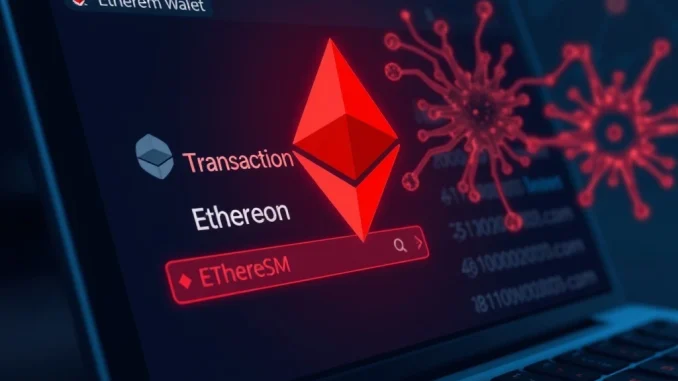
Ethereum Network Activity Surge: Alarming Link to Widespread Address Poisoning Attacks
A dramatic and concerning surge in Ethereum network activity has security analysts and blockchain researchers on high alert, with new data pointing directly to a rise in sophisticated address poisoning attacks exploiting recently lowered transaction costs. This unexpected spike, which saw daily transactions approach a record 2.9 million and over 2.7 million new addresses created in a single week, presents a dual narrative of network growth and heightened user risk. Consequently, the community must now scrutinize whether this activity represents organic adoption or a dangerous wave of automated fraud.
Ethereum Network Activity Reaches a Critical Juncture
The Ethereum blockchain, a cornerstone of decentralized finance and applications, recently exhibited metrics that initially suggested robust health and adoption. Specifically, transaction volumes soared, and new wallet creation accelerated at a remarkable pace. However, security researcher Andrey Sergeenkov provided crucial context, linking this surge not to positive market movements but to a decline in network fees. Since the implementation of the Ethereum Pectra upgrade in December, average gas fees have plummeted by more than 60%. This significant cost reduction, while beneficial for legitimate users, has inadvertently created a fertile environment for bad actors to execute large-scale, automated scams at a lower operational cost.
Network activity serves as a key health indicator for any blockchain. For instance, high transaction counts typically signal vibrant usage. Yet, analysts must differentiate between organic transactions and malicious noise. The current situation underscores a critical challenge in blockchain analytics: distinguishing real growth from artificial inflation driven by attacks. Therefore, this event provides a case study in the complex dynamics of blockchain economics and security.
Understanding the Mechanics of Address Poisoning
Address poisoning is a deceptive and insidious scam technique that preys on user habit and inattention. Attackers generate so-called “vanity” wallet addresses that deliberately mimic the first and last several characters of a target’s legitimate address. They then send a tiny, worthless transaction from this poisoned address to the victim’s wallet. The goal is not to steal funds directly from that transaction but to pollute the victim’s transaction history. When the victim later goes to send funds, they might mistakenly copy the fraudulent address from their history, believing it to be their own frequent contact or a saved address. Subsequently, any funds sent to the poisoned address are irrevocably lost.
- Vanity Address Generation: Attackers use algorithms to create addresses matching specific character patterns.
- Transaction History Pollution: A negligible-value transaction places the fake address in the victim’s ledger.
- Exploitation of Habit: The scam relies on users copying addresses from history without full verification.
This method differs from phishing, as it does not require compromising private keys or interacting with malicious websites. Instead, it exploits a weakness in user interface and behavior. The attack’s success hinges entirely on human error, making user education the primary defense.
The Pectra Upgrade’s Unintended Consequence
The Ethereum Pectra upgrade, a major network improvement implemented last December, successfully achieved one of its core goals: significantly reducing transaction fees for users. This reduction is a positive development for scalability and everyday use. However, security experts like Sergeenkov have highlighted a predictable side effect. Lower fees dramatically decrease the cost for scammers to execute bulk operations. Where sending millions of tiny, poisoning transactions was once cost-prohibitive, it is now economically feasible. This direct correlation between upgrade benefits and attack vector expansion presents a persistent dilemma for blockchain developers balancing efficiency with security.
We can illustrate the fee change impact with a simple comparison:
| Period | Average Gas Fee (Gwei) | Cost to Send 1M Micro-Tx | Primary Driver |
|---|---|---|---|
| Pre-Pectra Q4 2024 | ~40 Gwei | Prohibitively High | Market Demand |
| Post-Pectra Q1 2025 | ~15 Gwei | Economically Viable for Attackers | Protocol Upgrade |
This economic shift has enabled the scale of the current poisoning campaign. Attackers can now operate with a higher volume and lower risk of financial loss from the attack’s overhead costs.
Analyzing the Real-World Impact and User Response
The immediate impact of this activity surge is a tangible increase in user risk. While exchange and institutional wallets often have robust verification processes, everyday users and those interacting directly with smart contracts are most vulnerable. The blockchain’s immutable nature means a mistaken transaction is unrecoverable. Community response has been swift, with wallet providers like MetaMask and Ledger issuing renewed warnings about address verification. Furthermore, blockchain analytics firms have increased monitoring for patterns of vanity address generation and micro-transaction spam.
Long-term implications extend beyond individual losses. Persistent poisoning attacks can erode trust in the network’s usability. If users feel the environment is overly hostile, it may stifle adoption. The Ethereum community and core developers are now tasked with mitigating this threat without rolling back the fee benefits of the Pectra upgrade. Potential technical solutions include enhanced wallet software that flags similar addresses or network-level proposals to disincentivize micro-spam, though each comes with its own trade-offs regarding decentralization and user experience.
Conclusion
The recent Ethereum network activity surge presents a complex story where technological progress intersects with evolving security threats. The Pectra upgrade’s success in lowering gas fees has unwittingly catalyzed a wave of address poisoning attacks, reminding the ecosystem that every advancement requires parallel security considerations. For users, the imperative is clear: always verify every character of a wallet address before sending any transaction. For the network, this event underscores the ongoing battle to maintain a secure, scalable, and user-friendly blockchain environment. Vigilance and education remain the most powerful tools against these deceptive scams.
FAQs
Q1: What is address poisoning in cryptocurrency?
A1: Address poisoning is a scam where attackers create a wallet address mimicking the start and end of a victim’s real address. They send a tiny transaction to the victim so the fake address appears in their history, hoping the victim will later mistakenly send funds to it.
Q2: How did the Ethereum Pectra upgrade contribute to this problem?
A2: The Pectra upgrade successfully reduced network gas fees by over 60%. While beneficial for users, this lower cost made it economically feasible for scammers to send the vast number of small transactions required for large-scale address poisoning campaigns.
Q3: How can I protect myself from address poisoning attacks?
A3: Always manually verify the entire wallet address before confirming a transaction. Do not rely solely on transaction history or saved contact names. Use wallet features that allow you to label and verify trusted addresses, and be wary of unsolicited micro-transactions.
Q4: Does this surge in malicious activity mean Ethereum is insecure?
A4: No, the Ethereum protocol itself has not been compromised. This is a social engineering attack that exploits user behavior, not a flaw in the blockchain’s code. The network’s immutability and transparency are what allow analysts to detect and track these scams.
Q5: Are other blockchains experiencing similar attacks?
A5: Yes, address poisoning is a threat on any blockchain where addresses are long and complex, making visual verification difficult. However, the scale of the attack on Ethereum is currently notable due to the specific economic conditions created by the recent fee reduction.
Related News
- Chainlink (LINK) And SUI (SUI) On Notice? Algotech (ALGT) Emerges As A Surprise Contender
- Asia FX Rises: Weak Dollar Fuels Gains Amidst Disappointing Japan GDP
- Binance Perpetual Futures: Strategic Expansion with BIRB and GWEI Listings
Related: Echobit Exchange's Pivotal Partnership with XDGAI to Power Next-Generation Decentralized AI
Related: Single Asset Vault: Soil's Pivotal XRPL Move to Revolutionize Institutional Lending
Related: Bitcoin Correction Looms as Critical $69K-$72K Support Zone Faces Ultimate Test