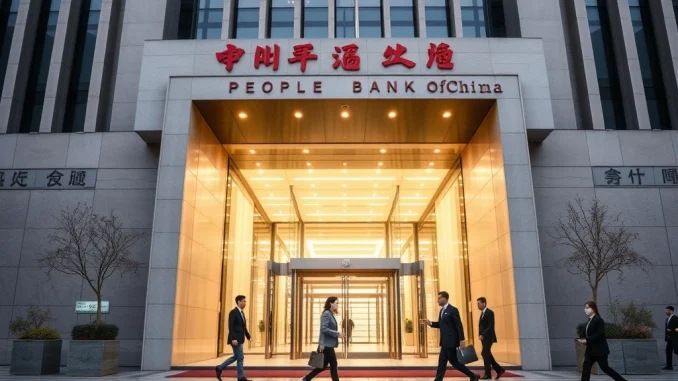
BEIJING, March 2025 – The People’s Bank of China announced today its decision to maintain benchmark lending rates unchanged, signaling a continued commitment to monetary stability during a period of significant global economic uncertainty. The central bank held its one-year loan prime rate at 3% and its five-year LPR at 3.5%, marking the fourth consecutive month of rate stability. This decision comes as China navigates complex domestic economic challenges while responding to shifting international monetary policies. Financial markets had widely anticipated this outcome, reflecting growing confidence in China’s measured approach to monetary management.
Understanding China’s Loan Prime Rate Mechanism
The People’s Bank of China employs the Loan Prime Rate as its de facto benchmark lending rate. This system replaced the traditional benchmark lending rate in 2019, creating a more market-oriented mechanism. Commercial banks submit their best lending rates to the central bank each month. Subsequently, the PBOC calculates and publishes the LPR based on these submissions. The one-year LPR primarily influences corporate and short-term loans. Meanwhile, the five-year LPR serves as the reference rate for mortgage pricing and long-term corporate borrowing.
This dual-rate structure allows for targeted monetary policy implementation. The central bank can influence different segments of the economy through specific rate adjustments. Financial institutions across China immediately adjust their lending practices following each monthly announcement. Consequently, the LPR decision directly impacts borrowing costs for millions of Chinese businesses and households. The current stability reflects careful calibration between supporting economic growth and maintaining financial system resilience.
Economic Context Behind the Rate Decision
China’s economy faces multiple pressures requiring careful monetary policy navigation. The manufacturing sector shows mixed signals with export demand fluctuating amid global trade tensions. Domestic consumption patterns continue evolving post-pandemic, with services recovering faster than durable goods purchases. Property market adjustments persist, though government support measures have stabilized the most acute pressures. Inflation remains well-contained, with consumer prices rising just 0.8% year-over-year in February 2025.
International factors significantly influence China’s monetary policy calculus. Major central banks, particularly the Federal Reserve and European Central Bank, maintain restrictive stances. Global capital flows respond sensitively to interest rate differentials between China and developed economies. The Chinese yuan faces both appreciation and depreciation pressures from these cross-border financial movements. Therefore, the PBOC must balance domestic needs with external stability considerations.
Expert Analysis of Monetary Policy Implications
Financial analysts emphasize the signaling importance of today’s decision. “The steady rates communicate confidence in current policy settings,” notes Dr. Li Wei, Chief Economist at Beijing Financial Research Institute. “The PBOC appears satisfied with existing liquidity conditions and credit transmission mechanisms.” Market participants interpret the consistency as evidence of coordinated policy across government agencies. Fiscal measures announced during the recent National People’s Congress complement this monetary stability.
Historical context reveals the significance of current rate levels. The table below illustrates China’s LPR trajectory since 2020:
| Period | 1-Year LPR | 5-Year LPR | Economic Context |
|---|---|---|---|
| Jan 2020 | 4.15% | 4.80% | Pre-pandemic levels |
| Aug 2022 | 3.65% | 4.30% | Post-pandemic recovery |
| Jun 2023 | 3.55% | 4.20% | Targeted stimulus phase |
| Feb 2024 | 3.45% | 4.20% | Modest easing cycle |
| Current (Mar 2025) | 3.00% | 3.50% | Stability emphasis |
This historical perspective demonstrates the gradual normalization process. Rates have declined substantially from pandemic-era peaks while maintaining positive real returns. The current spread between one-year and five-year rates stands at 50 basis points. This differential supports bank profitability while encouraging longer-term investment.
Market Reactions and Financial System Impact
Chinese financial markets responded calmly to today’s announcement. The Shanghai Composite Index traded within a narrow range, closing just 0.2% higher. Banking stocks showed minimal movement, reflecting investor expectations of continued net interest margin stability. Bond markets displayed similar composure, with 10-year government bond yields holding near 2.75%. Currency markets witnessed modest yuan strengthening against the dollar, reaching 7.18 yuan per dollar in afternoon trading.
The banking sector particularly benefits from predictable rate environments. Commercial banks can plan lending strategies with greater certainty when benchmark rates remain stable. Credit allocation becomes more efficient under these conditions. Small and medium enterprises gain improved access to financing when banks face reduced interest rate risk. Furthermore, financial stability strengthens as institutions manage their balance sheets more effectively.
Key transmission channels for monetary policy include:
- Credit channel: Stable rates encourage consistent lending growth
- Asset price channel: Predictable rates support equity and property valuations
- Exchange rate channel: Rate differentials influence capital flows and currency values
- Expectations channel: Policy consistency shapes business and consumer confidence
Comparative International Monetary Policy Landscape
China’s monetary policy stance diverges meaningfully from other major economies. The Federal Reserve maintains its federal funds rate above 5%, creating substantial interest rate differentials. The European Central Bank continues its gradual tightening cycle, though at a measured pace. Japan’s central bank maintains ultra-low rates while cautiously normalizing yield curve control. This global policy divergence presents both challenges and opportunities for Chinese policymakers.
Emerging market central banks watch China’s decisions closely. Many Asian economies maintain trade and investment linkages with China. Consequently, their monetary policies often correlate with Chinese decisions. The Association of Southeast Asian Nations particularly coordinates policies with China through various financial cooperation mechanisms. Regional financial stability benefits from China’s predictable policy approach.
Structural Reforms Supporting Monetary Effectiveness
China’s monetary policy operates within a broader reform context. Financial market liberalization continues progressing, though with careful sequencing. Interest rate corridor mechanisms have improved policy transmission since their 2020 implementation. The central bank’s balance sheet management has grown increasingly sophisticated. Macroprudential frameworks now complement traditional monetary tools, creating a more resilient financial system.
Digital currency developments represent another important dimension. The digital yuan continues expanding its pilot programs across major cities. This innovation potentially enhances monetary policy transmission efficiency. The central bank could implement more targeted stimulus through programmable digital currency features. However, officials emphasize that digital currency represents a complement rather than replacement for existing tools.
Forward Guidance and Policy Trajectory
The People’s Bank of China provides limited explicit forward guidance compared to Western central banks. Instead, policy signals emerge through various channels including quarterly monetary policy reports and senior official speeches. Recent communications emphasize “appropriate” and “targeted” policy adjustments. The phrase “counter-cyclical” appears frequently, suggesting readiness to respond to economic fluctuations.
Most analysts expect continued stability in coming months. However, certain triggers could prompt policy adjustments:
- Sustained economic slowdown below 4% quarterly growth
- Significant financial market volatility threatening stability
- Major external shocks affecting trade or capital flows
- Persistent deflationary pressures across multiple sectors
The central bank maintains substantial policy space for either easing or tightening. Reserve requirement ratios stand at historically normal levels, providing room for adjustment. Various lending facilities offer targeted support capabilities. Foreign exchange reserves remain ample for currency stabilization if needed.
Conclusion
The People’s Bank of China maintains its benchmark lending rates steady, demonstrating commitment to monetary stability during uncertain economic times. This decision reflects careful balancing of domestic growth objectives and external stability considerations. Financial markets respond positively to this policy predictability, supporting continued credit expansion and economic activity. The loan prime rate mechanism functions effectively as China’s primary monetary policy tool, transmitting decisions throughout the financial system. Looking forward, the central bank retains flexibility to adjust policies as economic conditions evolve, though current settings appear appropriate for present circumstances. This measured approach supports China’s economic transition while maintaining financial system resilience against global headwinds.
FAQs
Q1: What is the Loan Prime Rate and why does it matter?
The Loan Prime Rate serves as China’s benchmark lending rate, determining borrowing costs for businesses and households. Commercial banks reference these rates when pricing loans, making them crucial for economic activity and monetary policy transmission.
Q2: How often does the People’s Bank of China adjust lending rates?
The PBOC announces LPR decisions monthly, though changes occur only when economic conditions warrant adjustment. The central bank has maintained current rates for four consecutive months as of March 2025.
Q3: What factors influence China’s monetary policy decisions?
Key considerations include domestic growth, employment, inflation, financial stability, property market conditions, and international factors like exchange rates and capital flows.
Q4: How do China’s interest rates compare internationally?
China maintains lower policy rates than the United States and Europe but higher rates than Japan. This positioning reflects different economic cycles and policy priorities across regions.
Q5: What tools does the PBOC use besides interest rates?
The central bank employs reserve requirement ratios, open market operations, various lending facilities, macroprudential measures, and window guidance to commercial banks.