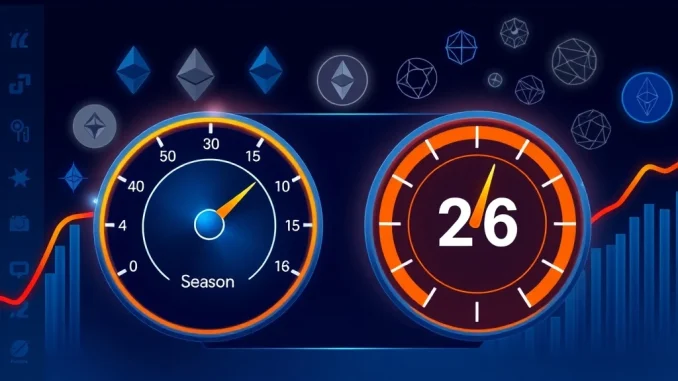
Global cryptocurrency markets observed a subtle yet significant shift on March 21, 2025, as CoinMarketCap’s widely monitored Altcoin Season Index inched upward to a score of 26. This single-point increase from the previous day’s reading of 25 fuels analytical discussions about potential early-stage rotation within the digital asset ecosystem. The index serves as a critical barometer, quantifying whether capital is predominantly flowing into Bitcoin or diversifying across alternative cryptocurrencies, commonly called altcoins.
Decoding the Altcoin Season Index Mechanics
CoinMarketCap’s Altcoin Season Index provides a data-driven framework for understanding market phases. Fundamentally, the tool measures the percentage of top cryptocurrencies that outperform Bitcoin over a specific period. Analysts calculate this metric by examining the performance of the top 100 digital assets by market capitalization, excluding stablecoins and wrapped tokens, over a rolling 90-day window.
The declaration of a formal “altcoin season” requires a stringent threshold. Specifically, 75% of these qualifying assets must outperform Bitcoin during that three-month span. Consequently, the index score reflects proximity to this threshold. A score closer to 100 indicates a stronger altcoin season, while a lower score suggests Bitcoin dominance. The recent move to 26, therefore, represents a movement toward, but still far from, a confirmed altcoin season.
Historical Context and Market Cycle Analysis
Understanding the current index level of 26 necessitates examining historical precedents. For instance, during the pronounced altcoin season of early 2021, the index sustained readings above 75 for several weeks. In contrast, prolonged Bitcoin-dominated periods, such as much of 2023, often saw the index languish below 10. The current position suggests a market in a transitional or accumulation phase.
Market analysts often correlate rising Altcoin Season Index values with increased risk appetite among investors. When confidence grows, capital frequently seeks higher-beta opportunities beyond Bitcoin, which is increasingly viewed as a digital reserve asset. This rotation can precede broader altcoin rallies, making the index a valuable leading indicator for portfolio strategists.
Expert Insights on Index Movements and Liquidity
Seasoned market observers emphasize that single-day movements, like the one-point rise to 26, require context. “The index is a momentum tool, not a timing signal,” notes a report from blockchain analytics firm IntoTheBlock. “Sustained movement over 50 is historically more significant than daily volatility. The current trend suggests watchful optimism but not confirmed rotation.”
Furthermore, on-chain data reveals that liquidity flows into altcoin markets often begin gradually. A rising index can reflect early institutional or large-scale investor positioning before retail sentiment fully shifts. This data-driven perspective underscores the importance of monitoring the index trend alongside volume and funding rate metrics across derivatives markets.
Comparative Performance and Sector Implications
The underlying calculation means that at an index level of 26, approximately a quarter of the top altcoins are outperforming Bitcoin over the past 90 days. This performance is rarely uniform across sectors. Analysis frequently shows that Layer 1 blockchains, decentralized finance (DeFi) tokens, or specific narrative-driven sectors may lead the initial outperformance.
A brief comparison of recent index thresholds and market phases illustrates this dynamic:
| Index Range | Typical Market Phase | Investor Sentiment |
|---|---|---|
| 0-25 | Bitcoin Dominance | Risk-Off, Cautious |
| 26-50 | Transition / Early Rotation | Watchful, Selective |
| 51-74 | Altcoin Momentum Building | Growing Risk Appetite |
| 75-100 | Confirmed Altcoin Season | High Risk-On, Broad Rally |
This structure helps investors align their strategies with observable market dynamics rather than sentiment alone.
The Role of Bitcoin Dominance in the Equation
The Altcoin Season Index operates in an inverse relationship with Bitcoin’s market dominance—the percentage of the total crypto market capitalization that Bitcoin represents. When Bitcoin dominance falls, the Altcoin Season Index typically rises, as capital flows into a broader array of assets. Currently, Bitcoin dominance remains historically elevated, which contextually explains the Altcoin Season Index’s moderate level.
Key factors that can catalyze a further rise in the index include:
- Macroeconomic shifts: Changes in interest rate expectations or dollar strength.
- Bitcoin consolidation: Periods where Bitcoin’s price stabilizes after a rally.
- Innovation catalysts: Major protocol upgrades or successful product launches in altcoin projects.
- Regulatory clarity: Positive developments for altcoin sectors like DeFi or tokenization.
Monitoring these catalysts provides a fuller picture than the index score alone.
Quantitative Data and Verification Standards
CoinMarketCap’s methodology ensures the index’s reliability. The exclusion of stablecoins (like USDT, USDC) and wrapped assets (like WBTC) prevents distortion from assets designed to track flat value or Bitcoin’s price. The 90-day window smooths out short-term volatility, focusing on sustained trends. This rigorous approach aligns with the data transparency standards demanded by institutional analysts entering the crypto space.
Independent verification from other data platforms, such as Glassnode or CryptoQuant, often shows correlated trends in altcoin net flows and exchange reserves, adding layers of confirmation to the index’s narrative.
Conclusion
The Altcoin Season Index’s climb to 26 marks a noteworthy data point in the evolving cryptocurrency landscape of 2025. While far from signaling a full altcoin season, this movement indicates early-stage rotation potential and shifting investor attention. Market participants should view this metric as one component of a broader analytical toolkit, combining it with on-chain data, macroeconomic indicators, and sector-specific developments. The index remains a crucial, neutral gauge for navigating the perpetual cycle between Bitcoin dominance and altcoin expansion, providing a factual foundation for strategic decision-making in a complex digital asset market.
FAQs
Q1: What exactly does an Altcoin Season Index score of 26 mean?
An index score of 26 indicates that approximately 26% of the top 100 cryptocurrencies (excluding stablecoins and wrapped coins) have outperformed Bitcoin over the previous 90 days. It suggests very early, tentative signs of altcoin momentum but is still firmly within a Bitcoin-dominant market phase.
Q2: How is the Altcoin Season Index calculated?
The index is calculated by CoinMarketCap. It measures the percentage of the top 100 crypto assets by market cap (excluding stablecoins and wrapped tokens) that have generated higher returns than Bitcoin over a rolling 90-day period. A score of 75 or above declares an official “altcoin season.”
Q3: Why are stablecoins and wrapped Bitcoin excluded from the index?
Stablecoins are excluded because their value is pegged to flat currencies and does not reflect speculative performance. Wrapped Bitcoin (like WBTC) is excluded because its price directly mirrors Bitcoin’s, so its inclusion would not measure *alternative* performance. This ensures the index only measures true altcoins.
Q4: Has a true altcoin season been confirmed?
No. A confirmed altcoin season requires the index to reach and sustain a level of 75 or higher. The current reading of 26 is significantly below that threshold, indicating the market is not in an altcoin season but may be in a very early transitional phase.
Q5: Should investors buy altcoins based solely on this index rising?
No. The index is a helpful broad market sentiment and momentum indicator, not a direct investment signal. Prudent investment decisions should be based on comprehensive research, including project fundamentals, tokenomics, technical analysis, and individual risk tolerance, not a single metric.