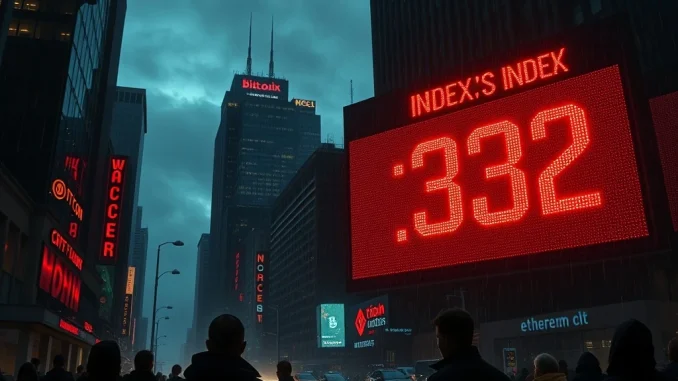
Global cryptocurrency markets entered a pronounced phase of anxiety this week as the widely monitored Crypto Fear & Greed Index recorded a sharp 12-point drop to a score of 32. Consequently, the benchmark firmly remains in the ‘Fear’ territory, reflecting heightened investor caution and negative market sentiment. This significant shift, reported by data provider Alternative.me on April 10, 2025, follows a period of increased volatility and signals a potential change in market psychology that demands a closer examination.
The Crypto Fear & Greed Index Plunges to 32
The Crypto Fear & Greed Index serves as a crucial barometer for digital asset sentiment. Specifically, it quantifies the emotional state of the market on a scale from 0 to 100. A score of 0 represents ‘Extreme Fear,’ while 100 signifies ‘Extreme Greed.’ Therefore, the current reading of 32 indicates a clear and sustained shift toward pessimism among traders and investors. This single-day decline of 12 points marks one of the most notable drops in recent months, suggesting a rapid deterioration in confidence.
Analysts immediately scrutinized the underlying data. The index derives its value from a sophisticated, multi-factor model designed to capture various market dimensions. For instance, market volatility and trading volume each contribute 25% to the final score. Simultaneously, social media sentiment and survey data each account for 15%. Finally, Bitcoin’s dominance share of the total crypto market capitalization and relevant Google search trends each provide the remaining 10%. This comprehensive methodology aims to filter out noise and present a holistic view of investor behavior.
Decoding the Components Behind the Fear
Understanding the drop requires a breakdown of its contributing factors. Primarily, increased price volatility across major cryptocurrencies like Bitcoin and Ethereum has played a substantial role. Historically, sharp price swings often correlate with fear, as they introduce uncertainty and risk for holders. Furthermore, trading volume data suggests a potential shift in activity, possibly indicating more selling pressure or a cautious retreat to the sidelines by institutional players.
Social media analysis reveals a corresponding trend. Platforms like X (formerly Twitter) and Reddit have shown a measurable increase in negative or cautious commentary regarding market direction. Concurrently, search engine data indicates a spike in queries related to ‘crypto crash’ and ‘market bottom,’ which the index interprets as fear-driven curiosity. Notably, Bitcoin’s market dominance, a metric watched for clues about altcoin cycles, also influences the score, though its recent movements have been less dramatic.
Historical Context and Comparative Analysis
Placing the current 32 reading in a historical context provides critical perspective. For example, during the major market downturn of 2022, the index frequently dwelled in ‘Extreme Fear,’ often dipping below 20. Conversely, during bull market peaks, it has soared above 75 into ‘Extreme Greed.’ The current ‘Fear’ zone is a common state during market corrections or periods of consolidation. A comparative table illustrates recent sentiment shifts:
| Date | Index Score | Sentiment | Key Market Event |
|---|---|---|---|
| Early March 2025 | 55 | Neutral | Period of sideways trading |
| Late March 2025 | 44 | Fear | Increased regulatory headlines |
| April 9, 2025 | 44 | Fear | Pre-drop level |
| April 10, 2025 | 32 | Fear | 12-point single-day plunge |
This data shows a clear trend of deteriorating sentiment leading to the latest plunge. Market technicians often view sustained fear as a potential contrarian indicator. However, they caution that sentiment alone does not predict immediate price reversals.
Potential Market Impacts and Trader Psychology
The persistence of fear sentiment typically triggers several observable market behaviors. Firstly, risk aversion tends to increase. Investors may reallocate capital from smaller, more volatile altcoins into perceived safer havens like Bitcoin or stablecoins. Secondly, trading activity often changes. Some participants may engage in panic selling, while others see fear as a buying opportunity, leading to clashes in market order flow. This dynamic can create the volatility that further feeds the fear metric.
Moreover, the psychological impact is profound. Extended periods of fear can lead to investor fatigue and apathy, reducing overall market participation. This reduction in liquidity can, in turn, exacerbate price movements. Financial psychologists note that the ‘Fear’ zone often separates short-term speculators from long-term believers in blockchain technology. Consequently, market structure can subtly shift during these phases.
Expert Insights on Sentiment Indicators
Market analysts emphasize that sentiment indicators like the Fear & Greed Index are best used as one tool among many. “Sentiment is a lagging indicator in fast-moving markets, but a powerful one for gauging crowd psychology,” notes a veteran crypto fund manager whose commentary is regularly cited in financial publications. “A reading of 32 tells us the crowd is scared, which is useful information. However, it doesn’t tell us *why* they are scared or what will change their mind. That requires analysis of fundamentals like adoption rates, regulatory developments, and macroeconomic factors.”
This expert view underscores the index’s role. It provides a snapshot of emotion, not a crystal ball. The recent drop likely reflects a combination of factors including:
- Macroeconomic pressures: Global interest rate decisions and inflation data.
- Regulatory uncertainty: Pending legislation in major economies.
- Technical breakdowns: Bitcoin falling below key support levels.
- Network activity: Shifts in on-chain transaction volume and value.
Therefore, a holistic analysis always combines sentiment data with these other critical lenses.
Navigating a Fear-Driven Market Environment
For investors, a fearful market presents both challenges and opportunities. The primary challenge is emotional discipline. The constant drumbeat of negative sentiment can lead to poor, reactionary decisions. The key opportunity, historically, has been the potential to accumulate assets at prices disconnected from their long-term fundamental value. Seasoned investors often develop checklists for such environments, focusing on project viability, developer activity, and real-world use cases rather than daily price quotes.
Risk management becomes paramount. Strategies may include:
- Rebalancing portfolios toward less volatile assets.
- Employing dollar-cost averaging to mitigate timing risk.
- Setting clear stop-loss and profit-taking levels based on personal risk tolerance, not fear.
- Ignoring sensationalist headlines and focusing on verifiable data.
Ultimately, markets are cyclical. Periods of fear have always been followed by periods of greed, and vice versa. The index’s value lies in objectively quantifying these emotional extremes, allowing for more reasoned decision-making.
Conclusion
The Crypto Fear & Greed Index’s decline to 32 provides a clear, data-driven signal of prevailing market fear. This sentiment shift, driven by volatility, social chatter, and trading behavior, offers a crucial snapshot of current investor psychology. While not a predictive tool, it serves as an essential gauge for understanding market dynamics. Historically, prolonged fear has often preceded periods of opportunity, though it requires patience and rigorous analysis to navigate. As the market digests this sentiment data, attention will inevitably turn to the fundamental drivers—technological adoption, regulatory clarity, and macroeconomic trends—that will ultimately determine the next shift in the Crypto Fear & Greed Index.
FAQs
Q1: What does a Crypto Fear & Greed Index score of 32 mean?
A score of 32 means the market is in a ‘Fear’ state. It indicates that current data from volatility, volume, social media, and surveys points toward predominant negative sentiment and caution among cryptocurrency investors.
Q2: Who creates the Crypto Fear & Greed Index and how is it calculated?
The index is created by data provider Alternative.me. It is calculated using six factors: volatility (25%), market volume (25%), social media (15%), surveys (15%), Bitcoin dominance (10%), and Google search trends (10%).
Q3: Is a low Fear & Greed Index score a good buying signal?
Not necessarily. While extreme fear can sometimes indicate a market bottom, it is not a timing tool. A low score signals negative sentiment, which can persist or worsen. It should be considered alongside fundamental and technical analysis.
Q4: How often does the Fear & Greed Index update?
The index updates daily, providing a fresh snapshot of market sentiment based on the previous 24 hours of data from its various sources.
Q5: Has the index ever been wrong?
The index measures sentiment, not future price. It can remain in ‘Fear’ during prolonged bear markets or in ‘Greed’ during bubbles. It accurately reflects prevailing emotions, but emotions do not always align with immediate price direction.