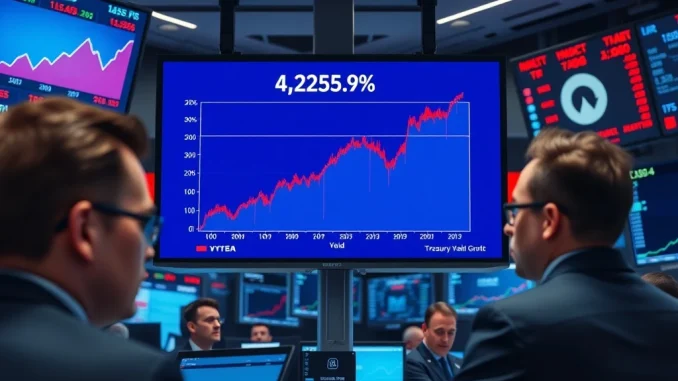
NEW YORK, March 2025 – The yield on the benchmark 10-year U.S. Treasury note has surged to 4.259%, marking its highest level in four months and signaling a pivotal shift in global capital markets. This crucial move above the 4.25% threshold, a level last seen in September of the previous year, immediately reduces investor appetite for speculative risk assets. Consequently, market participants globally are now reassessing their portfolios for potential volatility.
U.S. 10-Year Treasury Yield Reaches Critical 4-Month Peak
The 10-year Treasury yield serves as the world’s most critical interest rate benchmark. Its recent ascent to 4.259% reflects a complex interplay of economic data and central bank policy signals. For context, the yield began the year closer to 3.85%. This significant 40-plus basis point increase therefore represents a substantial repricing of long-term growth and inflation expectations within a short timeframe. Market analysts attribute the move primarily to stronger-than-anticipated economic indicators, which have tempered expectations for imminent Federal Reserve rate cuts.
Furthermore, the yield curve, which plots yields across different maturities, has undergone a notable shift. The following table illustrates the recent change in key Treasury benchmarks:
| Security | Yield (Early Jan 2025) | Yield (Current, March 2025) | Change (Basis Points) |
|---|---|---|---|
| 2-Year Treasury Note | 4.10% | 4.45% | +35 |
| 10-Year Treasury Note | 3.85% | 4.259% | +40.9 |
| 30-Year Treasury Bond | 4.05% | 4.40% | +35 |
This parallel upward shift suggests a broad-based reassessment of the monetary policy trajectory rather than isolated trading. The 10-year note’s role as a global safe-haven asset amplifies its impact, as international investors often flock to it during periods of uncertainty, albeit now at a higher yield.
Drivers Behind the Bond Market Sell-Off
Several concrete factors have converged to push the benchmark yield higher. First, recent labor market reports have consistently shown robust job creation and wage growth, easing fears of an economic slowdown. Second, inflation data, while moderating, has remained stubbornly above the Federal Reserve’s 2% target, particularly in services sectors. Third, statements from Federal Reserve officials have adopted a more cautious, data-dependent tone, effectively pushing back the timeline for potential interest rate reductions.
Market mechanics also play a direct role. When investors sell Treasury bonds, prices fall and yields rise. This sell-off often occurs when:
- Inflation expectations increase, eroding the future value of fixed bond payments.
- Growth forecasts improve, making other investments more attractive relative to bonds.
- The supply of government debt rises, requiring higher yields to attract sufficient buyers.
All three conditions have been present in recent weeks. The U.S. government continues to finance significant deficits, issuing new debt that the market must absorb. Simultaneously, economic resilience has led traders to price in a “higher for longer” interest rate environment.
Expert Analysis on the Yield Surge
Financial strategists point to the psychological importance of the 4.25% level. “Breaking above 4.25% on the 10-year is a technical and psychological milestone,” notes a veteran fixed-income strategist at a major investment bank. “It confirms the market has fully priced out the aggressive rate cut narrative from late last year and is now aligning with the Fed’s patient stance. The next key resistance level to watch is the October high of 4.35%.”
Historical context is essential here. The current yield remains below the peak of nearly 5.0% reached in October 2023, but the speed of the recent increase is what alarms portfolio managers. This rapid move can trigger forced selling in leveraged positions and cause dislocation in interest-rate-sensitive sectors like real estate and utilities.
Immediate Impact on Global Risk Assets
The rise in the so-called “risk-free rate” has immediate and profound consequences. Higher Treasury yields increase the discount rate used to value future corporate earnings, which typically pressures equity valuations. Growth-oriented technology stocks, whose valuations are heavily based on long-term profit projections, often feel the brunt of this adjustment. Indeed, major equity indices have shown increased volatility concurrent with the yield climb.
Moreover, the U.S. dollar often strengthens as higher yields attract foreign capital seeking better returns. This dollar strength can create headwinds for multinational corporations and emerging markets with dollar-denominated debt. The classic correlation where bonds provide a portfolio hedge against equity weakness has also been tested, as both asset classes have faced pressure simultaneously during this repricing period.
Other asset classes react predictably:
- Cryptocurrencies: Often treated as speculative risk assets, cryptocurrencies like Bitcoin and Ethereum typically face selling pressure when Treasury yields rise sharply, as investors reduce exposure to high-volatility investments.
- Gold: The non-yielding precious metal becomes less attractive compared to newly issued bonds paying over 4.25%, leading to potential outflows.
- Corporate Bonds: Spreads between corporate bond yields and Treasury yields may widen, especially for lower-rated “high-yield” debt, reflecting increased risk aversion.
Forward Outlook and Federal Reserve Policy Path
The critical question for markets is whether this yield increase represents a new equilibrium or a temporary overshoot. The answer hinges almost entirely on incoming economic data and the Federal Reserve’s reaction function. The central bank’s next policy meeting and its updated “dot plot” projections will be scrutinized for any change in the median forecast for the federal funds rate. Any indication that rate cuts will be delayed further into 2025 or reduced in number could validate the current yield level and potentially push it higher.
Conversely, a marked slowdown in inflation or employment data could quickly reverse the trend. Market participants are therefore navigating a landscape where every data release carries heightened significance. The yield’s behavior around key technical levels will offer clues about trader conviction. Sustained trading above 4.25% would suggest a fundamental reassessment of the post-pandemic economic landscape, with implications for borrowing costs for mortgages, auto loans, and business investment for the foreseeable future.
Conclusion
The U.S. 10-year Treasury yield’s climb to a 4-month high of 4.259% is a definitive market event with far-reaching implications. Driven by resilient economic data and a recalibrated Federal Reserve policy outlook, this move in the world’s primary benchmark interest rate is reshaping capital flows and risk appetites globally. While the yield remains below its recent historical peaks, its rapid ascent acts as a sobering reminder that the era of ultra-low rates has ended. Investors must now navigate an environment where the “risk-free” rate offers substantial competition to other asset classes, demanding more selective and disciplined portfolio construction. Monitoring the trajectory of this crucial U.S. 10-year Treasury yield will remain essential for understanding broader financial market direction.
FAQs
Q1: What does the 10-year Treasury yield represent?
The 10-year Treasury yield represents the annualized return an investor would receive if they bought a U.S. government bond today and held it for ten years. It is the most widely watched benchmark for long-term interest rates globally, influencing everything from mortgage rates to corporate borrowing costs.
Q2: Why does a higher Treasury yield reduce appetite for risk assets like stocks?
A higher “risk-free” Treasury yield increases the opportunity cost of holding risky assets. Investors can earn a safer return from government bonds, making the potential extra return from stocks less attractive. Additionally, higher yields increase the discount rate used in valuation models, lowering the present value of companies’ future earnings.
Q3: How does this impact the average person?
Higher benchmark yields directly lead to increased interest rates on loans. This means more expensive mortgages, auto loans, and credit card rates. Conversely, it also means higher yields on savings accounts, certificates of deposit (CDs), and government savings bonds.
Q4: Is a 4.259% yield considered high historically?
Context is key. While significantly higher than the sub-1% yields seen during the peak of the pandemic, 4.259% is moderate by longer-term historical standards. For comparison, the 10-year yield averaged above 5% in the early 2000s and was above 15% in the early 1980s.
Q5: What could cause the 10-year yield to stop rising or reverse?
A sustained drop in inflation data, weaker-than-expected employment or growth reports, or a clear signal from the Federal Reserve that it is prepared to cut rates sooner than currently anticipated could all put downward pressure on yields. Geopolitical events that spur a “flight to safety” could also cause investors to buy bonds, pushing prices up and yields down.