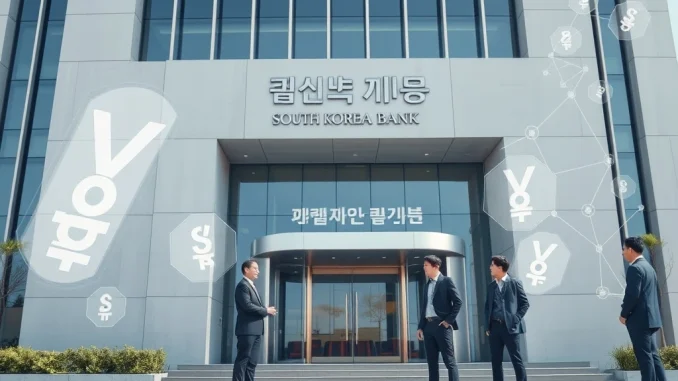
SEOUL, South Korea – January 2025 – South Korea’s banking sector has launched a coordinated push to issue a government-backed digital currency that could revolutionize the nation’s financial landscape. According to exclusive reports from the Electronic Times, major financial institutions are advocating for a won-denominated stablecoin with a crucial condition: they must be permitted to pay interest on these digital assets. This strategic move comes as the country prepares for the implementation of its landmark Digital Asset Basic Act, positioning traditional banks at the forefront of South Korea’s digital financial transformation.
South Korean Banks Consolidate Stablecoin Position
The Korea Federation of Banks (KFB) recently held a private briefing for its member institutions on January 15, 2025. This meeting specifically focused on coordinating a unified response regarding stablecoin issuance. Major commercial banks participated in discussions that centered on a single, bank-centric stablecoin model. Consequently, the banking industry aims to establish a standardized approach before regulators finalize digital asset frameworks.
Financial industry sources revealed that the January 19 briefing represented a significant development in ongoing discussions. The meeting formed part of an interim review of a comprehensive research project on won-backed stablecoins. Significantly, the KFB commissioned this study from global consulting firm McKinsey & Company. Therefore, the banking sector’s position reflects extensive research and strategic planning rather than spontaneous reaction.
Interest Payments: The Core Banking Proposition
South Korean banks have identified interest payments as their primary condition for stablecoin issuance. This proposal distinguishes their approach from existing stablecoin models worldwide. Traditional stablecoins typically function as digital representations of fiat currency without yielding returns. However, bank-issued interest-bearing stablecoins could bridge conventional banking services with blockchain technology.
The banking industry’s interest-bearing proposal addresses several critical concerns:
- Regulatory Compliance: Interest payments would bring stablecoins under existing financial regulations
- Consumer Protection: Banks would provide familiar safeguards for digital asset holders
- Financial Inclusion: Interest-bearing digital assets could attract traditional savers to blockchain platforms
- Monetary Policy Integration: Central banks could potentially influence digital currency circulation through interest rates
n
Industry analysts suggest this approach represents a strategic effort to maintain banking sector relevance. As decentralized finance platforms gain popularity, traditional institutions seek to offer competitive digital alternatives. Moreover, interest-bearing stablecoins could prevent capital migration from traditional bank accounts to non-interest-bearing digital alternatives.
Strategic Timing Ahead of Regulatory Framework
The banking sector’s coordinated push comes at a pivotal moment in South Korea’s regulatory timeline. The government’s Digital Asset Basic Act approaches enactment, creating urgency for industry stakeholders to influence final regulations. By presenting a unified position now, banks aim to shape regulatory frameworks from their initial design stages.
This proactive strategy reflects lessons from other jurisdictions where financial institutions reacted to rather than shaped digital asset regulations. South Korean banks apparently seek to avoid similar scenarios by engaging regulators during the policy formulation phase. Their position paper, developed through the KFB, emphasizes stability, consumer protection, and financial system integration.
Comparative Analysis: Global Stablecoin Approaches
South Korea’s proposed bank-led model contrasts significantly with approaches in other major economies. The following table illustrates key differences:
| Country/Region | Primary Issuer | Interest Feature | Regulatory Status |
|---|---|---|---|
| South Korea (Proposed) | Commercial Banks | Interest-bearing | Under Development |
| United States | Private Companies | Non-interest-bearing | State-regulated |
| European Union | Mixed (Bank & Non-bank) | Mostly non-interest | MiCA Framework |
| Singapore | Payment Institutions | Non-interest-bearing | PSA-regulated |
This comparative analysis reveals South Korea’s distinctive approach to stablecoin development. Unlike the United States where private companies dominate stablecoin issuance, South Korean banks advocate for a regulated banking sector monopoly. Similarly, the European Union’s Markets in Crypto-Assets (MiCA) framework permits various issuers but doesn’t mandate interest features.
Potential Impacts on South Korea’s Financial Ecosystem
The introduction of bank-issued interest-bearing stablecoins could transform multiple aspects of South Korea’s financial system. First, traditional banking services would extend directly into the digital asset space. Consequently, consumers might access blockchain-based financial products through their existing bank relationships. This integration could accelerate digital currency adoption among mainstream users.
Second, monetary policy implementation could evolve significantly. The Bank of Korea might gain new tools for influencing digital currency circulation through interest rate mechanisms. Furthermore, financial stability monitoring could improve with regulated bank issuance compared to private company models. Transaction transparency and anti-money laundering controls would likely strengthen under banking sector oversight.
Third, South Korea’s position in global digital finance could strengthen substantially. The country already demonstrates strong cryptocurrency adoption rates and technological infrastructure. A regulated, interest-bearing stablecoin could position South Korea as an innovator in digital currency design. International financial centers might subsequently study this model for potential adaptation.
Expert Perspectives on Banking Sector Motivation
Financial technology analysts identify several strategic motivations behind the banking sector’s stablecoin push. Primarily, banks seek to maintain their central role in the financial system amid digital transformation. By controlling stablecoin issuance, traditional institutions preserve their intermediary function in an increasingly decentralized landscape.
Additionally, interest-bearing features address competitive threats from decentralized finance platforms. These platforms often offer yield-generating opportunities that traditional savings accounts cannot match. Bank-issued interest-bearing stablecoins could therefore retain customer deposits within the regulated banking system. This retention strategy becomes particularly important as younger generations show increasing interest in digital asset investments.
Finally, the banking sector likely recognizes revenue opportunities in stablecoin services. Transaction fees, custody services, and interest rate spreads could generate substantial income streams. These financial incentives complement strategic positioning considerations. Together, they explain the banking industry’s coordinated advocacy for this specific stablecoin model.
Regulatory Considerations and Implementation Timeline
The Digital Asset Basic Act represents South Korea’s comprehensive framework for digital asset regulation. Expected implementation in 2025 creates urgency for all stakeholders. Banking sector proposals must align with several regulatory priorities including consumer protection, financial stability, and innovation promotion.
Key regulatory considerations for interest-bearing stablecoins include:
- Deposit Insurance: Whether stablecoin holdings qualify for deposit protection
- Capital Requirements: Appropriate reserve ratios for stablecoin issuers
- Interest Rate Regulations: Compliance with existing interest rate policies
- Cross-border Transactions: International transfer rules for digital won
The implementation timeline suggests several development phases. First, the KFB will finalize its position based on McKinsey research findings. Second, banking representatives will engage with financial regulators and legislators. Third, pilot programs might test technical infrastructure and consumer response. Finally, full-scale implementation would follow regulatory approval and system testing.
Conclusion
South Korean banks have positioned themselves as proactive advocates for a regulated, interest-bearing won stablecoin. Their coordinated push through the Korea Federation of Banks reflects strategic planning ahead of the Digital Asset Basic Act implementation. The proposed model distinguishes itself through bank-led issuance and interest payment features, potentially creating a new category of digital financial instrument. As regulatory discussions progress, this South Korean won stablecoin proposal could significantly influence both domestic financial services and global digital currency development. The banking sector’s early engagement demonstrates recognition of digital transformation’s importance and determination to shape rather than follow emerging financial paradigms.
FAQs
Q1: What makes South Korea’s proposed stablecoin different from others?
The South Korean model uniquely combines bank-led issuance with interest payment features, distinguishing it from most existing stablecoins issued by private companies without yield generation.
Q2: Why are South Korean banks pushing for interest-bearing stablecoins?
Banks seek to maintain relevance in digital finance, compete with decentralized platforms offering yields, and create new revenue streams while ensuring regulatory compliance and consumer protection.
Q3: How does this relate to South Korea’s Digital Asset Basic Act?
The banking sector aims to influence the regulatory framework before final implementation, positioning traditional financial institutions at the center of the country’s digital asset ecosystem.
Q4: What are potential benefits for consumers?
Consumers could access digital currency with familiar banking protections, potential interest earnings, and seamless integration with existing financial services through their current banking relationships.
Q5: When might South Korean won stablecoins become available?
While no official timeline exists, industry observers suggest pilot programs could begin following regulatory approval, potentially within 12-18 months of the Digital Asset Basic Act implementation.