HONG KONG, March 2025 – The cryptocurrency market has definitively moved past its politically-driven ‘Trump moment’ and is now undergoing a profound structural transition, according to a pivotal analysis from Animoca Brands co-founder Yat Siu. This shift redirects investor focus from speculative sentiment toward fundamental utility and institutional adoption, fundamentally reshaping the digital asset landscape for the coming decade.
Crypto Market’s ‘Trump Moment’ Concludes as Fundamentals Resurface
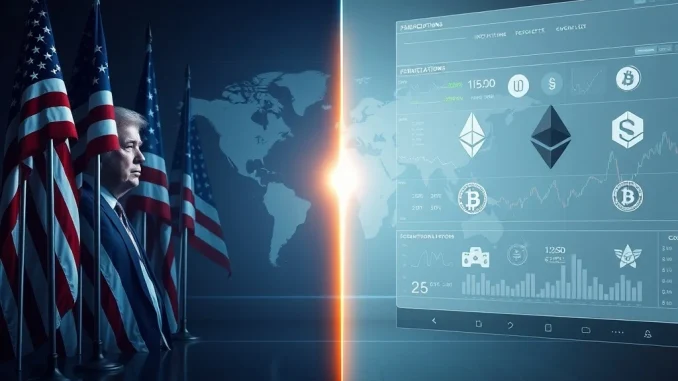
Yat Siu’s recent interview with CoinDesk marks a significant turning point in market narrative analysis. He asserts that the period where former U.S. President Donald Trump was perceived as a potential savior for the crypto industry has conclusively ended. This sentiment, which peaked in late 2023 and 2024, fueled substantial market optimism. However, it failed to materialize into concrete, actionable policy frameworks that could sustainably support growth. Consequently, investors and institutions are now executing a strategic pivot. They are refocusing their capital and analysis on core technological fundamentals, real-world application, and verifiable economic models. This represents a maturation phase for the asset class, moving away from reactive political speculation.
The transition carries substantial implications for portfolio construction and risk assessment. Market participants increasingly demand proof of utility and sustainable tokenomics. This environment favors projects with clear revenue models and active user bases. Conversely, it creates significant challenges for tokens lacking tangible use cases beyond speculative trading. The following table contrasts the characteristics of the previous ‘sentiment-driven’ market with the emerging ‘fundamentals-driven’ market:
| Sentiment-Driven Market (2023-2024) | Fundamentals-Driven Market (2025+) |
|---|---|
| Price action tied to political statements and election cycles | Price action correlated with user growth, revenue, and protocol activity |
| Investment theses based on regulatory speculation | Investment theses based on technological differentiation and market fit |
| High volatility from news-driven retail flows | Moderated volatility from institutional dollar-cost averaging |
| Dominance of meme coins and narrative plays | Dominance of infrastructure, DeFi, and gamified finance platforms |
Institutional Capital Influx Reshapes Market Character
Siu emphasizes that the accelerating influx of institutional capital is the primary catalyst for this structural change. This capital operates under different mandates and risk parameters compared to retail investment. Institutional players, including:
• Asset Managers: Firms like BlackRock and Fidelity with Bitcoin and Ethereum ETFs.
• Hedge Funds: Systematic and quantitative funds deploying sophisticated strategies.
• Corporate Treasuries: Companies allocating balance sheets to digital assets.
• Pension Funds: Large, long-term capital seeking uncorrelated returns.
This demographic prioritizes regulatory clarity, custody solutions, and deep liquidity. Their participation is steadily altering market dynamics by increasing overall stability and reducing the impact of short-term, sentiment-driven volatility. The maturation of financial infrastructure, such as regulated exchanges and institutional-grade custody, directly enables this shift.
The Bifurcated Future: Bitcoin as Digital Gold vs. Altcoin Utility
A key insight from Siu’s analysis is the emerging bifurcation within the crypto asset universe. Bitcoin is increasingly solidifying its role as a digital reserve asset, often compared to digital gold. Its value proposition centers on scarcity, security, and decentralization, making it a preferred macro hedge for institutions. Meanwhile, alternative cryptocurrencies (altcoins) face a heightened utility imperative. They must demonstrate tangible value creation beyond mere store-of-value narratives. Success for altcoins now hinges on metrics like:
• Active developer communities and GitHub commit history.
• Transaction volume and fee revenue generated on their networks.
• Real-world integration in sectors like supply chain, digital identity, or content creation.
• Sustainable tokenomics that align incentives between users, developers, and investors.
Convergence of Cryptocurrency and AI Defines Next-Gen Finance
Looking forward, Siu identifies the convergence of cryptocurrency and artificial intelligence as the frontier that will reshape the financial landscape. This synergy manifests in several critical areas. AI agents will likely require autonomous economic identities and the ability to transact, potentially using crypto wallets and smart contracts. Furthermore, decentralized AI training and data marketplaces, powered by crypto-economic incentives, could emerge to challenge centralized models. AI can also optimize DeFi protocols for risk management, yield generation, and fraud detection, creating more efficient and secure systems.
Perhaps most transformative is Siu’s vision of gamified finance or ‘GameFi’ for future generations. This concept merges blockchain-based ownership, play-to-earn mechanics, and immersive digital experiences. It represents a fundamental shift in how younger demographics interact with financial systems, viewing them not as separate tools but as integrated components of digital life and entertainment. This trend is already evident in the growth of:
• Major gaming studios integrating NFTs for in-game asset ownership.
• Virtual worlds with fully functional economies built on blockchain.
• Platforms that reward user engagement and content creation with tradable tokens.
Conclusion
The declaration that the crypto market’s ‘Trump moment’ is over signifies a watershed event for the industry. The market’s structural transition toward fundamentals, driven by institutional capital, creates a more mature and sustainable foundation for growth. While Bitcoin cements its status as a digital reserve asset, the pressure is on altcoins to prove indispensable utility. Ultimately, the converging paths of cryptocurrency, AI, and gamified experiences are poised to define the next generation of global finance, moving the ecosystem beyond political cycles and into an era of tangible, technology-driven value creation.
FAQs
Q1: What did Yat Siu mean by the ‘Trump moment’ in crypto?
Yat Siu used the term to describe a period in 2023-2024 where market sentiment and prices were heavily influenced by the perception that former U.S. President Donald Trump and his potential policies would be overwhelmingly positive for cryptocurrency adoption and regulation. This sentiment-driven rally has now subsided as investors refocus on technological fundamentals.
Q2: How is institutional capital changing the cryptocurrency market?
Institutional capital introduces larger, more stable investment flows, a demand for robust regulatory and custody infrastructure, and a focus on long-term, fundamentals-based investing. This reduces extreme volatility caused by retail sentiment and pushes projects to demonstrate real utility and sustainable business models.
Q3: What is the ‘utility imperative’ for altcoins?
The utility imperative refers to the growing necessity for alternative cryptocurrencies to prove they have a specific, valuable use case beyond speculation. This could be facilitating decentralized finance (DeFi), powering a gaming ecosystem, verifying supply chain data, or providing scalable computation. Tokens without clear utility face increasing challenges in a fundamentals-driven market.
Q4: What is gamified finance (GameFi)?
Gamified finance, or GameFi, refers to the integration of blockchain-based economic systems into video games and virtual worlds. It allows players to truly own digital assets (as NFTs), earn cryptocurrency through gameplay, and participate in decentralized governance. Yat Siu believes this will be a primary form of finance for future generations.
Q5: Why is the convergence of AI and cryptocurrency significant?
The convergence is significant because AI systems may require decentralized economic networks to operate autonomously, transact, and access resources. Conversely, crypto networks can use AI for optimization, security, and creating more intelligent smart contracts. This synergy could lead to new paradigms in both artificial intelligence and decentralized economic organization.