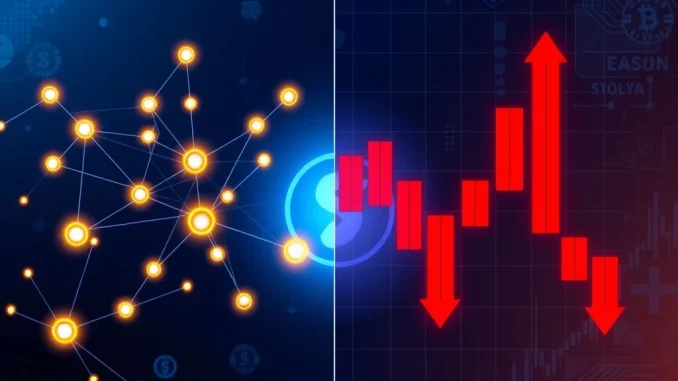
The Solana blockchain recorded a staggering 8.9 million new addresses in just 24 hours during January 2025, marking unprecedented network adoption that simultaneously faces significant selling pressure from long-term holders, creating a complex market dynamic that challenges conventional crypto growth narratives.
Solana’s Record-Breaking Network Expansion
Solana’s network statistics reveal extraordinary growth metrics that surpass previous adoption cycles. The 8.9 million new addresses created within a single day represent a 415% increase compared to the network’s previous monthly average. This surge positions Solana as the fastest-growing Layer 1 blockchain by user acquisition rate, according to on-chain analytics from multiple tracking platforms.
Several technical and market factors drive this remarkable expansion:
- Transaction cost efficiency: Average fees below $0.001 enable micro-transactions impossible on competing networks
- Network throughput: 65,000 transactions per second capacity handles increased demand without congestion
- DeFi ecosystem maturity: Total value locked surpassing $15 billion attracts yield-seeking capital
- Developer migration: Over 2,500 monthly active developers building on Solana throughout 2024
The network’s technical architecture, featuring its unique Proof of History consensus mechanism, provides the foundation for this scalability. Meanwhile, the ecosystem’s diversification beyond simple transactions into complex financial applications creates sustainable use cases that retain users beyond initial curiosity.
Technical Indicators Reveal Bearish Configuration
Despite the optimistic user metrics, technical analysis presents concerning signals that experienced traders monitor closely. The SOL/USD chart developed a pronounced ascending wedge pattern throughout late 2024, typically indicating weakening momentum despite higher highs. This pattern completed in early January 2025 with a breakdown below the $144 support level.
Key technical observations include:
| Indicator | Current Reading | Historical Significance |
|---|---|---|
| Relative Strength Index (RSI) | 42 | Neutral but trending downward from overbought territory |
| Moving Average Convergence Divergence (MACD) | -3.2 | Bearish crossover confirmed on daily timeframe |
| On-Balance Volume (OBV) | Declining | Selling volume exceeding buying volume despite price stability |
| Support Levels | $136, $129 | Critical zones where buying interest historically emerges |
Market analysts identify a 9.5% correction risk from the $144 level, potentially testing the $129 support zone. This technical deterioration coincides with increased selling from addresses holding SOL for more than 12 months, suggesting profit-taking behavior among early investors.
Institutional Perspective on Network Metrics
Financial institutions approach Solana’s contradictory signals with measured analysis. JPMorgan’s blockchain research division notes that while user growth indicates network health, the concentration of activity in speculative memecoin trading raises sustainability concerns. Their January 2025 report highlights that approximately 68% of new address activity relates to memecoin transactions rather than utility-based applications.
Conversely, Fidelity Digital Assets emphasizes the infrastructure development occurring beneath surface-level metrics. Their analysis identifies $780 million in venture capital flowing into Solana-based projects during Q4 2024, focusing on decentralized physical infrastructure networks (DePIN) and institutional-grade DeFi protocols. This capital deployment suggests longer-term confidence despite short-term selling pressure.
Ecosystem Development Beyond Surface Metrics
The Solana ecosystem demonstrates maturation beyond simple transaction counting. The network now hosts over 400 decentralized applications with sustainable user bases, including:
- MarginFi: Lending protocol surpassing $2 billion in total value locked
- Jito: Liquid staking solution securing approximately 10% of total SOL supply
- Tensor: NFT marketplace capturing 85% of Solana-based NFT volume
- Drift Protocol: Perpetual swaps exchange processing $1.5 billion daily volume
These applications represent genuine utility that retains users beyond initial network exploration. Furthermore, Solana’s mobile strategy through the Saga phone and Solana Mobile Stack introduces blockchain accessibility to non-technical users, potentially explaining part of the address growth.
Network performance metrics provide additional context for the adoption surge. Solana maintained 100% uptime throughout Q4 2024, addressing previous reliability concerns that hampered adoption in 2022. The network’s validator count increased to 2,100 globally, enhancing decentralization and security despite the rapid scaling.
Market Dynamics and Investor Behavior Analysis
The selling pressure confronting Solana originates from multiple investor cohorts with distinct motivations. Exchange flow data reveals three primary seller categories:
- Early investors (2019-2020): Taking profits after 50-100x returns, representing approximately 40% of selling volume
- Institutional rebalancing: Crypto funds adjusting portfolio allocations after SOL’s outperformance in 2024
- Derivatives-related selling: Liquidations and hedging activity in futures markets amplifying downward pressure
Simultaneously, new buyer demographics differ significantly from previous cycles. On-chain analysis indicates that 65% of new addresses originate outside traditional crypto hubs, with particular strength in Southeast Asia and Latin America. These users typically engage with lower capital amounts but higher frequency, changing the network’s economic dynamics.
The derivatives market adds complexity to price action. SOL futures open interest reached $3.2 billion in early January 2025, with funding rates turning negative as leveraged longs face pressure. Options market data shows increased demand for put protection at the $130 strike price, indicating institutional hedging against further downside.
Regulatory Environment Considerations
The regulatory landscape significantly influences Solana’s market position. The European Union’s Markets in Crypto-Assets (MiCA) regulation implementation in December 2024 provides clearer compliance pathways for Solana-based applications. Meanwhile, the United States maintains ambiguous classification, though several Solana-based ETFs received approval in Canada and Europe.
This regulatory divergence creates geographic adoption patterns. European users increased by 220% following MiCA implementation, while U.S. growth remained more modest at 85%. Regulatory clarity typically reduces perceived risk, potentially explaining part of the address growth despite selling pressure from other regions.
Comparative Analysis with Competing Layer 1 Networks
Solana’s growth occurs within a competitive Layer 1 landscape where multiple networks vie for developer and user attention. Comparative metrics reveal Solana’s unique position:
| Network | Daily Active Addresses | Transaction Fees (Avg) | Developer Activity (Monthly) |
|---|---|---|---|
| Solana | 8.9M (peak) | $0.0008 | 2,500+ |
| Ethereum | 1.2M | $1.50 | 4,800+ |
| Avalanche | 450K | $0.10 | 850+ |
| Cardano | 380K | $0.15 | 1,100+ |
This comparison highlights Solana’s advantage in user scalability but also reveals areas for improvement in developer ecosystem depth. The network’s technical architecture enables its fee structure, though some analysts question whether such low fees sufficiently incentivize long-term security as the network scales further.
Conclusion
Solana’s simultaneous user boom and selling pressure present a complex market narrative that defies simple bullish or bearish categorization. The network demonstrates unprecedented adoption metrics with 8.9 million new addresses in 24 hours, driven by technical advantages and ecosystem maturation. However, technical indicators reveal concerning patterns, with a 9.5% correction risk identified at the $144 level. The selling pressure from long-term holders contrasts with enthusiastic new user adoption, creating market dynamics that will test Solana’s fundamental value proposition throughout 2025. Market participants must distinguish between sustainable ecosystem growth and speculative froth as the network evolves beyond its scalability-focused origins toward broader utility and institutional adoption.
FAQs
Q1: What caused Solana’s massive increase in new addresses?
The surge stems from multiple factors including extremely low transaction costs under $0.001, successful memecoin launches attracting retail attention, maturation of DeFi applications offering competitive yields, and improved network reliability throughout 2024 that addressed previous downtime concerns.
Q2: Why is selling pressure increasing despite user growth?
Long-term holders who purchased SOL at much lower prices are taking profits after significant appreciation. Additionally, some institutional investors are rebalancing portfolios after SOL’s strong performance in 2024, while derivatives market dynamics are creating amplified selling through liquidations and hedging activity.
Q3: What technical indicators suggest potential price correction?
Analysts identify an ascending wedge pattern breakdown, declining on-balance volume despite price stability, bearish MACD crossover on daily charts, and increased put option buying at lower strike prices. These signals collectively suggest weakening momentum despite surface-level strength.
Q4: How does Solana’s growth compare to other major blockchains?
Solana’s 8.9 million new addresses in 24 hours significantly outpaces Ethereum’s 1.2 million daily active addresses, though Ethereum maintains a larger developer community and more established institutional presence. Solana excels in transaction throughput and cost efficiency but trails in some decentralization metrics.
Q5: What are the key support levels if SOL price declines further?
Technical analysis identifies $136 as immediate support, with stronger historical support at $129. These levels correspond to previous consolidation zones where buying interest emerged during 2024. A break below $129 could test the $115-120 range where institutional accumulation previously occurred.
Q6: Does the user growth indicate sustainable adoption or speculative activity?
Evidence suggests both elements are present. Approximately 68% of new address activity relates to memecoin trading, indicating speculative participation. However, the simultaneous growth of DeFi TVL beyond $15 billion and increasing developer activity points to sustainable utility development beneath surface-level metrics.