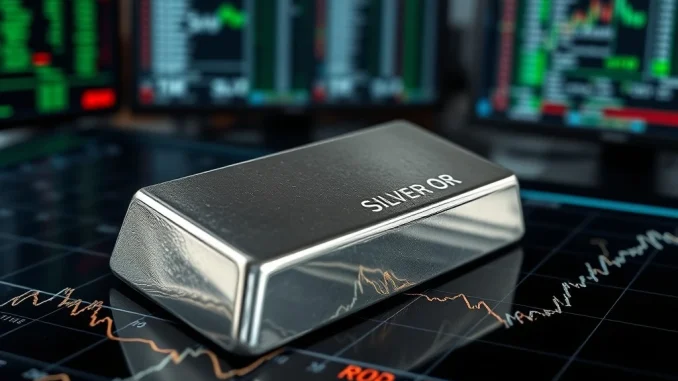
Global financial markets witnessed a historic shift over the past year, as the silver market cap exploded by a staggering $3.9 trillion, decisively outperforming traditional stocks, volatile cryptocurrencies, and even its peer gold. According to data from CryptoBriefing, this monumental rally has propelled silver’s total valuation past the $5 trillion mark, cementing its position as the world’s second-largest physical asset. Consequently, this surge redefines the landscape for investors and central banks alike, prompting a urgent reassessment of portfolio strategies worldwide.
Silver Market Cap Achieves Historic Milestone
The performance of silver over the last twelve months represents a financial phenomenon. Specifically, its market capitalization growth of $3.9 trillion translates to an unprecedented rate of expansion for a major commodity. For context, this increase alone is larger than the entire annual economic output of major nations like Germany. Meanwhile, the spot price of silver soared to an all-time high near $93 per ounce before stabilizing around $89. This price action directly fueled the massive expansion in total market value. Furthermore, the rally occurred amid significant macroeconomic crosscurrents, including shifting interest rate expectations and geopolitical tensions, which traditionally influence precious metals.
The Data Behind the Dominance
A comparative analysis reveals the sheer scale of silver’s outperformance. The following table illustrates the 12-month returns across major asset classes:
| Asset Class | Approximate 12-Month Return | Key Driver |
|---|---|---|
| Silver | ~300%+ (Market Cap Basis) | Industrial demand, monetary hedge, supply constraints |
| Gold | ~70% | Safe-haven demand, central bank buying |
| Nasdaq Composite | ~21% | Technology earnings growth |
| S&P 500 | ~17% | Broad corporate profitability |
| Bitcoin (BTC) | ~ -4% | Regulatory scrutiny and risk asset rotation |
This data underscores a dramatic capital rotation. Investors clearly sought assets with both tangible utility and perceived safety. Silver’s unique dual role as an industrial metal and a monetary store of value positioned it perfectly for this environment. Additionally, supply chain reports from mining analysts indicated constraints in primary silver production, exacerbating the supply-demand imbalance.
Decoding the Drivers of the Precious Metals Rally
Several interconnected factors converged to create the ideal conditions for this rally. Primarily, sustained industrial demand formed a solid price floor. Silver is a critical component in photovoltaic panels for solar energy, electronics, and automotive applications. The global green energy transition, particularly, accelerated consumption. Simultaneously, monetary demand surged as investors globally hedged against currency debasement and persistent inflation. Central banks, notably across Asia and the Global South, continued their multi-year trend of diversifying reserves away from the US dollar, adding both gold and silver to their holdings.
Market structure also played a crucial role. The silver market is notably smaller and less liquid than the gold market. Therefore, large inflows of capital can create more pronounced price movements. The rise of accessible precious metals ETFs and digital trading platforms further democratized access, allowing retail and institutional investors to gain exposure more easily than ever before. This increased participation amplified trading volumes and price discovery.
Expert Analysis on Sustainability
Financial historians and commodity strategists point to historical precedents. Dr. Anya Petrova, a senior commodities analyst at Global Macro Advisors, notes, “While the velocity of this move is exceptional, silver has historically experienced sharp catch-up rallies relative to gold. The gold-to-silver ratio, which had been historically high, compressed rapidly. This was a mean-reversion event supercharged by contemporary macro drivers.” Her research indicates that sustained high prices will likely incentivize increased recycling flows and secondary supply, which could moderate future volatility. However, primary mine supply faces long lead times, limiting a rapid production response.
Global Impact and Future Trajectory
The repercussions of a $5+ trillion silver market are far-reaching. For national economies, countries with significant silver mining operations, such as Mexico, Peru, and China, are experiencing substantial trade balance improvements and currency inflows. For industries, manufacturers of electronics and solar panels are facing higher input costs, potentially accelerating research into alternative materials or efficiency gains. For investors, the asset allocation model of the 60/40 portfolio (stocks/bonds) is being challenged by the re-emergence of commodities as a core, non-correlated holding.
Looking forward, market participants are monitoring several key indicators:
- Central Bank Policy: The pace of interest rate adjustments by the Federal Reserve and ECB.
- Industrial Data: Monthly reports on solar panel installations and electronics manufacturing.
- Investment Flows: Weekly holdings data from major silver-backed ETFs like iShares Silver Trust (SLV).
- Currency Markets: Strength or weakness in the US Dollar Index (DXY).
Market technicians are observing the $89-$90 level as critical short-term support. A sustained break above the $93 high could target psychologically important levels near $100, while a breakdown could signal a deeper consolidation phase. Regardless, the events of the past year have permanently altered silver’s profile from a speculative industrial metal to a mainstream macro asset.
Conclusion
The silver market cap surge of $3.9 trillion stands as the defining asset performance story of the period. It highlights a powerful convergence of industrial necessity, monetary demand, and investment flows. Silver not only outperformed gold but also eclipsed returns from major equity indices and cryptocurrencies. This rally underscores the importance of tangible assets in a diversified portfolio, especially during periods of economic transition and uncertainty. As the global economy navigates the challenges of decarbonization and monetary policy normalization, silver’s unique fundamentals suggest it will remain a critical barometer for financial market health and investor sentiment.
FAQs
Q1: What exactly does “market cap” mean for a commodity like silver?
A1: For a commodity, market capitalization (or market value) is an estimate of the total dollar value of all above-ground, investable supply. It is calculated by multiplying the current spot price by the estimated total ounces available for investment. It provides a snapshot of the asset’s total size in the global financial system.
Q2: Why did silver outperform gold during this period?
A2: Silver outperformed due to its higher sensitivity to economic growth (industrial demand) alongside its monetary properties. The green energy boom drove significant industrial consumption, while its lower price point made it more accessible to a broader base of investors compared to gold, amplifying capital inflows.
Q3: How does the performance of Bitcoin affect silver?
A3: While both are sometimes discussed as alternative assets, they often attract different investor profiles. The negative return for Bitcoin over this period suggests a potential rotation of capital from digital, high-risk assets into tangible, hard assets like precious metals during times of market stress or regulatory uncertainty.
Q4: Is the current silver price sustainable?
A4: Sustainability depends on the persistence of its demand drivers. Strong ongoing industrial demand, particularly from the solar sector, provides a structural support. However, prices at these elevated levels may eventually stimulate increased supply from recycling and, with a lag, new mining projects, which could balance the market.
Q5: What is the simplest way for an individual investor to gain exposure to silver?
A5: Common methods include purchasing physical bullion (bars or coins), buying shares of a silver-backed Exchange-Traded Fund (ETF) like SLV, or investing in stocks of silver mining companies. Each method carries different considerations regarding storage costs, liquidity, and exposure to company-specific risks.