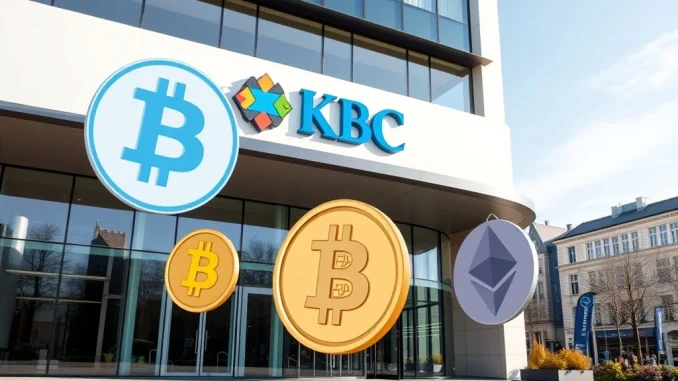
In a landmark development for European finance, Belgian banking giant KBC has confirmed plans to launch Bitcoin (BTC) and Ethereum (ETH) trading services for its customers starting February 16, 2025. This strategic move, first reported by Cointelegraph, represents a significant institutional embrace of digital assets within the European Union’s regulated framework. Consequently, KBC has formally submitted its registration as a Crypto Asset Service Provider (CASP) to Belgian financial authorities, ensuring full compliance with the EU’s pioneering Markets in Crypto-Assets (MiCA) regulation. This step signals a profound shift in how traditional banks perceive and integrate cryptocurrency services.
KBC Bank’s Strategic Entry into Cryptocurrency Trading
KBC Group, a major European bank-insurer with deep roots in Belgium and Central Europe, is preparing to offer direct trading in Bitcoin and Ethereum. The service launch date is set for February 16. This initiative follows a clear trend of traditional financial institutions expanding into digital assets. However, KBC’s approach is notably deliberate and compliance-first. The bank has proactively submitted its CASP registration to the Financial Services and Markets Authority (FSMA) in Belgium. This registration is a mandatory requirement under MiCA for any entity providing crypto services in the EU. Therefore, KBC is positioning itself not as a speculative newcomer, but as a fully regulated and trusted gateway for its extensive customer base.
The decision to start with only Bitcoin and Ethereum is highly strategic. These two assets collectively represent over 60% of the total cryptocurrency market capitalization. They are widely regarded as the most established and institutionally recognized digital assets. By focusing on them initially, KBC mitigates risk while meeting clear client demand. The bank will likely integrate these trading functions directly into its existing online and mobile banking platforms. This integration promises a seamless user experience, allowing customers to manage traditional and digital investments within a single, familiar interface. Such convenience could dramatically lower the barrier to entry for retail investors previously hesitant to use external crypto exchanges.
The Regulatory Backbone: MiCA Compliance
KBC’s move is inextricably linked to the implementation of the Markets in Crypto-Assets (MiCA) regulation. MiCA, which became fully applicable in late 2024, establishes a comprehensive regulatory framework for crypto-assets across the European Union. Its primary goals are to protect investors, ensure market integrity, and promote financial stability. For a bank like KBC, MiCA provides the legal clarity and operational guidelines necessary to enter the crypto space with confidence. The regulation mandates strict requirements for CASPs, including:
- Capital Requirements: Firms must hold sufficient capital to operate safely.
- Custody Rules: Strict standards for safeguarding clients’ crypto assets.
- Consumer Protection: Clear disclosure of risks, costs, and charges.
- Market Abuse Prevention: Measures to combat insider trading and market manipulation.
By aligning its launch with MiCA’s framework, KBC immediately differentiates itself from unregulated or offshore exchanges. The bank can leverage its existing reputation for security and trust. For the customer, this means their crypto holdings will benefit from the same rigorous standards applied to their traditional savings and investments. This regulatory alignment is a key factor driving institutional adoption across Europe, as it transforms crypto from a niche, high-risk venture into a supervised financial service.
Impact on the Belgian and European Financial Landscape
KBC’s announcement has substantial implications for both the Belgian market and the broader European financial sector. As one of Belgium’s largest banks, its endorsement of crypto trading lends unprecedented legitimacy to the asset class within the country. It effectively signals to other conservative European banks that offering crypto services is now a viable, regulated business line. This could trigger a domino effect, accelerating adoption across the continent. Furthermore, Belgium’s position as a key EU administrative hub makes this development symbolically important for policymakers observing MiCA’s real-world application.
The entry of major banks into crypto trading also intensifies competition for dedicated cryptocurrency exchanges. While exchanges offer a wider variety of altcoins, traditional banks boast superior brand trust, integrated financial ecosystems, and direct access to millions of existing customers. The competitive landscape is likely to evolve into a bifurcated model: banks offering safe, simple access to major assets like BTC and ETH, while specialized exchanges continue to cater to advanced traders seeking a broader range of products. Ultimately, this competition should benefit consumers through improved services, enhanced security, and potentially lower fees.
| Feature | KBC Bank (Projected) | Typical Crypto Exchange |
|---|---|---|
| Asset Variety | Limited (BTC, ETH initially) | Extensive (100s of tokens) |
| Regulatory Framework | Full MiCA Compliance | Varies (Some fully regulated, others not) |
| Customer Base | Existing retail banking clients | Tech-savvy, crypto-native users |
| Integration | Seamless with bank accounts | Separate platform, requires transfers |
| Perceived Security | Very High (Bank-grade) | Variable |
Expert Analysis on Institutional Adoption Trends
Financial analysts view KBC’s move as part of a broader, irreversible trend. “The launch of regulated crypto services by a systemic bank like KBC is a tipping point,” notes a senior fintech analyst at a European consultancy. “It moves digital assets from the periphery to the core of financial services. The key driver isn’t speculative hype, but a strategic response to client demand and a new, clear regulatory environment.” Experts emphasize that MiCA has provided the essential “rulebook” that large, risk-averse institutions required. The regulation addresses longstanding concerns about consumer protection, anti-money laundering (AML), and operational resilience.
Looking ahead, the success of KBC’s service will be closely monitored. Key performance indicators will include user adoption rates, trading volumes, and the demographic profile of users. Success could encourage KBC and other banks to expand their offerings to include services like crypto staking, custody for institutional clients, or even tokenized traditional assets. The timeline for this expansion will depend on regulatory developments and market maturity. Nevertheless, February 16, 2025, marks a definitive date on the calendar of crypto’s integration into mainstream European finance.
Conclusion
KBC Bank’s decision to offer BTC and ETH trading services starting February 16 represents a pivotal moment in the maturation of the cryptocurrency market. By operating under the EU’s MiCA framework as a registered Crypto Asset Service Provider, KBC bridges the gap between innovative digital assets and the trusted, regulated world of traditional banking. This move provides a safe, familiar on-ramp for millions of customers and validates crypto as a legitimate asset class for conservative financial institutions. As MiCA continues to shape the European landscape, KBC’s foray will likely inspire similar actions from other major banks, fundamentally altering how people access and perceive Bitcoin, Ethereum, and the future of digital finance.
FAQs
Q1: When exactly will KBC start its Bitcoin and Ethereum trading service?
A1: KBC plans to launch the service for its customers on February 16, 2025, as reported.
Q2: What is MiCA, and why is it important for KBC’s new service?
A2: MiCA is the EU’s Markets in Crypto-Assets regulation. It provides a comprehensive legal framework for crypto services. KBC’s registration as a CASP under MiCA ensures its service is fully compliant, offering customers strong consumer protections and operational security.
Q3: Can any KBC customer use this service, or are there restrictions?
A3: While official eligibility criteria will be confirmed by KBC, the service will likely be available to retail customers in Belgium who meet standard banking and know-your-customer (KYC) requirements. It may not be immediately available in all countries where KBC operates due to local regulations.
Q4: Will KBC offer other cryptocurrencies besides Bitcoin and Ethereum?
A4: The initial launch will focus solely on BTC and ETH. The bank may consider adding more digital assets in the future, depending on client demand, regulatory developments, and market conditions.
Q5: How does buying crypto through KBC differ from using a regular exchange?
A5: Buying through KBC will likely be integrated into your existing online banking, offering convenience and a trusted interface. It will be fully regulated under MiCA. In contrast, dedicated crypto exchanges often offer a wider selection of coins but may operate under different or less stringent regulatory regimes.