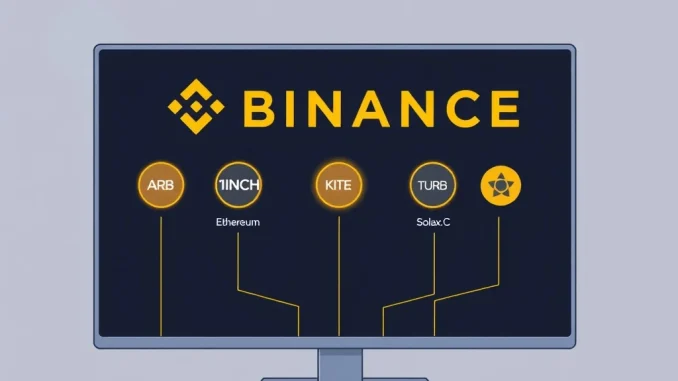
In a significant operational update impacting thousands of users, global cryptocurrency exchange Binance has announced a critical suspension of deposit and withdrawal services for five prominent digital assets. The sweeping change, set for 8:00 a.m. UTC on January 22, 2025, will temporarily halt transactions for ARB, 1INCH, KITE, 0G, and TURBO across specific blockchain networks, prompting immediate user action and market analysis. This move underscores the ongoing technical and compliance challenges within the rapidly evolving digital asset infrastructure.
Binance Suspends Tokens: A Detailed Breakdown of Affected Networks
Binance’s announcement provides a precise, network-specific roadmap for the upcoming service pause. The exchange, a cornerstone of the global crypto trading ecosystem, will implement suspensions on a per-token, per-network basis rather than a blanket halt. Consequently, users must verify the specific blockchain associated with their holdings. For instance, the suspension targets ARB and 0G solely on the Ethereum network, meaning transactions for these tokens on other supported chains like Arbitrum One may continue unaffected for now.
Similarly, the 1INCH token will face deposit and withdrawal pauses exclusively on the BNB Smart Chain (BEP-20). Meanwhile, KITE transactions on the AVAX-C Chain and TURBO transactions on the Solana network will also be suspended. This granular approach is common during network upgrades, wallet maintenance, or security reviews. However, it requires users to exercise diligence. Trading of these token pairs on Binance’s spot markets will remain operational throughout the suspension period, allowing for price discovery and portfolio rebalancing.
Understanding the Context Behind Exchange Network Maintenance
Periodic network suspensions are a standard, if disruptive, aspect of cryptocurrency exchange operations. These pauses typically occur for several verifiable reasons rooted in technical necessity and user protection. Primarily, exchanges like Binance initiate such halts to facilitate scheduled network upgrades or hard forks on the underlying blockchain. Pausing deposits and withdrawals prevents transaction failures or fund loss during these unstable periods.
Furthermore, suspensions allow for critical wallet maintenance and security enhancements. Exchanges routinely audit and upgrade their cold and hot wallet infrastructure to mitigate hacking risks. Another common catalyst is the resolution of persistent network congestion or instability. If a specific blockchain experiences prolonged slow transaction times or high failure rates, an exchange may temporarily disable support to protect users from lost transactions and excessive fees. While Binance’s announcement did not specify the exact reason, historical precedent points to one of these standard operational procedures.
Expert Analysis on Market Impact and User Strategy
Market analysts note that while such suspensions can cause short-term price volatility due to reduced liquidity flows, the long-term impact is often negligible for established tokens. “These are procedural pauses, not delistings,” explains a veteran blockchain infrastructure analyst. “The key for users is to distinguish between a temporary technical halt and a fundamental loss of exchange support. For ARB and 1INCH, which are large-cap ecosystem tokens, this is almost certainly a routine network update.”
Data from past Binance suspensions shows a typical pattern. Users should monitor the official Binance Announcement channel for the specific resumption notice, which will be posted once all technical checks are complete. Proactively, users holding these tokens on affected networks should consider completing any urgent transfers before the January 22 deadline. Alternatively, they might explore transferring assets via a different, still-supported network if the token is multi-chain, though this incurs bridge fees and complexity.
Comparative Overview of Affected Tokens and Networks
The following table clarifies the scope of the suspension, helping users quickly identify if their assets are impacted.
| Token | Affected Network | Primary Use Case |
|---|---|---|
| ARB (Arbitrum) | Ethereum (ERC-20) | Governance for Arbitrum layer-2 scaling solution |
| 1INCH | BNB Smart Chain (BEP-20) | Utility token for the 1inch Network DEX aggregator |
| KITE | AVAX-C Chain | Token associated with specific DeFi protocols on Avalanche |
| 0G (ZeroGravity) | Ethereum (ERC-20) | Labelled as an AI-focused blockchain infrastructure project |
| TURBO | Solana | Meme token created and traded on the Solana blockchain |
This suspension highlights the multi-chain reality of modern crypto assets. A single token like 1INCH exists on Ethereum, BNB Chain, and Polygon. Therefore, the action is highly targeted. Users holding 1INCH on Ethereum can still deposit and withdraw, while only BNB Chain holdings are paused. This distinction is crucial for effective portfolio management.
Actionable Steps for Users and Broader Ecosystem Implications
For users directly affected by this announcement, taking clear, immediate steps can prevent inconvenience. First, log into your Binance account and review your wallet balances for the listed tokens. Second, check the network for each holding. Third, if you need to move assets off-exchange before the deadline, initiate withdrawals well in advance of the 8:00 a.m. UTC cutoff on January 22. Finally, disable any automated trading or DeFi strategies that rely on depositing or withdrawing these specific token-network combinations.
Beyond individual action, this event reflects the broader, maturing infrastructure of cryptocurrency. Exchanges now manage support for hundreds of tokens across dozens of networks, a monumental technical challenge. These maintenance periods, while disruptive, are essential for ensuring long-term security and stability. They also demonstrate the increasing specialization of blockchain networks, with tokens like KITE and TURBO being native to specific ecosystems like Avalanche and Solana, respectively.
Conclusion
Binance’s decision to suspend deposits and withdrawals for ARB, 1INCH, KITE, 0G, and TURBO on select networks is a measured operational response to technical requirements. By providing clear advance notice, the exchange enables users to adapt and secure their assets. The targeted nature of the suspension—affecting specific token and network pairs—underscores the complex, interconnected reality of digital asset management. While temporarily limiting transaction options, such maintenance is a standard practice critical for safeguarding user funds and ensuring the robust, secure functioning of the platform. All users should verify their holdings against the announced networks and plan accordingly before the January 22 implementation.
FAQs
Q1: Can I still trade ARB and 1INCH on Binance during the suspension?
A1: Yes. The suspension applies only to deposits and withdrawals on the specified networks. Trading for these token pairs on Binance’s spot markets will continue as normal.
Q2: My ARB is on the Arbitrum network, not Ethereum. Is it affected?
A2: No. According to the announcement, the suspension for ARB is specifically for the Ethereum (ERC-20) network. ARB held on the Arbitrum One network should not be subject to this deposit/withdrawal pause.
Q3: What time exactly does the suspension start, and what timezone?
A3: The suspension is scheduled to begin at 08:00 a.m. UTC (Coordinated Universal Time) on Wednesday, January 22, 2025. Users should convert this to their local time.
Q4: How long will the suspension last?
A4: Binance has not provided an estimated end time. The service will resume once the required maintenance or upgrade is complete. Users must monitor the official Binance Announcements page for the resumption notice.
Q5: Will this suspension affect the price of these tokens?
A5: While temporary suspensions can sometimes cause minor volatility due to reduced liquidity movement, they are generally considered routine operational events. The long-term price is driven by broader market and project fundamentals, not short-term deposit halts.