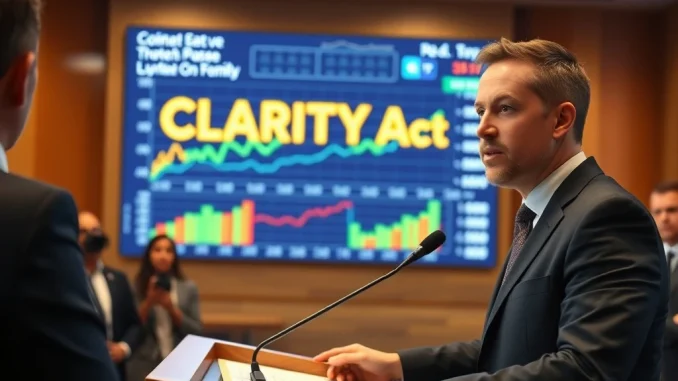
In a significant development for the digital asset industry, Coinbase CEO Brian Armstrong has announced his readiness to resume negotiations on the contentious crypto market structure bill, known as the CLARITY Act. This declaration, made during a CNBC interview on March 15, 2025, marks a potential turning point after Coinbase’s previous withdrawal of support. The move signals a renewed effort to find common ground on legislation that could define the United States’ regulatory approach to cryptocurrencies for years to come.
Coinbase CEO Crypto Bill Stance Evolves
Brian Armstrong’s statement represents a notable evolution in his company’s position. Previously, Coinbase had publicly opposed the proposed CLARITY Act, citing several fundamental concerns. The exchange had argued that specific provisions would create substantial barriers for the broader crypto ecosystem. Armstrong’s renewed willingness to engage suggests a strategic pivot, possibly influenced by shifting political landscapes or revised legislative drafts. This development occurs amidst increasing global competition for crypto innovation and a domestic regulatory environment that many industry leaders describe as fragmented.
Furthermore, the timing of this announcement is crucial. Regulatory bodies worldwide are actively crafting frameworks for digital assets. The European Union has already implemented its Markets in Crypto-Assets (MiCA) regulation. Consequently, the United States faces pressure to establish clear rules to maintain its financial leadership. Armstrong’s offer to return to the table injects new energy into stalled congressional discussions. It provides lawmakers with a key industry partner for crafting workable legislation.
Understanding the CLARITY Act’s Core Provisions
The Crypto-Asset Regulatory Framework and Investor Protection Act, or CLARITY Act, aims to create a comprehensive structure for overseeing digital assets. Its primary goal is to delineate regulatory authority between the Securities and Exchange Commission (SEC) and the Commodity Futures Trading Commission (CFTC). Historically, jurisdictional overlap has created uncertainty for businesses and investors alike. The bill proposes a test to determine whether a digital asset is a security or a commodity, a distinction with profound implications for compliance.
However, Coinbase’s initial objections centered on several specific elements. The company highlighted provisions that could, in its view, stifle innovation and overreach into user privacy. A detailed breakdown of the major contested points follows:
- Tokenized Securities: Provisions interpreted as a de facto ban on tokenized stocks and other real-world assets.
- DeFi Access: Rules that could potentially block or severely restrict decentralized finance (DeFi) protocols.
- Financial Surveillance: Requirements for unrestricted access to user financial information by regulators.
- Agency Hierarchy: A structure making the CFTC subordinate to the SEC, potentially weakening commodities oversight.
- Stablecoin Functions: Clauses that might block reward or yield-generating mechanisms for stablecoins.
Expert Analysis on the Regulatory Impasse
Financial regulation experts note that Armstrong’s shift may reflect a pragmatic assessment of the legislative process. “When a major market participant like Coinbase re-engages, it often indicates behind-the-scenes revisions or a more favorable political calculus,” observes Dr. Lena Torres, a fintech policy analyst at Georgetown University. Data from the Congressional Research Service shows that over 50 digital asset bills have been introduced in the current session, yet comprehensive market structure legislation remains elusive. This context makes any movement from a key stakeholder highly significant.
Moreover, the CFTC has consistently advocated for a larger role in overseeing spot markets for non-security digital commodities. The original CLARITY framework was seen by some as diluting that authority. Armstrong’s renewed talks could focus on rebalancing this power dynamic. The outcome will directly affect how thousands of crypto firms operate, influencing everything from product offerings to compliance costs. Market analysts predict that regulatory clarity, even if imperfect, could unlock significant institutional investment currently waiting on the sidelines.
The Path Forward for Digital Asset Legislation
The resumption of talks does not guarantee a swift resolution. The legislative process involves multiple committees, stakeholder groups, and potential amendments. Key senators and representatives will need to reconcile divergent views from industry advocates, traditional finance institutions, and consumer protection groups. A comparative table illustrates the core tensions in the debate:
| Stakeholder Group | Primary Regulatory Concern | Desired Outcome from CLARITY |
|---|---|---|
| Crypto Exchanges (e.g., Coinbase) | Jurisdictional clarity, innovation-friendly rules | Clear security/commodity test, defined CFTC role |
| Securities Regulators (SEC) | Investor protection, market integrity | Clear authority over security-like assets, disclosure rules |
| Derivatives Regulators (CFTC) | Market oversight for commodities | Expanded authority over spot crypto commodity markets |
| Consumer Advocates | Fraud prevention, transparency | Strong enforcement powers, robust disclosure mandates |
Armstrong’s commitment suggests that closed-door negotiations may have addressed some of Coinbase’s most severe concerns. Alternatively, the company may be adopting a strategy of seeking modifications from within the process rather than opposing it outright. This approach is common in complex financial regulation, where incremental change is often more achievable than wholesale rejection. The coming months will reveal whether this engagement leads to a revised bill that can garner broader support from both the crypto industry and policymakers.
Conclusion
Coinbase CEO Brian Armstrong’s decision to resume talks on the crypto market structure bill is a pivotal moment for digital asset regulation. It moves a critical industry voice from opposition back to the negotiation table, potentially breaking a long-standing legislative logjam. The success of these discussions will hinge on finding a balance between necessary consumer protections and fostering continued innovation in the crypto sector. As the 2025 legislative session progresses, all stakeholders will watch closely to see if this renewed dialogue can translate into the coherent, forward-looking regulatory framework that the United States crypto market urgently needs.
FAQs
Q1: What is the CLARITY Act?
The CLARITY Act is proposed U.S. legislation formally known as the Crypto-Asset Regulatory Framework and Investor Protection Act. It aims to establish a clear regulatory structure for digital assets by defining the roles of the SEC and CFTC.
Q2: Why did Coinbase initially oppose the bill?
Coinbase withdrew support due to concerns over provisions it believed could ban tokenized stocks, restrict DeFi, grant regulators excessive access to financial data, weaken the CFTC’s authority, and block stablecoin reward functions.
Q3: What does Brian Armstrong’s renewed engagement mean?
It signals a potential shift in strategy, indicating Coinbase may see an opportunity to shape the bill through negotiation rather than outright opposition, possibly due to changes in the political or legislative landscape.
Q4: How does this affect cryptocurrency investors?
Clear regulation can reduce market uncertainty, potentially leading to greater institutional investment and more robust consumer protections. However, the specific impact depends entirely on the final bill’s language.
Q5: What are the next steps for the crypto bill?
The bill must proceed through congressional committees, potentially be amended, and secure majority votes in both the House and Senate before reaching the President’s desk. Armstrong’s engagement is one step in a complex, multi-stakeholder process.