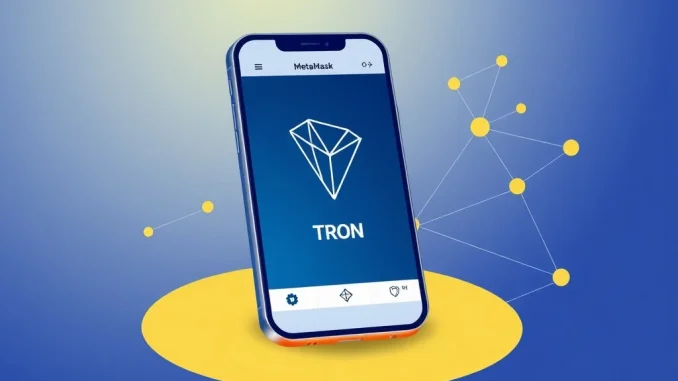
In a significant move for blockchain interoperability, MetaMask has officially integrated support for the Tron network into its widely used mobile application and browser extension. This pivotal development, first reported by The Block, fundamentally transforms how millions of users interact with the Tron ecosystem. Consequently, individuals can now manage Tron-based assets like TRX and interact with decentralized applications (dApps) on the Tron blockchain directly from their existing MetaMask interface. This integration fulfills a partnership announcement from August 2024 between MetaMask’s parent company, ConsenSys, and the Tron DAO, marking a major step in bridging distinct blockchain communities.
MetaMask Tron Support: Technical Implementation and User Impact
The technical integration involves adding the Tron network as a selectable option within MetaMask’s network menu. Users must manually add the Tron Mainnet by inputting the correct RPC (Remote Procedure Call) endpoint details, which MetaMask provides through its official channels. Once configured, the wallet displays TRX balances and supports transactions for TRC-20 tokens, which are the standard on the Tron network. This process mirrors how users add other networks like Polygon or Arbitrum. The update is available globally for both the browser extension and the mobile app, ensuring consistent access across devices.
For the average user, this integration eliminates the need for a separate Tron-specific wallet like TronLink. It consolidates asset management into a single, familiar interface known for its security and ease of use. Developers building on Tron also benefit significantly. They can now attract users who prefer MetaMask’s interface, potentially increasing adoption of their dApps. This move reflects a broader industry trend towards wallet interoperability and multi-chain accessibility, reducing friction in the Web3 user experience.
Background and Strategic Partnership Timeline
The path to this integration began with a formal partnership announcement between ConsenSys and the Tron DAO in August 2024. This collaboration signaled a strategic alignment between one of Ethereum’s core infrastructure providers and a major competing smart contract platform. The Tron network, founded by Justin Sun, has established itself as a high-throughput blockchain focused on the entertainment and content-sharing economy. Its native token, TRX, consistently ranks among the top cryptocurrencies by market capitalization. MetaMask’s decision to integrate Tron, therefore, is not merely technical but also a recognition of Tron’s substantial market presence and active user base.
| Feature | Detail |
|---|---|
| Integration Type | Network addition (Tron Mainnet) |
| Supported Assets | TRX (native token), TRC-20 tokens |
| Available Platforms | MetaMask Browser Extension, MetaMask Mobile App |
| Announcement Date | August 2024 (Partnership), March 2025 (Live Integration) |
| Primary Benefit | Unified wallet for Ethereum Virtual Machine (EVM) and non-EVM chain access |
Analyzing the Broader Crypto Wallet Landscape
MetaMask’s expansion into supporting Tron represents a notable shift in the competitive dynamics of non-custodial wallets. Traditionally, MetaMask has been synonymous with the Ethereum and EVM-compatible ecosystem. By integrating a prominent non-EVM chain like Tron, MetaMask directly challenges specialized wallets and positions itself as a more universal gateway. This strategy addresses user demand for simplicity, as managing multiple wallets for different chains creates security risks and operational complexity.
Other major wallet providers are pursuing similar strategies. For instance, Trust Wallet and Coinbase Wallet also support a wide array of blockchains. However, MetaMask’s dominant market share, especially among browser-based users, gives this integration particular weight. The move can be interpreted as a defensive measure to retain users who might otherwise migrate to a competitor for Tron access. It also serves as a potential user acquisition tool, drawing Tron’s existing community into the broader MetaMask and ConsenSys product suite.
- Enhanced User Convenience: A single wallet for Ethereum, Layer 2s, and now Tron.
- Security Consolidation: Reduces the attack surface compared to managing several wallets.
- Ecosystem Growth: Cross-pollination of users between Ethereum and Tron dApps.
Evidence of Market Demand and Future Implications
Data from blockchain analytics firms prior to the integration showed consistent overlap between Ethereum and Tron user addresses, indicating a clear demand for unified management tools. Furthermore, the volume of TRC-20 tokens, particularly stablecoins like USDT, has seen massive growth, creating practical need for seamless wallet support. This integration likely sets a precedent. The technical and business frameworks established for Tron could streamline future additions of other non-EVM chains, such as Solana or Cardano, though those would present different technical challenges.
From a regulatory perspective, offering support for more assets within a single, audited application like MetaMask may simplify compliance and user education efforts. However, it also increases the responsibility on MetaMask to provide clear network differentiation to prevent user errors, as sending assets to incompatible addresses remains a critical risk.
Conclusion
The addition of MetaMask Tron support is a landmark development in the evolution of Web3 infrastructure. It transcends a simple feature update, representing a strategic embrace of blockchain diversity by a leading Ethereum-native tool. This integration enhances user choice, reduces friction, and promotes greater connectivity across the decentralized web. As the industry continues to mature, such efforts at interoperability will be crucial for driving mainstream adoption. The successful rollout of Tron support within MetaMask sets a new standard for what users can expect from their primary gateway to blockchain applications.
FAQs
Q1: How do I add the Tron network to my MetaMask wallet?
You must add it manually. In your MetaMask wallet, navigate to the network selection dropdown, click “Add network,” and enter the official Tron Mainnet RPC details provided by MetaMask or the Tron DAO. Always verify these settings from official sources to avoid phishing scams.
Q2: Can I store and send all Tron-based tokens (TRC-10, TRC-20) in MetaMask now?
The integration primarily supports the TRC-20 token standard, which is the most common for dApps and stablecoins on Tron. The older TRC-10 standard may not be fully supported in the initial rollout. Always test with a small amount first.
Q3: Does this integration mean Tron is now compatible with the Ethereum Virtual Machine (EVM)?
No. Tron is not EVM-compatible. This integration is a separate network addition, meaning MetaMask now communicates directly with Tron nodes using Tron’s own protocol, not the EVM. The wallet interface has been adapted to handle this different underlying technology.
Q4: Is my MetaMask seed phrase/private key the same for my Ethereum and Tron addresses?
Yes. MetaMask uses the same cryptographic seed phrase to generate your addresses on all supported networks, including Tron. This is a core feature of non-custodial wallets, giving you a single recovery phrase for all your assets across different blockchains.
Q5: What are the main benefits of using MetaMask for Tron instead of a native wallet like TronLink?
The primary benefit is consolidation. If you actively use both Ethereum and Tron ecosystems, managing all assets in one interface improves convenience and security. You also benefit from MetaMask’s extensive audit history, large user community, and familiar design patterns.