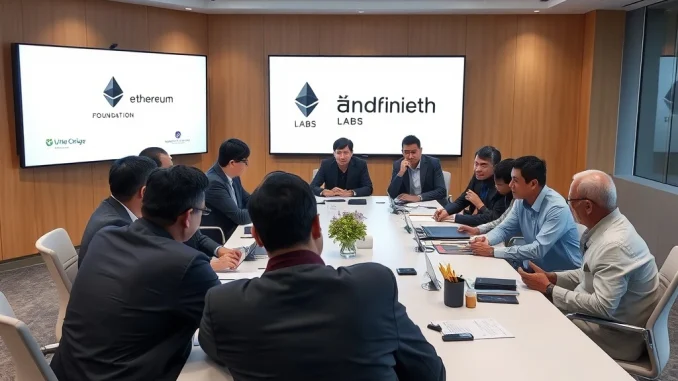
SEOUL, SOUTH KOREA — April 2025 marks a transformative moment for Asia’s fourth-largest economy as blockchain education firm Undefined Labs announces a strategic partnership with the Ethereum Foundation Enterprise Team, launching an ambitious initiative to educate South Korea’s entire financial sector about Ethereum technology and its institutional applications.
Ethereum Foundation’s Strategic Move into South Korean Finance
The Ethereum Foundation Enterprise Team has consistently focused on institutional adoption since its establishment. This partnership represents their most significant educational initiative in Asia’s financial sector to date. South Korea’s financial market, valued at approximately $2.5 trillion, presents substantial opportunities for blockchain integration. Consequently, the Foundation selected Undefined Labs as their regional partner due to their established reputation in blockchain research and education.
South Korean financial institutions have demonstrated increasing interest in blockchain technology throughout 2024. Major banks including Shinhan Bank and KB Kookmin Bank have already initiated blockchain research divisions. Moreover, securities firms like Samsung Securities and Mirae Asset Securities have explored tokenization projects. This educational initiative arrives at a critical juncture when institutions seek practical implementation guidance.
Undefined Labs’ Role in South Korea’s Blockchain Ecosystem
Undefined Labs has operated as South Korea’s premier blockchain education provider since 2021. The firm has trained over 5,000 professionals across various industries. Their curriculum development team includes former executives from major financial institutions and blockchain developers with enterprise experience. Additionally, they maintain partnerships with three major South Korean universities for blockchain certification programs.
The company’s previous educational initiatives have focused primarily on technical fundamentals. However, this new partnership represents their first comprehensive program targeting senior financial executives. Their approach combines theoretical knowledge with practical case studies from global financial institutions that have implemented Ethereum-based solutions.
Educational Program Structure and Timeline
The joint educational program will unfold in three distinct phases throughout 2025. The initial phase begins with seminars in mid-April for executives from major banks and securities firms. Subsequently, the second phase launches in June with technical workshops for development teams. Finally, the third phase commences in September with customized implementation consulting for participating institutions.
Each seminar session will address specific financial use cases including:
- Cross-border payments and settlements using Ethereum-based solutions
- Digital asset tokenization for traditional financial instruments
- Decentralized finance (DeFi) integration with existing banking infrastructure
- Regulatory compliance frameworks for blockchain implementation
- Smart contract security and auditing best practices
South Korea’s Financial Sector Transformation Timeline
| Year | Development | Significance |
|---|---|---|
| 2020 | South Korea passes specific digital asset legislation | Established legal framework for cryptocurrency |
| 2022 | Major banks launch blockchain research divisions | Institutional interest begins formalizing |
| 2023 | Financial Services Commission releases blockchain guidelines | Regulatory clarity improves for institutions |
| 2024 | First tokenized securities offerings approved | Practical blockchain applications emerge |
| 2025 | Ethereum Foundation partnership announced | Comprehensive education initiative begins |
Global Context and Comparative Analysis
South Korea’s approach to blockchain education differs significantly from other major economies. Singapore’s Monetary Authority has operated its own blockchain education programs since 2020. Meanwhile, Japan’s financial institutions have pursued more conservative, internally-developed training. The Ethereum Foundation’s direct involvement in South Korea represents their most substantial educational commitment to any national financial sector.
European financial institutions have generally focused on private blockchain implementations. Conversely, South Korean institutions show particular interest in public blockchain integration. This distinction makes Ethereum’s public blockchain architecture especially relevant for their educational needs. Furthermore, South Korea’s advanced digital infrastructure supports more rapid blockchain adoption than many other markets.
Expert Perspectives on the Partnership’s Significance
Financial technology analysts emphasize several critical aspects of this initiative. First, the timing aligns with South Korea’s broader digital transformation strategy. Second, the partnership addresses a significant knowledge gap between blockchain developers and financial executives. Third, the program’s phased approach allows for continuous feedback and curriculum adjustment.
Industry experts note that previous blockchain education efforts often suffered from technical complexity. However, this program specifically tailors content for financial professionals without technical backgrounds. The curriculum emphasizes practical implementation considerations rather than theoretical concepts. Additionally, case studies from global financial institutions provide real-world context for South Korean participants.
Technical Architecture Focus Areas
The educational sessions will concentrate on several key technical components. Ethereum’s consensus mechanism transition from proof-of-work to proof-of-stake receives particular attention. Additionally, layer-2 scaling solutions for financial transactions form a major curriculum component. Smart contract development standards and security protocols represent another critical focus area.
Enterprise Ethereum implementations require specific architectural considerations. The curriculum addresses permissioned blockchain configurations for financial institutions. Furthermore, interoperability with existing banking systems receives detailed examination. Regulatory compliance features within Ethereum-based solutions also form an essential discussion topic.
Potential Impact on South Korea’s Financial Landscape
This educational initiative could accelerate blockchain adoption across multiple financial sectors. Banking institutions might implement Ethereum-based solutions for international remittances. Securities firms could develop tokenized asset platforms using Ethereum standards. Insurance companies might explore smart contract applications for policy automation.
The program’s success metrics extend beyond simple participation numbers. Actual blockchain implementations within six months of training completion represent the primary success indicator. Additionally, the formation of inter-institutional blockchain working groups would demonstrate meaningful collaboration. Long-term talent development within South Korea’s financial sector remains another important objective.
Conclusion
The Ethereum Foundation’s partnership with Undefined Labs represents a strategic investment in South Korea’s financial future. This comprehensive educational initiative addresses critical knowledge gaps while providing practical implementation guidance. The phased approach ensures appropriate content delivery for different organizational roles. Ultimately, this program could position South Korea as a global leader in financial blockchain integration. The mid-April seminar launch marks just the beginning of this transformative educational journey for South Korea’s financial sector.
FAQs
Q1: What specific financial institutions will participate in the initial seminars?
A1: The initial mid-April seminars will include executives from major South Korean banks including Shinhan Bank, KB Kookmin Bank, and Hana Bank, along with representatives from leading securities firms like Samsung Securities and Mirae Asset Securities. The organizers have confirmed participation from at least fifteen major financial institutions.
Q2: How does this educational program differ from previous blockchain training in South Korea?
A2: Previous blockchain education in South Korea primarily focused on cryptocurrency trading or basic technical concepts. This program specifically addresses enterprise implementation within regulated financial institutions, featuring case studies from global financial organizations that have successfully deployed Ethereum-based solutions.
Q3: What qualifications do the Ethereum Foundation Enterprise Team educators possess?
A3: The Ethereum Foundation Enterprise Team educators include former financial sector executives with blockchain implementation experience, Ethereum core developers with enterprise solution expertise, and regulatory compliance specialists familiar with international financial standards. Many have previously consulted for major global banks.
Q4: Will the educational materials be available in Korean language?
A4: All educational materials, presentations, and case studies will be professionally translated into Korean. Simultaneous translation will be available during live sessions. Additionally, Undefined Labs has assembled a team of bilingual blockchain experts to ensure accurate technical translation and cultural relevance.
Q5: How will this program address regulatory compliance concerns specific to South Korea?
A5: The curriculum includes dedicated modules on South Korea’s specific regulatory framework, featuring guidance from local legal experts familiar with the Financial Services Commission’s requirements. The program will also examine how Ethereum-based solutions can incorporate necessary compliance features while maintaining operational efficiency.