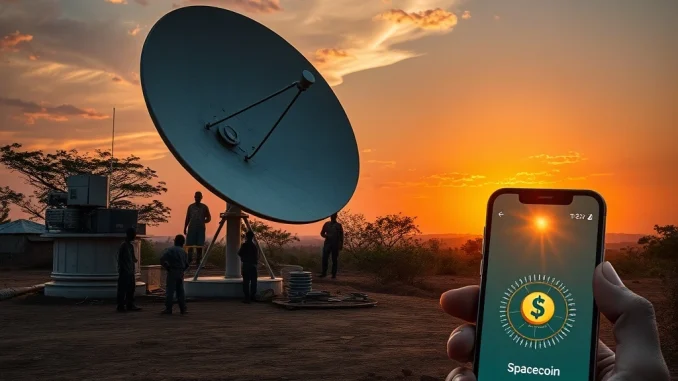
Nairobi, Kenya – January 15, 2025 – Spacecoin (SPACE), the decentralized satellite internet initiative, has announced groundbreaking strategic partnerships across Africa and Southeast Asia, marking a significant step toward bridging the digital divide in underserved regions. The project secured crucial agreements with governments and telecommunications providers to launch local Proof-of-Concept demonstrations, potentially transforming connectivity landscapes in emerging markets.
Spacecoin’s Strategic Expansion into Emerging Markets
Spacecoin’s recent announcements reveal a carefully planned expansion strategy targeting regions with significant connectivity challenges. The project secured a satellite connection transmission license for Internet of Things monitoring through collaboration with Kenya’s Communications Authority. This regulatory approval represents a critical milestone for the cryptocurrency-powered connectivity project.
Furthermore, Spacecoin is pursuing similar satellite connection Proof-of-Concept demonstrations with governments and local partners in Cambodia and Indonesia. These strategic moves demonstrate the project’s commitment to validating its technology in diverse geographical and regulatory environments. The company emphasizes that these partnerships aim to bridge communications gaps in regions with historically low internet access.
Technical Infrastructure and Deployment Strategy
Spacecoin’s technical approach relies on its initial satellite constellation consisting of three CTC-1 satellites, successfully launched via SpaceX missions. This infrastructure forms the backbone of their connectivity solution. The project combines blockchain technology with satellite communications to create a decentralized network.
The Proof-of-Concept demonstrations will test several key aspects:
- Network reliability in diverse climatic conditions
- Local applicability of the technology infrastructure
- Regulatory compliance across different jurisdictions
- Economic viability for sustainable operations
These tests will determine the project’s scalability and practical implementation potential across target regions.
Regulatory Recognition and Market Potential
Spacecoin’s expansion follows increasing regulatory recognition of satellite internet technologies in emerging markets. Regulatory bodies in Kenya, Cambodia, and Indonesia have acknowledged the potential of decentralized connectivity solutions. This regulatory openness creates opportunities for innovative approaches to infrastructure development.
The project’s timing aligns with global trends in satellite internet adoption. Traditional satellite providers have demonstrated the viability of space-based connectivity, while blockchain integration offers new possibilities for decentralized network management and financing. Spacecoin’s approach represents a convergence of these technological trends.
Impact on Regional Connectivity and Development
The potential impact of Spacecoin’s expansion extends beyond basic internet access. Successful implementation could transform economic opportunities in target regions. Reliable connectivity enables digital education, telemedicine, agricultural technology, and financial inclusion initiatives.
In Africa, where approximately 40% of the population lacks internet access according to recent World Bank data, satellite solutions offer particular promise for reaching remote communities. Southeast Asia faces similar challenges, with archipelagic nations like Indonesia requiring innovative approaches to connect thousands of islands.
Spacecoin’s decentralized model presents several potential advantages:
| Feature | Traditional Satellite Internet | Spacecoin’s Approach |
|---|---|---|
| Network Control | Centralized corporate control | Decentralized governance |
| Payment Systems | Traditional banking required | Cryptocurrency integration |
| Infrastructure Investment | Corporate capital intensive | Community participation possible |
| Local Adaptation | Standardized global approach | Customizable local solutions |
Challenges and Considerations for Implementation
Despite promising developments, Spacecoin faces significant implementation challenges. Regulatory frameworks for satellite communications vary widely across target countries. Spectrum allocation, licensing requirements, and local partnership structures require careful navigation.
Technical challenges include maintaining network reliability during adverse weather conditions, ensuring adequate bandwidth for growing user bases, and integrating with existing telecommunications infrastructure. The project must also address affordability concerns to ensure accessibility for low-income populations.
Furthermore, the cryptocurrency aspect introduces additional considerations. Volatility in token value could affect service pricing stability. Regulatory clarity around cryptocurrency usage varies across target markets, requiring careful legal navigation.
Comparative Analysis with Existing Solutions
Spacecoin enters a competitive landscape with established satellite internet providers and emerging blockchain projects. Traditional providers offer proven technology but often at higher costs with centralized control. Other blockchain-based initiatives focus on different aspects of decentralized connectivity.
Spacecoin’s differentiation lies in its specific focus on emerging markets and its strategic government partnerships. The project’s Proof-of-Concept approach allows for gradual, validated expansion rather than rapid, untested deployment. This methodical strategy may prove advantageous in complex regulatory environments.
Future Development and Expansion Timeline
Spacecoin’s development follows a phased approach. The current Proof-of-Concept phase will gather crucial data on technical performance and user adoption. Successful demonstrations could lead to expanded partnerships and broader deployments.
The project roadmap includes several key milestones:
- Q1 2025: Initial Proof-of-Concept deployments in Kenya
- Q2 2025: Expansion to Cambodia and Indonesia test sites
- Q3 2025: Evaluation and refinement based on initial results
- Q4 2025: Potential scaling decisions and additional partnerships
This timeline allows for iterative improvement based on real-world testing results and stakeholder feedback.
Conclusion
Spacecoin’s strategic expansion into Africa and Southeast Asia represents a significant development in decentralized connectivity solutions. The project’s partnerships with governments and telecommunications companies demonstrate growing recognition of satellite internet’s potential in bridging digital divides. While challenges remain in implementation and scalability, the Proof-of-Concept approach provides a measured path toward validating the technology’s local applicability. As Spacecoin progresses through its demonstration phase, the results will offer valuable insights into the future of decentralized connectivity in emerging markets.
FAQs
Q1: What is Spacecoin’s main objective with these expansions?
Spacecoin aims to bridge communications gaps in regions with low internet access by deploying decentralized satellite internet technology through strategic local partnerships.
Q2: Which countries are currently involved in Spacecoin’s Proof-of-Concept demonstrations?
The project has secured agreements in Kenya, Cambodia, and Indonesia, with the Kenyan Communications Authority granting a satellite transmission license for IoT monitoring.
Q3: How does Spacecoin’s technology differ from traditional satellite internet?
Spacecoin combines satellite communications with blockchain technology, creating a decentralized network that integrates cryptocurrency payments and community governance elements.
Q4: What infrastructure does Spacecoin currently have in place?
The project operates three CTC-1 satellites launched via SpaceX, forming its initial constellation for providing connectivity services.
Q5: What are the main challenges Spacecoin faces in these expansions?
Key challenges include navigating diverse regulatory environments, ensuring technical reliability in various climates, maintaining service affordability, and addressing cryptocurrency-related regulatory considerations.