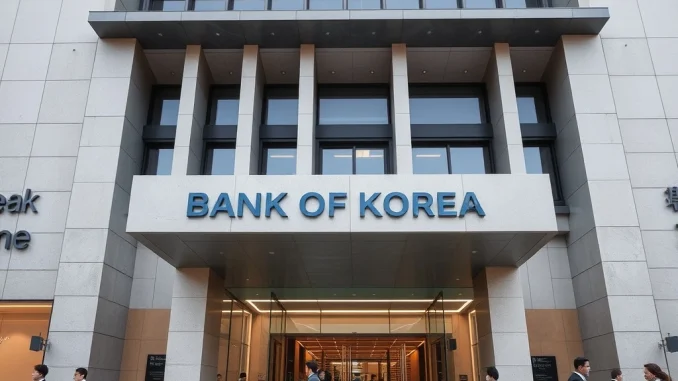
SEOUL, South Korea – The Bank of Korea (BOK) has decisively maintained its benchmark interest rate at 2.50% for a fifth consecutive meeting, reinforcing a prolonged period of monetary policy stability. This significant decision, announced today, extends a holding pattern initiated in July of last year. Consequently, the central bank continues its careful navigation between persistent inflation concerns and fragile economic growth signals.
Bank of Korea Interest Rate Decision Analysis
The Monetary Policy Board’s unanimous vote to freeze the base rate reflects a complex economic balancing act. Furthermore, this extended pause follows a series of aggressive rate hikes totaling 300 basis points between August 2021 and January 2023. Therefore, policymakers now emphasize a data-dependent approach. Key domestic indicators, including consumer price inflation and household debt levels, heavily influenced today’s outcome. The BOK’s statement highlighted ongoing uncertainties in the global economic landscape as a primary reason for maintaining the current stance.
Economists widely anticipated this steady policy. However, the extended duration of the freeze signals deepening caution. The central bank’s primary mandate focuses on price stability, yet growth risks are mounting. South Korea’s export-reliant economy faces headwinds from sluggish global demand, particularly from China. Simultaneously, domestic consumption remains uneven. This policy inertia, therefore, represents a strategic wait for clearer economic signals before any future adjustments.
The Inflation and Growth Tightrope
Consumer price inflation remains a critical watchpoint for the BOK. Recent data shows inflation hovering above the central bank’s 2% target, though it has moderated from previous peaks. Core inflation, which excludes volatile food and energy prices, has proven particularly sticky. This persistence complicates any move toward monetary easing. Conversely, economic growth forecasts have been tempered. The International Monetary Fund (IMF) recently revised its 2025 growth projection for South Korea downward, citing external vulnerabilities.
Historical Context of BOK Monetary Policy
Understanding the current freeze requires examining the recent policy trajectory. The BOK embarked on one of the most aggressive tightening cycles globally post-pandemic. This table outlines the key recent decisions:
| Meeting Date | Policy Action | Benchmark Rate |
|---|---|---|
| January 2023 | Final Rate Hike | 3.50% |
| April 2023 | Hold | 3.50% |
| July 2023 | Hold | 3.50% |
| October 2023 | Hold | 3.50% |
| January 2024 | Rate Cut | 3.25% |
| April 2024 | Rate Cut | 3.00% |
| July 2024 | Rate Cut | 2.75% |
| August 2024 | Rate Cut | 2.50% |
| Present (2025) | Fifth Consecutive Hold | 2.50% |
The shift from tightening to easing, and now to an extended hold, mirrors the global central banking pivot. Major institutions like the U.S. Federal Reserve and the European Central Bank have also entered holding patterns. This synchronized global caution underscores interconnected financial system risks. South Korea’s policy, therefore, cannot diverge significantly without risking currency volatility and capital flow disruptions.
Economic Impacts and Market Reactions
Financial markets responded with muted volatility to the expected announcement. The Korean won and sovereign bond yields showed limited movement. This stability suggests investors had fully priced in the continuation of the status quo. However, longer-term implications are significant for several sectors:
- Household Debt: High household indebtedness remains a systemic vulnerability. A prolonged period of stable rates provides predictability for borrowers but delays balance sheet repair.
- Corporate Investment: Businesses benefit from stable financing costs, potentially supporting capital expenditure plans in a uncertain demand environment.
- Real Estate Market: The property sector, sensitive to interest rate changes, finds a temporary floor under prices, though transaction volumes may remain subdued.
- Export Competitiveness: A stable interest rate policy, relative to global peers, influences the won’s exchange rate, affecting the price competitiveness of key exports like semiconductors and automobiles.
Analysts from major investment banks, including Samsung Securities and Korea Investment & Securities, published immediate notes. Their consensus view suggests the BOK will likely maintain this rate well into the second half of 2025. Their forecasts hinge on inflation sustainably returning to the target band and a recovery in external demand. The central bank’s own forward guidance, however, remains deliberately vague, emphasizing flexibility.
Expert Perspectives on the Policy Stance
Former BOK governor and renowned economist Dr. Lee Seong-hwan commented on the decision’s prudence. “In an environment of high uncertainty, the cost of a policy mistake is elevated,” he noted in a recent seminar. “The Board is correctly prioritizing data confirmation over preemptive moves. Their patience, while challenging for some market participants, is a hallmark of mature central banking.” This expert view underscores the calculated nature of the extended pause. It reflects a shift from reactive to observant monetary management.
Global Central Banking Parallels
The BOK’s stance aligns with a broader global trend of monetary policy normalization pauses. After a frenetic period of rate hikes to combat post-pandemic inflation, central banks worldwide have hit the brakes. The U.S. Federal Reserve has held its federal funds rate steady for several meetings. Similarly, the European Central Bank has paused after concluding its own hiking cycle. This global synchronization reduces the risk of disruptive currency movements and capital flight. For a trade-intensive economy like South Korea’s, this alignment is not coincidental but strategically essential.
Nevertheless, subtle divergences exist. Japan’s Bank of Japan, for instance, has only recently moved away from its ultra-loose policy. China’s central bank continues to implement targeted easing measures. South Korea’s position, therefore, sits between these major economic poles. The BOK must carefully monitor these divergent paths to safeguard its own policy autonomy and economic stability. This global context adds a critical layer of complexity to domestic rate decisions.
Conclusion
The Bank of Korea’s decision to hold its benchmark interest rate at 2.50% for a fifth consecutive time solidifies a patient, watchful monetary policy era. This extended pause strategically balances the persistent threat of inflation against emerging risks to economic growth. By maintaining stability, the BOK provides a predictable environment for households and businesses navigating global uncertainty. Ultimately, the central bank’s future moves will depend critically on incoming data regarding price pressures, growth momentum, and the actions of global peers. The current calculated hold reflects a mature, evidence-based approach to steering the national economy through a complex post-pandemic landscape.
FAQs
Q1: What is the Bank of Korea’s current benchmark interest rate?
The Bank of Korea has maintained its benchmark interest rate at 2.50% following its latest monetary policy meeting, marking the fifth consecutive decision to hold rates steady.
Q2: Why does the BOK keep freezing the interest rate?
The central bank is maintaining a cautious stance to balance several factors: moderating but above-target inflation, high household debt, fragile economic growth, and significant uncertainty in the global economic environment.
Q3: How does this interest rate hold affect ordinary South Koreans?
A stable rate means consistent borrowing costs for mortgages and loans, providing predictability for household budgets. It also influences savings account returns and can impact currency exchange rates, affecting the cost of imports and overseas travel.
Q4: When is the Bank of Korea likely to change interest rates again?
Most analysts project the hold will continue for several more meetings, potentially well into late 2025. Any change will depend on clear, sustained evidence that inflation is returning to the 2% target and that economic growth is on a firmer footing.
Q5: How does South Korea’s monetary policy compare to other major economies?
The BOK’s extended hold aligns with a global trend. Major central banks like the U.S. Federal Reserve and the European Central Bank are also in holding patterns after concluding their aggressive rate-hiking cycles, creating a synchronized period of global monetary policy stability.