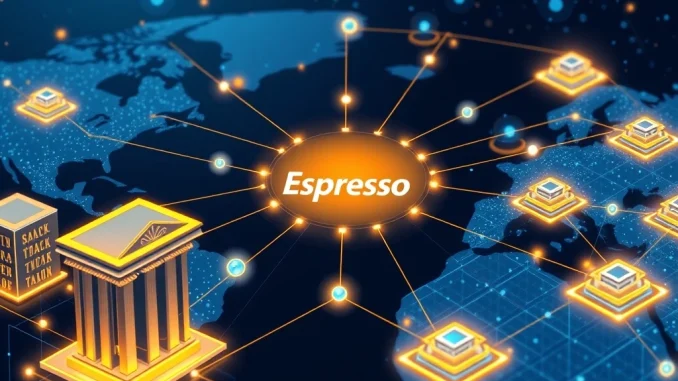
SEOUL, South Korea – February 2025 – A groundbreaking report from blockchain consulting firm ARK Point reveals how the Espresso blockchain shared sequencer solution addresses one of cryptocurrency’s most persistent challenges: the infrastructure gap preventing seamless integration between global financial systems and decentralized networks. This development comes as major blockchain platforms including Celo, Arbitrum, and Polygon move beyond testing phases to implement Espresso as core infrastructure, signaling a potential paradigm shift in how financial applications interact with blockchain technology.
Espresso Blockchain: Solving the Rollup Fragmentation Problem
The cryptocurrency industry faces a critical infrastructure challenge despite significant scaling advancements through rollup technology. While rollups successfully increased transaction throughput, they simultaneously created a fragmented ecosystem of isolated chains. According to ARK Point’s comprehensive analysis titled “Espresso: Building a Global Baselayer for the Rollup Economy,” this fragmentation creates substantial barriers for financial institutions and consumer applications requiring real-time, reliable connectivity.
Traditional reliance on Ethereum’s Layer 1 as the unifying infrastructure proves insufficient for modern financial applications. Ethereum’s 12 to 15-minute finality timeframe falls dramatically short of the sub-second expectations in global finance. Consequently, this infrastructure gap limits blockchain adoption for payment systems, trading platforms, and other time-sensitive financial services that demand immediate settlement confirmation.
The Shared Sequencer Solution: Technical Architecture and Advantages
Espresso introduces a novel approach through its decentralized consensus and finality layer specifically engineered for the rollup economy. This shared sequencer functions as a high-performance “baselayer” that unifies disparate rollup chains while maintaining their individual sovereignty. The system achieves transaction finality in just two seconds with a clear roadmap toward sub-one-second performance.
Unlike traditional sequencing models that operate independently for each rollup, Espresso’s shared architecture provides several distinct advantages:
- Cross-rollup atomic composability: Applications can execute transactions across multiple rollups simultaneously
- Enhanced security through decentralization: Multiple independent operators validate transactions
- Reduced infrastructure costs: Shared resources eliminate redundant sequencing overhead
- Improved user experience: Consistent finality times across all connected rollups
Industry Adoption and Implementation Timeline
Major blockchain ecosystems have progressed from experimental testing to production integration, according to the ARK Point report. Celo (CELO), known for its mobile-first blockchain approach, now incorporates Espresso to enhance its payment infrastructure. Similarly, Arbitrum (ARB) developer Offchain Labs and Polygon (POL) have moved beyond proof-of-concept stages to implement Espresso as foundational infrastructure.
This adoption pattern suggests growing industry consensus about shared sequencer technology’s importance. Financial institutions exploring blockchain integration particularly benefit from Espresso’s predictable finality times, which align more closely with traditional settlement systems. The transition from isolated rollup chains to interconnected networks through shared sequencing could accelerate institutional blockchain adoption significantly.
Comparative Analysis: Finality Performance Across Blockchain Layers
The following table illustrates how Espresso’s performance compares to existing blockchain infrastructure solutions:
| Infrastructure Layer | Average Finality Time | Cross-Chain Composability | Decentralization Level |
|---|---|---|---|
| Ethereum Layer 1 | 12-15 minutes | Limited | High |
| Traditional Rollups | Varies (minutes) | None | Medium |
| Alternative Layer 1s | 3-10 seconds | Native | Varies |
| Espresso Shared Sequencer | 2 seconds (→ sub-1s) | Full | High |
This performance comparison highlights Espresso’s unique positioning. The solution combines Ethereum’s security decentralization with alternative Layer 1 speed while adding cross-rollup functionality absent in both approaches. Financial applications particularly benefit from this combination, as they require both security guarantees and rapid settlement confirmation.
Real-World Applications and Financial Sector Implications
The infrastructure gap between traditional finance and blockchain technology has practical consequences beyond technical specifications. Payment processors face reconciliation challenges when integrating blockchain settlements. Trading platforms encounter latency issues during high-volume periods. Cross-border payment systems struggle with inconsistent confirmation times across different blockchain networks.
Espresso’s shared sequencer architecture addresses these practical concerns directly. Financial institutions can build applications that interact with multiple blockchain networks simultaneously while receiving consistent performance guarantees. This interoperability reduces development complexity and operational overhead, potentially lowering barriers to blockchain integration for traditional financial services.
Furthermore, the predictable two-second finality enables new financial products previously impractical on blockchain infrastructure. High-frequency trading algorithms, real-time payment systems, and instant settlement mechanisms become technically feasible with Espresso’s performance characteristics. These capabilities could accelerate blockchain adoption beyond cryptocurrency into mainstream financial infrastructure.
Expert Analysis and Industry Perspectives
Blockchain infrastructure experts emphasize shared sequencing’s importance for the ecosystem’s next evolution. According to the ARK Point report, fragmented rollup chains create user experience friction and development complexity that hinder mass adoption. The consulting firm’s analysis draws from extensive industry experience working with financial institutions exploring blockchain integration.
Industry observers note that Espresso’s approach differs significantly from previous interoperability solutions. Rather than creating another bridging protocol or cross-chain messaging system, Espresso operates at the sequencing layer itself. This architectural distinction provides more fundamental connectivity while maintaining each rollup’s execution independence and security model.
Technical Implementation and Security Considerations
Espresso’s shared sequencer implementation maintains rigorous security standards despite its performance advantages. The system utilizes a decentralized set of operators who collectively order transactions across connected rollups. This decentralization prevents single points of failure or censorship while ensuring liveness guarantees essential for financial applications.
The architecture also preserves each rollup’s sovereignty regarding execution and data availability. Rollups continue operating their own execution environments and data storage solutions while outsourcing transaction ordering to the shared sequencer. This separation of concerns allows rollups to maintain their unique features and optimizations while benefiting from cross-chain connectivity.
Security researchers highlight several advantages of this approach compared to alternative interoperability solutions. Shared sequencing avoids the trust assumptions required by many cross-chain bridges, which have suffered significant exploits in recent years. Additionally, the architecture maintains Ethereum’s security model for settlement while enhancing performance through optimized sequencing.
Future Development Roadmap and Industry Trajectory
Espresso’s development roadmap extends beyond current two-second finality toward sub-one-second performance. This progression aligns with financial industry requirements for real-time settlement systems. The project also plans expanded rollup compatibility, potentially including optimistic rollups, zk-rollups, and emerging scaling solutions.
Industry analysts predict increased shared sequencer adoption throughout 2025 as more rollup projects recognize fragmentation’s limitations. The infrastructure gap between traditional finance and blockchain represents both a challenge and opportunity for technology providers. Solutions like Espresso that address this gap while maintaining blockchain’s core principles could determine which platforms achieve mainstream financial adoption.
Furthermore, regulatory developments increasingly recognize finality time’s importance for financial blockchain applications. Regulatory clarity around settlement finality could accelerate institutional adoption of solutions providing predictable, rapid confirmation times. Espresso’s performance characteristics position it favorably within this evolving regulatory landscape.
Conclusion
The Espresso blockchain shared sequencer solution addresses a critical infrastructure gap preventing seamless integration between global financial systems and blockchain technology. ARK Point’s comprehensive report demonstrates how Espresso’s two-second finality and cross-rollup connectivity enable financial applications previously impractical on blockchain infrastructure. With major platforms including Celo, Arbitrum, and Polygon implementing Espresso as core infrastructure, shared sequencing represents a significant evolution in blockchain architecture. This development could accelerate institutional blockchain adoption by providing the performance, reliability, and interoperability required by modern financial systems while maintaining blockchain’s security and decentralization principles.
FAQs
Q1: What problem does Espresso’s shared sequencer solve specifically?
Espresso addresses the infrastructure gap between traditional financial systems and blockchain technology by providing rapid, predictable transaction finality and cross-rollup connectivity that financial applications require but existing blockchain infrastructure cannot consistently deliver.
Q2: How does Espresso achieve faster finality than Ethereum Layer 1?
Espresso operates as a dedicated consensus and finality layer optimized specifically for rollup sequencing, bypassing Ethereum’s general-purpose consensus mechanism to provide specialized, high-performance transaction ordering with two-second finality.
Q3: Which major blockchain platforms are integrating Espresso?
According to the ARK Point report, Celo (CELO), Arbitrum (ARB) developer Offchain Labs, and Polygon (POL) have moved beyond testing phases to implement Espresso as core infrastructure for their respective ecosystems.
Q4: How does shared sequencing differ from traditional rollup operation?
Traditional rollups operate independent sequencers for each chain, creating fragmentation. Shared sequencing uses a decentralized network of operators to order transactions across multiple rollups simultaneously, enabling cross-chain functionality while maintaining individual rollup sovereignty.
Q5: What are the security implications of using a shared sequencer?
Espresso maintains security through decentralization with multiple independent operators, avoiding single points of failure. The architecture preserves each rollup’s execution environment and data availability while only sharing transaction ordering, maintaining security boundaries between connected chains.