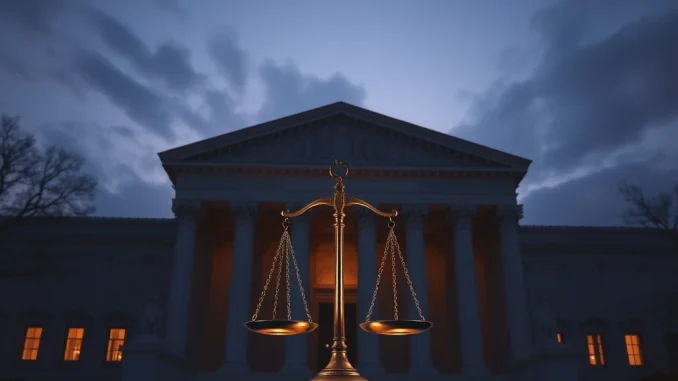
WASHINGTON, D.C., January 14, 2025 – The United States Supreme Court notably withheld its anticipated ruling on the legality of former President Donald Trump’s universal global tariffs during Wednesday’s scheduled opinion session, creating immediate uncertainty across international trade markets and legal circles. This unexpected development leaves one of the most consequential trade policy questions of the decade unresolved, potentially affecting trillions in global commerce.
Supreme Court Delays Critical Tariff Ruling
The Supreme Court’s decision to postpone its judgment represents a significant procedural development in a case that has spanned multiple presidential administrations. Legal observers had anticipated a ruling this session following extensive oral arguments last November. Consequently, the Court’s silence has generated widespread speculation about potential internal deliberations or procedural complexities. The delay maintains the legal status quo, meaning the tariffs remain in effect pending judicial review.
This case originated from multiple legal challenges filed by coalitions of states, multinational corporations, and trading partners. These plaintiffs argue that the executive authority invoked to impose the tariffs exceeded constitutional limits. Specifically, they contend the tariffs violate the Constitution’s separation of powers and infringe upon congressional authority over international commerce. Meanwhile, the Department of Justice maintains the tariffs represent a legitimate exercise of presidential power regarding national security and trade policy.
Background of the Global Tariff Legal Challenge
The tariffs in question represent a sweeping trade policy initiative first implemented during the Trump administration. Initially justified under Section 232 of the Trade Expansion Act of 1962, which addresses national security threats, the policy imposed significant duties on imports from numerous countries. Subsequently, the administration expanded the rationale to include broader economic and trade imbalance concerns. The policy affected steel, aluminum, and hundreds of other product categories.
Legal challenges emerged almost immediately from various quarters. For instance, the European Union, China, Canada, and Mexico filed formal complaints with the World Trade Organization. Simultaneously, domestic manufacturers who rely on imported materials filed lawsuits in U.S. courts. These cases eventually consolidated into the matter now before the Supreme Court. The central legal question involves whether the President possesses unilateral authority to impose such comprehensive tariffs without specific congressional authorization.
Expert Analysis of the Legal Stakes
Constitutional law scholars emphasize this case’s significance for executive power boundaries. “This represents a fundamental test of presidential authority in the realm of international economic policy,” explains Dr. Eleanor Vance, Professor of Constitutional Law at Georgetown University. “Historically, courts have granted presidents considerable latitude in foreign affairs. However, the scale and economic impact of these tariffs present novel constitutional questions.”
Trade policy experts note the ruling’s delayed timing creates practical complications. “Every day without a decision prolongs uncertainty for businesses making long-term supply chain investments,” states Marcus Chen, Senior Fellow at the Peterson Institute for International Economics. “Companies face difficult decisions about sourcing, pricing, and contracts while the legal framework remains unsettled.”
Economic Impacts of the Tariff Policy
The tariffs have generated complex economic consequences since their implementation. Proponents argue they protected domestic industries and manufacturing jobs, particularly in the steel and aluminum sectors. They point to increased production capacity and reduced import dependence in certain strategic industries. Additionally, some analysts credit the tariffs with strengthening U.S. negotiating positions in subsequent trade agreements.
Critics highlight several negative economic effects, including:
- Increased consumer costs for automobiles, appliances, and construction materials
- Supply chain disruptions for manufacturers dependent on imported components
- Retaliatory tariffs from trading partners affecting agricultural exports
- Reduced competitiveness for U.S. companies in global markets
The Congressional Budget Office estimates the tariffs have reduced real GDP by approximately 0.3% annually while increasing consumer price inflation. These economic impacts have varied significantly across different sectors and regions of the country.
International Relations and Trade Implications
The Supreme Court’s pending decision carries substantial implications for international trade relations. Trading partners have closely monitored the case, as the outcome will influence future U.S. trade policy approaches. Many countries have implemented retaliatory measures while awaiting judicial resolution. These counter-tariffs have particularly affected U.S. agricultural exports, prompting federal assistance programs for affected farmers.
The delay in ruling complicates ongoing trade negotiations with multiple partners. Negotiators face uncertainty about which policy tools will remain available to future administrations. Furthermore, the case’s outcome may influence how other nations structure their own trade enforcement mechanisms. International law experts suggest the ruling could either reinforce or undermine the global rules-based trading system, depending on its final disposition.
Historical Context of Presidential Trade Authority
Presidential authority over trade policy has evolved significantly throughout U.S. history. Congress has delegated increasing trade powers to the executive branch through legislation like the Trade Act of 1974 and various trade promotion authorities. However, the Supreme Court has occasionally reasserted congressional primacy in commerce matters. The current case represents the most significant test of these boundaries in decades.
Previous Supreme Court decisions provide limited guidance for this specific situation. The 1976 case of United States v. Guy W. Capps, Inc. affirmed presidential authority in certain trade matters, while the 2015 case of Zivotofsky v. Kerry emphasized presidential primacy in foreign affairs recognition. Legal scholars disagree about which precedent most closely applies to the tariff question currently before the Court.
Potential Outcomes and Their Consequences
The Supreme Court could ultimately rule in several directions, each with distinct implications:
| Possible Ruling | Immediate Effect | Long-Term Impact |
|---|---|---|
| Tariffs declared unconstitutional | Immediate removal of duties, potential refunds | Reduced presidential trade authority, congressional reassertion |
| Tariffs upheld as constitutional | Continuation of current policy | Expanded executive power, potential tariff escalation |
| Mixed ruling with limitations | Partial tariff adjustments | Clarified but constrained presidential authority |
Each potential outcome would trigger different market reactions and policy adjustments. A ruling against the tariffs would likely prompt immediate adjustments in global supply chains and commodity pricing. Conversely, upholding the tariffs could encourage their continuation or expansion by future administrations. A narrowly tailored decision might establish new parameters for executive trade actions without completely invalidating the policy.
Conclusion
The Supreme Court’s decision to withhold its ruling on Trump’s global tariffs creates continued uncertainty in international trade policy and economic planning. This delay affects businesses, consumers, and diplomatic relations worldwide. The eventual decision will establish important precedents regarding presidential authority over trade matters. Consequently, legal experts, policymakers, and market participants continue monitoring the Court’s docket closely. The ruling, when it comes, will shape U.S. trade policy and constitutional boundaries for years to come.
FAQs
Q1: What exactly did the Supreme Court decide on January 14?
The Court did not issue any ruling on the tariff case during its scheduled opinion session. This means the decision has been postponed to a future date, maintaining the current legal status of the tariffs.
Q2: Why is this tariff case so significant?
This case tests the constitutional limits of presidential power over international trade policy. The outcome will determine whether future presidents can impose comprehensive tariffs without specific congressional authorization, affecting the balance of power between branches of government.
Q3: How have the tariffs affected the U.S. economy?
Economic analyses show mixed effects. The tariffs have provided protection for some domestic industries but have increased costs for consumers and manufacturers. They have also prompted retaliatory measures from trading partners that have affected U.S. exports, particularly agricultural products.
Q4: What happens to the tariffs while the Supreme Court deliberates?
The tariffs remain in full effect during the judicial review process. Businesses must continue complying with all applicable duties and regulations until the Court issues a final ruling that might change the policy’s legal status.
Q5: When might the Supreme Court issue its ruling?
The Court could announce its decision at any future opinion session before the current term ends in June 2025. However, the Court has discretion over timing and could potentially delay the ruling further if necessary for internal deliberations.