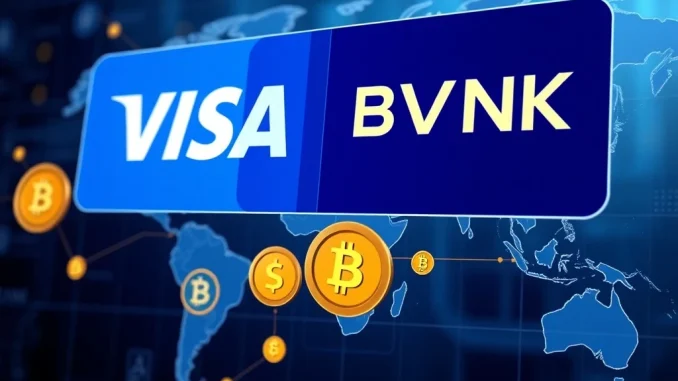
In a landmark move that signals mainstream cryptocurrency adoption, global payments giant Visa has announced a strategic partnership with digital asset infrastructure provider BVNK to integrate stablecoin payment capabilities into its Visa Direct service. This groundbreaking development, first reported by CoinDesk on March 15, 2025, fundamentally transforms how businesses and individuals conduct cross-border transactions by leveraging blockchain technology through established payment networks.
Visa’s Strategic Stablecoin Integration with BVNK
Visa’s collaboration with BVNK represents a significant evolution in traditional payment systems. The integration specifically enables select businesses to pre-fund payments using stablecoins and subsequently send them directly to recipients’ digital wallets through Visa Direct. This service traditionally facilitates business-to-person payments including salary disbursements and international remittances. Consequently, the partnership establishes new operational standards for stablecoin utilization within regulated financial frameworks.
Industry analysts immediately recognized the announcement’s importance. “This partnership bridges the gap between traditional finance and digital assets,” noted Sarah Chen, Director of Digital Payments Research at FinTech Analytics Group. “Visa brings unparalleled network reach while BVNK provides specialized blockchain infrastructure. Together, they create a compliant pathway for stablecoin adoption.”
The Technical Infrastructure Behind the Partnership
BVNK’s payment infrastructure serves as the technological backbone for this initiative. The London-based company, founded in 2021, has developed a comprehensive platform that handles digital asset custody, liquidity, and settlement. Their system converts stablecoins into fiat currency at the point of disbursement when necessary. This conversion process ensures recipients can access funds through their preferred method while businesses benefit from blockchain efficiency.
The technical implementation involves multiple layers of compliance and security. BVNK’s infrastructure maintains real-time transaction monitoring to meet anti-money laundering requirements. Additionally, the system provides transparent audit trails for all stablecoin movements. These features address regulatory concerns that have previously slowed institutional cryptocurrency adoption.
Transforming Global Remittance and Payment Systems
International remittances represent a primary application for this new service. The World Bank reports that global remittance flows exceeded $860 billion in 2024, with transaction costs averaging 6.2%. Traditional cross-border payments typically involve multiple intermediaries, resulting in delays and high fees. Visa’s stablecoin integration directly addresses these inefficiencies through blockchain technology.
Businesses using the service can expect several operational benefits:
- Reduced transaction costs by minimizing intermediary banks
- Faster settlement times from near-instant blockchain confirmation
- Enhanced transparency through immutable transaction records
- Improved cash flow management with predictable settlement
These advantages particularly benefit industries with international workforces. For example, technology companies employing remote developers across different continents can streamline payroll processing. Similarly, manufacturing firms with global supply chains can optimize vendor payments. The service’s flexibility accommodates various business models and payment structures.
Comparative Analysis: Traditional vs. Stablecoin Remittances
| Aspect | Traditional Remittance | Visa-BVNK Stablecoin Service |
|---|---|---|
| Transaction Time | 1-5 business days | Minutes to hours |
| Average Cost | 5-7% of transaction value | 1-3% projected |
| Transparency | Limited tracking | Full blockchain visibility |
| Settlement Finality | Subject to recall | Irreversible confirmation |
| Currency Options | Limited major currencies | Multiple stablecoin types |
Regulatory Landscape and Compliance Considerations
The partnership operates within an evolving regulatory environment. Global financial authorities have increased scrutiny of cryptocurrency transactions throughout 2024 and 2025. Visa and BVNK have proactively engaged with regulators across multiple jurisdictions to ensure compliance. Their approach emphasizes three key areas: transaction monitoring, customer verification, and jurisdictional adherence.
“Regulatory compliance isn’t an obstacle but a requirement for mainstream adoption,” explained Michael Rodriguez, Head of Regulatory Affairs at BVNK. “We’ve designed our infrastructure with compliance as a foundational element, not an afterthought. This enables financial institutions to leverage blockchain benefits while maintaining regulatory standards.”
Different regions present unique regulatory challenges. The European Union’s Markets in Crypto-Assets (MiCA) regulation, fully implemented in 2024, establishes comprehensive rules for stablecoin issuers and service providers. Meanwhile, the United States continues developing its regulatory framework through multiple agencies. The Visa-BVNK partnership accounts for these variations through adaptable compliance protocols.
Market Impact and Competitive Response
Visa’s move follows increasing cryptocurrency integration by traditional financial institutions. Mastercard launched its Crypto Source program in 2023, while PayPal expanded its stablecoin offerings throughout 2024. However, Visa’s direct integration with Visa Differentiates their approach through existing network infrastructure. This strategy leverages Visa’s established relationships with over 15,000 financial institutions worldwide.
The partnership potentially disrupts specialized remittance providers like Western Union and MoneyGram. These companies have begun exploring blockchain solutions but lack Visa’s scale and direct banking relationships. Traditional banks also face increased pressure to modernize their cross-border payment systems. Many institutions now accelerate their digital asset strategies in response to Visa’s announcement.
Future Developments and Industry Implications
BVNK plans to establish new payment standards for stablecoins through this partnership. The company aims to create interoperability protocols between different stablecoin types and blockchain networks. These standards would enable seamless transactions across various digital assets and platforms. Such developments could eventually create a unified stablecoin payment ecosystem.
The service’s initial rollout targets selected enterprise clients in specific regions. Visa and BVNK plan gradual expansion based on regulatory approvals and market readiness. Future phases may include consumer-facing applications and additional cryptocurrency integrations. The partners also explore central bank digital currency (CBDC) compatibility as governments worldwide develop sovereign digital currencies.
Industry observers anticipate broader implications for financial inclusion. Stablecoin remittances could significantly reduce costs for migrant workers sending funds to developing nations. Additionally, the technology enables faster disaster relief payments and humanitarian aid distribution. These social benefits complement the commercial advantages for businesses and financial institutions.
Conclusion
Visa’s partnership with BVNK to launch a stablecoin remittance service represents a pivotal moment in financial technology convergence. The integration of blockchain-based payments through Visa Direct’s established network bridges traditional and digital finance. This development addresses longstanding inefficiencies in cross-border transactions while maintaining regulatory compliance. As the service expands, it will likely accelerate cryptocurrency adoption and transform global payment systems. The Visa-BVNK collaboration establishes a new benchmark for institutional blockchain integration with far-reaching implications for businesses, consumers, and the broader financial ecosystem.
FAQs
Q1: What exactly does the Visa and BVNK partnership enable?
The partnership integrates BVNK’s stablecoin payment infrastructure into Visa Direct, allowing businesses to send payments using stablecoins directly to individuals’ digital wallets for applications like salary payments and international remittances.
Q2: How does this service benefit businesses compared to traditional payment methods?
Businesses benefit from reduced transaction costs, faster settlement times (minutes instead of days), enhanced transparency through blockchain tracking, and improved cash flow management with predictable transaction completion.
Q3: Which stablecoins will the service support initially?
While specific stablecoins haven’t been officially announced, industry analysts expect support for major regulated stablecoins like USDC and USDT initially, with expansion to additional stablecoins based on regulatory compliance and market demand.
Q4: How does this service address regulatory concerns about cryptocurrency transactions?
The system incorporates real-time transaction monitoring, comprehensive audit trails, customer verification protocols, and jurisdiction-specific compliance measures developed in consultation with financial regulators across multiple regions.
Q5: When will this service be available to businesses and consumers?
The service is initially rolling out to select enterprise clients in approved jurisdictions, with gradual expansion planned throughout 2025 and 2026 based on regulatory approvals, technical implementation, and market readiness assessments.