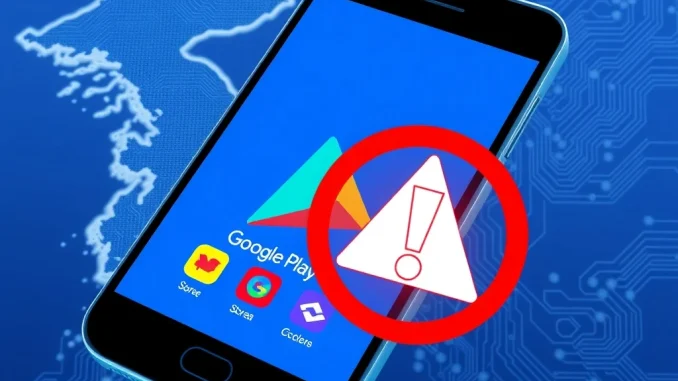
SEOUL, South Korea – January 15, 2025 – The Google Play Store will implement a critical regulatory enforcement action against cryptocurrency applications in South Korea, potentially blocking downloads and updates for unregistered exchange and software wallet apps starting January 28. This decisive move mandates that all relevant apps must have submitted a Virtual Asset Service Provider (VASP) declaration to the nation’s Financial Intelligence Unit (FIU). Consequently, this policy represents the latest escalation in South Korea’s comprehensive framework for digital asset oversight, directly impacting millions of users and dozens of service providers.
Google Play Store Crypto Ban: The Core Regulatory Mandate
Google’s new enforcement policy specifically targets cryptocurrency exchange applications and custodial wallet services available within South Korea. According to the official notice, the company will require these applications to prove they have submitted the mandatory VASP declaration to the FIU, which operates under the Financial Services Commission (FSC). Apps failing to meet this requirement will face removal from the South Korean version of the Play Store. Importantly, Google clarified that non-custodial or self-custody wallets, where users control their private keys, remain exempt from this specific policy. However, a significant ambiguity persists regarding whether mere submission of the declaration suffices or if full FIU approval is necessary for compliance.
This action follows South Korea’s implementation of the Travel Rule and stricter anti-money laundering (AML) protocols for virtual asset service providers. The FIU requires all VASPs operating in the country to register and comply with detailed reporting obligations. Google’s policy effectively acts as a gatekeeper, enforcing these national financial regulations at the application distribution level. The timeline is immediate, with the January 28 deadline giving developers and companies less than two weeks to ensure compliance.
Context: South Korea’s Evolving Crypto Landscape
South Korea has established itself as one of the world’s most active and regulated cryptocurrency markets. The government has progressively tightened oversight following major industry incidents, including the collapse of the Terra-Luna ecosystem, which had significant ties to the country. The current regulatory framework, often called the “Digital Asset Basic Act” provisions, mandates strict licensing, real-name account verification, and robust consumer protection measures. Google’s Play Store policy directly supports these governmental objectives by controlling software access for millions of Android users, who represent a majority of the mobile market in South Korea.
Implications for Crypto Exchanges and Wallet Providers
The potential blocking of applications carries profound implications. For established, registered exchanges like Upbit, Bithumb, Coinone, and Korbit, this policy reinforces their compliant market position. However, for smaller domestic platforms or international exchanges seeking South Korean users without local registration, access to the primary Android app marketplace will cease. This creates a substantial barrier to entry and favors incumbent, fully licensed operators. The policy also draws a clear regulatory line between different types of wallet services.
- Custodial Wallets: Services that hold users’ private keys (like many exchange-integrated wallets) must comply with VASP registration.
- Non-Custodial Wallets: Software where users solely control keys (e.g., MetaMask, Trust Wallet) are exempt, as they are not classified as VASPs under current interpretation.
This distinction underscores a global regulatory trend focusing on entities that control customer funds. The table below summarizes the key affected parties:
| Entity Type | Impact | Required Action |
|---|---|---|
| Registered Korean Crypto Exchanges | Low; must maintain compliance | Ensure FIU registration is current and communicated to Google |
| Unregistered/Foreign Exchanges | High; app blocked from Korean Play Store | Submit VASP declaration and seek FIU approval or cease distribution |
| Custodial Wallet Apps | High; must prove VASP status | Submit declaration as a Virtual Asset Service Provider |
| Non-Custodial Wallet Apps | Low; explicitly exempt | No action required under this policy |
Expert Analysis on Compliance and Market Structure
Financial technology compliance experts note that Google’s move is a predictable evolution of platform accountability. “Application stores are increasingly recognized as critical chokepoints for enforcing national financial regulations,” explains Dr. Min-ji Park, a fintech law professor at Seoul National University. “We observed similar dynamics with China’s app store policies. Google is proactively aligning its operations with South Korean law to mitigate its own legal and reputational risk. The ambiguity around ‘submission’ versus ‘approval’ is the crucial detail that will determine the short-term disruption.”
Industry analysts predict this will accelerate market consolidation within South Korea. Smaller, non-compliant apps will vanish from the mainstream distribution channel, potentially pushing users toward web-based platforms or sideloading APK files, which carries security risks. This could inadvertently benefit the largest, most compliant exchanges by reducing competition. Furthermore, it sets a precedent that Apple’s App Store may follow, potentially harmonizing enforcement across both major mobile ecosystems.
The Global Precedent and User Security Considerations
This policy does not exist in a vacuum. Other jurisdictions, including the United Kingdom and the European Union under MiCA (Markets in Crypto-Assets Regulation), are moving toward stringent licensing regimes for crypto firms. Google’s action in South Korea may serve as a template for enforcement in other regulated markets. From a user security perspective, the policy has a dual effect. It protects consumers from unregistered, potentially risky platforms but may also push determined users toward less secure methods of obtaining software, such as unofficial third-party websites, if their preferred app is removed.
Conclusion: A New Era of Enforced Crypto Compliance
The impending Google Play Store crypto ban for unregistered apps in South Korea marks a definitive shift from voluntary to enforced compliance. Starting January 28, the digital storefront will act as a direct extension of the nation’s financial regulatory authority. This development underscores the maturation and institutionalization of the cryptocurrency sector within one of its most important markets. While ensuring greater consumer protection and regulatory oversight, it also raises questions about market accessibility and the central role of tech giants in global financial governance. The coming weeks will reveal whether submission alone prevents blockage or if full FIU approval becomes the definitive benchmark for all crypto app compliance on the platform.
FAQs
Q1: What exactly is Google banning from the Play Store in South Korea?
Google will block downloads and updates for cryptocurrency exchange apps and custodial wallet apps that have not submitted a Virtual Asset Service Provider (VASP) declaration to South Korea’s Financial Intelligence Unit (FIU).
Q2: Are all cryptocurrency wallets affected by this ban?
No. Google explicitly states that non-custodial wallets, where users control their own private keys (like MetaMask), are exempt from this policy. Only wallets that custody user funds on their behalf must comply.
Q3: When does this new policy take effect?
The enforcement is scheduled to begin on January 28, 2025. Apps must demonstrate compliance by this date to avoid being removed or blocked in the South Korean Play Store.
Q4: Can users still access blocked apps through other means?
Technically, yes. Users could sideload Android application packages (APKs) from websites, but this bypasses Google’s security checks and is strongly discouraged due to heightened risks of malware and fraud.
Q5: Does this affect iPhone users on the Apple App Store?
Not directly. This is a Google Play Store policy. However, Apple often mirrors such regulatory compliance measures, so a similar policy on the App Store could follow in the future.
Q6: What should a user do if their preferred crypto app disappears from the Play Store?
Users should first check the app provider’s official website for announcements regarding their compliance status. They should only download apps from official, verified sources and consider switching to a fully registered and compliant platform operating legally in South Korea.