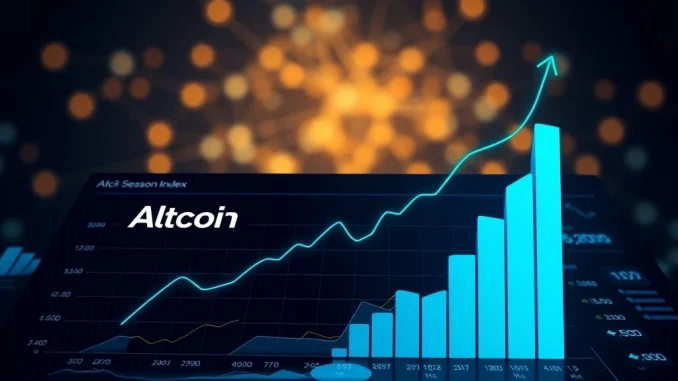
Global cryptocurrency markets are witnessing a subtle but potentially significant shift, as the widely monitored Altcoin Season Index has climbed to a score of 30, marking a two-point increase from the previous day. This movement, recorded by data aggregator CoinMarketCap, provides a crucial quantitative signal for traders and analysts attempting to gauge the complex dynamics between Bitcoin and the broader altcoin market. The index’s rise, while still far from the definitive threshold, introduces a fresh layer of analysis into the ongoing debate about market cycle progression and capital rotation within the digital asset ecosystem.
Decoding the Altcoin Season Index and Its Recent Rise
The Altcoin Season Index serves as a specialized metric designed to quantify market sentiment and performance trends. CoinMarketCap calculates this index by analyzing the price performance of the top 100 cryptocurrencies by market capitalization over a rolling 90-day period. The calculation specifically excludes stablecoins and wrapped tokens to focus purely on speculative assets. The core function of the index is to measure how many of these top altcoins are outperforming Bitcoin, the market’s dominant benchmark. Consequently, a rising index suggests a broadening of market gains beyond Bitcoin, a phenomenon often described as “altcoin season.” The recent increase to 30, while modest, represents a continuation of an upward trend that market participants are monitoring closely for confirmation of a larger shift.
Historically, the cryptocurrency market has exhibited cyclical behavior characterized by distinct phases. Analysts often observe periods of “Bitcoin dominance,” where capital and attention concentrate heavily on the pioneer cryptocurrency, followed by phases where investor appetite for risk and diversification increases, leading to capital flowing into alternative coins, or altcoins. The Altcoin Season Index provides a data-driven framework to identify these phases. A score above 75 is traditionally considered the threshold for a confirmed “altcoin season,” indicating that at least 75% of the top altcoins have outperformed Bitcoin over the preceding quarter. Conversely, a score persistently below 25 suggests a strong “Bitcoin season.” The current position at 30 places the market in a transitional or neutral zone, sparking analysis about which direction the trend will solidify.
The Mechanics and Historical Context of Market Cycles
Understanding the index requires a look at its underlying mechanics and past performance. The 90-day window smooths out short-term volatility and aims to capture sustained trends rather than fleeting price spikes. For context, during the pronounced altcoin season of early 2021, the index frequently hovered above 90, coinciding with massive rallies in tokens across decentralized finance (DeFi) and non-fungible tokens (NFTs). In contrast, during prolonged bear markets or periods of macroeconomic uncertainty, the index often languished below 10, reflecting a “flight to quality” mentality where investors retreated to Bitcoin’s perceived relative stability. The move from 28 to 30, therefore, is not an isolated data point but part of a longer narrative of market recovery and sentiment evolution following the crypto winter of 2022-2023.
Analyzing the Current Crypto Market Landscape
The index’s rise coincides with several observable factors in the current market environment. Firstly, Bitcoin itself has demonstrated relative strength, often a prerequisite for a healthy altcoin season, as it builds overall market confidence. Secondly, on-chain data and exchange flow metrics from various analytics firms show changing patterns in capital allocation. While Bitcoin exchange-traded funds (ETFs) have absorbed significant institutional capital, on-chain activity for several major smart contract platforms like Ethereum, Solana, and Avalanche has shown notable increases in transaction volume and developer activity. This bifurcation—institutional focus on Bitcoin versus retail and developer activity in altcoin ecosystems—creates the complex backdrop against which the Altcoin Season Index is currently moving.
Furthermore, sector-specific performances are contributing to the index’s calculation. For instance, tokens within the artificial intelligence (AI) and real-world asset (RWA) tokenization sectors have shown notable outperformance in recent months, even as memecoins experienced volatility. This selective strength, rather than a uniform altcoin rally, helps explain why the index is rising gradually rather than skyrocketing. The market is not in a frenzy of indiscriminate buying but may be in a phase of strategic rotation, where capital seeks specific narratives and technological propositions within the broader altcoin universe. This nuanced behavior is critical for investors to understand, as it differs from the blanket altcoin rallies of previous cycles.
| Index Range | Commonly Interpreted Market Phase | Typical Investor Sentiment |
|---|---|---|
| 0-25 | Bitcoin Season / Risk-Off | Caution, capital preservation, focus on market leader |
| 26-74 | Transition / Neutral Zone | Watchful, selective allocation, testing hypotheses |
| 75-100 | Altcoin Season / Risk-On | Optimism, diversification, pursuit of higher beta assets |
Expert Perspectives on Index Movements and Implications
Market analysts emphasize that the index is a lagging indicator, reflecting performance that has already occurred. However, its trend can offer insights into sustaining momentum. Analysts from firms like Glassnode and CryptoQuant often cross-reference this data with on-chain metrics such as exchange net flows, miner behavior, and wallet activity to build a more complete picture. The consensus among many seasoned observers is that a sustained move above 50 would be a stronger signal of a developing altcoin season, while a failure to hold the 30 level could see a reversion toward Bitcoin dominance. This analytical framework underscores the importance of using the index not in isolation but as part of a broader toolkit for market assessment.
Strategic Considerations for Market Participants
For investors and traders, the rising Altcoin Season Index presents specific strategic considerations. The primary implication is the potential for changing correlation dynamics. During Bitcoin-dominated phases, altcoins often exhibit high correlation to Bitcoin’s price movements. A genuine altcoin season typically sees a decoupling, where altcoin prices begin to move on their own fundamental or narrative-driven merits. The current index level suggests this decoupling is tentative and incomplete. Therefore, a prudent approach involves:
- Monitoring Breadth: Watching if the outperformance spreads beyond a handful of sectors to a wider array of the top 100 assets.
- Assessing Volume: Ensuring price increases are supported by rising trading volume, not just speculative leverage.
- Reviewing Fundamentals: Focusing on projects with clear development roadmaps and utility, as these may lead a sustainable rally.
It is also crucial to consider external macroeconomic factors. Interest rate decisions by major central banks, inflation data, and geopolitical events continue to exert significant influence on liquidity and risk appetite across all asset classes, including cryptocurrencies. The Altcoin Season Index measures internal market structure but does not operate in a vacuum isolated from these larger financial currents. A shift in global liquidity conditions could accelerate or halt the trend the index is currently suggesting.
Conclusion
The Altcoin Season Index’s rise to 30 offers a valuable, data-centric snapshot of a cryptocurrency market in a state of flux. While far from signaling a definitive altcoin season, the upward movement indicates a measurable shift in comparative performance that warrants attention. This index serves as a critical barometer for understanding the rhythm of capital rotation between Bitcoin and alternative cryptocurrencies. For market participants, the key takeaway is the importance of context: this metric is most powerful when combined with on-chain analysis, sector performance reviews, and macroeconomic awareness. As the market continues to evolve, the trajectory of the Altcoin Season Index will remain a focal point for gauging whether the current trend matures into a full-scale season of altcoin outperformance or recedes back into Bitcoin’s shadow.
FAQs
Q1: What does an Altcoin Season Index of 30 actually mean?
An index score of 30 means that, based on the 90-day performance window, the market is in a transitional phase. It indicates some altcoins are beginning to outperform Bitcoin, but the breadth and strength of this outperformance are not yet sufficient to declare a full “altcoin season,” which requires a score above 75.
Q2: How is the Altcoin Season Index calculated?
CoinMarketCap calculates the index by comparing the 90-day price performance of each of the top 100 cryptocurrencies (excluding stablecoins and wrapped tokens) against Bitcoin’s performance over the same period. The percentage of altcoins that outperform Bitcoin is then translated into the index score.
Q3: Is a rising Altcoin Season Index a good buying signal for altcoins?
Not necessarily in isolation. The index is a lagging indicator, confirming past performance. A rising trend can suggest improving conditions, but it should be confirmed with other data like trading volume, on-chain activity, and project fundamentals before making investment decisions.
Q4: What typically happens after an Altcoin Season Index peaks?
Historically, after a prolonged period with a high index score (altcoin season), the market often experiences a correction or a rotation back into Bitcoin. This can lead to a declining index as Bitcoin regains relative strength, marking a return to a “Bitcoin season” or a bear market.
Q5: Can the index go above 100?
No, the Altcoin Season Index is scaled from 0 to 100. A score of 100 would indicate that 100% of the qualifying top altcoins have outperformed Bitcoin over the preceding 90 days, an extreme but possible scenario during a powerful altcoin bull market.