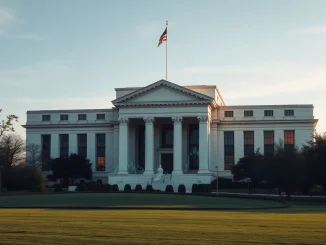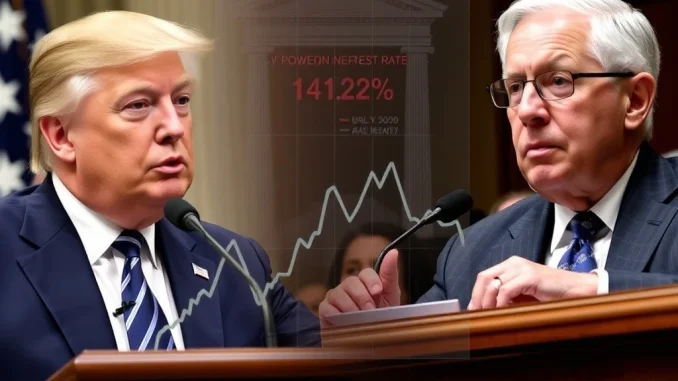
WASHINGTON, D.C. – March 2025 – President Donald Trump has intensified pressure on the Federal Reserve, publicly urging immediate interest rate reductions despite recent positive economic indicators. This latest intervention marks another chapter in the ongoing tension between the White House and the nation’s independent central bank, raising fundamental questions about monetary policy autonomy during periods of economic expansion.
Federal Reserve Faces Renewed Presidential Pressure
According to Walter Bloomberg’s reporting, President Trump specifically criticized Federal Reserve Chairman Jerome Powell’s approach to monetary policy. The President asserted that the central bank leader “is ruining every bull market” through restrictive interest rate policies. This criticism emerges despite recent data showing robust economic growth, low unemployment, and controlled inflation metrics. The Federal Reserve typically maintains operational independence from political influence, a principle established over decades to ensure monetary decisions prioritize long-term economic stability over short-term political considerations.
Historical context reveals this isn’t the first presidential challenge to Fed independence. President Lyndon Johnson famously confronted Fed Chairman William McChesney Martin in 1965, while President Richard Nixon pressured Arthur Burns in the early 1970s. However, modern norms have generally preserved clearer separation between monetary and fiscal authorities. Trump’s latest comments therefore represent a significant contemporary test of these institutional boundaries.
Interest Rate Policy in Economic Context
The Federal Reserve’s current interest rate framework reflects careful balancing of multiple economic indicators. Recent data shows:
- GDP Growth: 2.8% annualized rate in Q4 2024
- Unemployment: 3.7% as of February 2025
- Core Inflation: 2.3% year-over-year
- Federal Funds Rate: 4.75-5.00% target range
Economists generally interpret these figures as indicating a healthy, expanding economy that might not require stimulative rate cuts. The Fed’s dual mandate requires balancing maximum employment with price stability, creating complex decision matrices that often conflict with political preferences for accelerated growth.
Expert Perspectives on Monetary Independence
Former Federal Reserve officials and monetary policy experts express concern about political pressure influencing rate decisions. “The Fed’s independence represents a cornerstone of modern economic stability,” explains Dr. Sarah Chen, former Federal Reserve Board economist now at the Brookings Institution. “When markets perceive political interference, they often react with increased volatility and reduced confidence in long-term price stability.”
Historical analysis supports this perspective. Research from the National Bureau of Economic Research indicates that periods of perceived Fed independence correlate with lower long-term inflation expectations and reduced market volatility. Conversely, episodes of political pressure frequently precede policy errors, including the Great Inflation of the 1970s and subsequent painful disinflation periods.
Bull Market Dynamics and Monetary Policy
President Trump’s specific criticism about “ruining every bull market” references the relationship between interest rates and equity valuations. Lower interest rates generally support higher stock prices through multiple mechanisms:
| Transmission Channel | Effect on Stocks |
|---|---|
| Discount Rate Effect | Lower rates increase present value of future earnings |
| Corporate Borrowing | Reduced financing costs boost profitability |
| Investor Behavior | Lower bond yields make equities relatively attractive |
| Economic Growth | Stimulative policy supports corporate revenue |
However, the Federal Reserve must consider broader economic impacts beyond equity markets. Excessive monetary accommodation can fuel asset bubbles, encourage risky leverage, and undermine long-term financial stability. The 2008 financial crisis demonstrated how prolonged low-rate environments can distort risk assessment and create systemic vulnerabilities.
Global Central Banking Comparisons
International context provides important perspective on the Fed’s position. Major central banks currently maintain varied policy stances:
- European Central Bank: Maintaining cautious stance with gradual normalization
- Bank of Japan: Continuing ultra-accommodative policy amid deflation concerns
- Bank of England: Balancing inflation control with growth support
- People’s Bank of China: Implementing targeted stimulus measures
This global divergence reflects different economic conditions and institutional frameworks. The Federal Reserve’s relative hawkishness stems from the United States’ stronger recovery trajectory and greater inflationary pressures compared to other advanced economies. International coordination remains limited, with each central bank prioritizing domestic mandates over global policy alignment.
Market Reactions and Forward Guidance
Financial markets have shown measured responses to the presidential comments. Equity futures initially dipped on concerns about institutional stability, while Treasury yields exhibited modest volatility. Market participants generally expect the Federal Reserve to maintain its data-dependent approach, with futures pricing indicating only modest probability of near-term rate cuts absent significant economic deterioration.
The Fed’s communication strategy emphasizes forward guidance based on economic indicators rather than political considerations. Recent statements from Federal Open Market Committee members consistently highlight patience and careful assessment of incoming data. This approach aims to maintain policy credibility while avoiding premature reactions to transitory political pressures.
Conclusion
President Trump’s renewed call for Federal Reserve interest rate cuts highlights persistent tensions between political objectives and monetary policy independence. While presidential interest in economic management remains legitimate, institutional safeguards protecting central bank autonomy serve crucial stabilizing functions. The Federal Reserve’s current stance reflects careful balancing of multiple economic indicators, with decisions ultimately resting on empirical data rather than political preferences. As economic conditions evolve, maintaining this delicate balance between democratic accountability and technical expertise will continue challenging policymakers across the institutional spectrum.
FAQs
Q1: Why does President Trump want the Federal Reserve to cut interest rates?
President Trump believes lower interest rates would further stimulate economic growth and support financial markets. He has expressed concern that current monetary policy might restrain the ongoing bull market in equities.
Q2: How independent is the Federal Reserve from political pressure?
The Federal Reserve operates with substantial independence, established by Congress to insulate monetary policy from short-term political considerations. While presidents appoint Fed chairs and board members, the institution makes policy decisions based on economic analysis rather than political directives.
Q3: What economic indicators does the Federal Reserve consider when setting interest rates?
The Fed primarily considers inflation data, employment figures, GDP growth, financial stability metrics, and global economic conditions. Their dual mandate requires balancing maximum employment with price stability.
Q4: Have other presidents pressured the Federal Reserve on interest rates?
Yes, several presidents have expressed preferences regarding monetary policy, including Lyndon Johnson, Richard Nixon, and George H.W. Bush. However, modern norms have generally strengthened institutional independence since the high-inflation episodes of the 1970s.
Q5: What are the risks of cutting interest rates during economic expansion?
Premature rate cuts during expansionary periods can overstimulate the economy, potentially causing asset bubbles, excessive inflation, and financial instability. They may also reduce policy flexibility needed for future economic downturns.