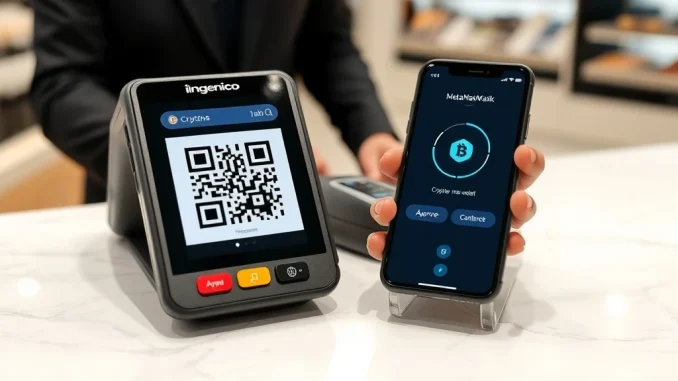
In a landmark development for cryptocurrency adoption, global payment processing giant Ingenico announced a strategic partnership with WalletConnect Pay on March 15, 2025, fundamentally transforming how consumers can use digital assets for everyday purchases. This collaboration enables direct stablecoin payments at physical retail locations worldwide, bridging the gap between blockchain technology and conventional commerce. Consequently, millions of merchants using Ingenico terminals can now accept major stablecoins like USDC, EURC, and USDT through popular cryptocurrency wallets including MetaMask and Trust Wallet.
Ingenico’s Strategic Move into Stablecoin Payments
Ingenico, a French multinational corporation with over four decades of payment industry experience, processes transactions for more than 40 million merchants globally. The company’s decision to integrate WalletConnect Pay represents a significant validation of cryptocurrency’s role in mainstream finance. Moreover, this partnership arrives during a period of accelerating institutional adoption of digital assets. Financial analysts immediately recognized the announcement as a pivotal moment for retail cryptocurrency integration. The implementation leverages Ingenico’s existing AXIUM platform, which already supports various payment methods including credit cards, mobile wallets, and QR code systems. Therefore, the stablecoin functionality integrates seamlessly into established merchant workflows without requiring additional hardware investments.
The Technical Implementation and User Experience
The integration operates through a streamlined process that maintains security while ensuring convenience. First, customers select the WalletConnect Pay option on the Ingenico terminal. Subsequently, the terminal generates a QR code containing payment details. Then, users scan this code with their cryptocurrency wallet application. Importantly, supported wallets include MetaMask, Trust Wallet, Rainbow, and other WalletConnect-compatible applications. After scanning, users confirm the transaction amount and currency within their wallet interface. Finally, the transaction settles on the respective blockchain network, typically within seconds. This process mirrors conventional contactless payments in speed while utilizing blockchain technology for settlement.
Understanding the Stablecoin Ecosystem for Retail
The partnership specifically supports three major stablecoins, each serving distinct market segments. USDC (USD Coin), issued by Circle, maintains full dollar reserves and undergoes regular attestations. EURC provides euro-pegged stability for European markets. Meanwhile, USDT (Tether) represents the most widely adopted stablecoin by market capitalization. These digital assets offer price stability by pegging their value to traditional currencies. Consequently, they eliminate the volatility concerns associated with cryptocurrencies like Bitcoin or Ethereum for daily transactions. Retailers benefit from immediate settlement and reduced processing fees compared to traditional card networks. Additionally, blockchain transactions provide transparent audit trails and minimize chargeback risks.
| Stablecoin | Issuer | Blockchain Networks | Reserve Type |
|---|---|---|---|
| USDC | Circle | Ethereum, Solana, Polygon | Cash & U.S. Treasuries |
| EURC | Circle | Ethereum, Solana, Stellar | Euro Deposits |
| USDT | Tether | Ethereum, Tron, Solana | Commercial Paper & Reserves |
Market Context and Competitive Landscape
This announcement follows several years of gradual cryptocurrency integration in payment systems. Previously, companies like BitPay and Coinbase Commerce enabled online cryptocurrency payments. However, physical retail adoption faced significant technical and regulatory hurdles. Meanwhile, competitors including Verifone and Clover have explored limited cryptocurrency integrations. Nevertheless, Ingenico’s partnership represents the most comprehensive solution from a traditional payment processor. The timing coincides with regulatory clarity in major markets regarding stablecoin usage. For instance, the European Union’s Markets in Crypto-Assets (MiCA) regulation establishes clear frameworks for stablecoin issuers. Similarly, United States legislation has progressed toward comprehensive digital asset regulation.
Implications for Merchants and Consumers
Merchants gain multiple advantages from accepting stablecoin payments through this integration. First, transaction fees typically range between 0.5% and 1%, substantially lower than credit card processing rates. Second, settlements occur within minutes rather than days, improving cash flow management. Third, the system reduces fraud risks associated with card-present transactions. Fourth, merchants can attract cryptocurrency-enthusiast customers who prefer spending digital assets. Conversely, consumers benefit from enhanced payment options and potential loyalty rewards. Many cryptocurrency wallets offer integrated reward programs for transactions. Additionally, international travelers can avoid foreign exchange fees by using globally accepted stablecoins.
- Lower Transaction Costs: Stablecoin payments bypass traditional interchange fees
- Faster Settlement: Blockchain confirmation versus multi-day bank processing
- Enhanced Security: Cryptographic verification reduces fraud potential
- Global Accessibility: Borderless transactions without currency conversion
- Financial Inclusion: Unbanked populations can participate via mobile wallets
Technical Infrastructure and Security Considerations
The implementation utilizes WalletConnect’s established protocol for secure communication between wallets and applications. This open-source technology creates encrypted connections without exposing private keys. Ingenico terminals run validated software ensuring compliance with Payment Card Industry (PCI) standards. Furthermore, the system incorporates multiple security layers including transaction limits and merchant verification. Stablecoin transactions settle on their respective blockchain networks, providing immutable records. However, the partnership does not require merchants to custody cryptocurrency directly. Instead, payment processors can immediately convert stablecoins to fiat currency if desired. This approach minimizes volatility exposure for traditional businesses.
Regulatory Compliance and Industry Standards
Ingenico’s implementation addresses regulatory requirements through several mechanisms. First, the company conducts Know Your Customer (KYC) verification through partner exchanges and wallet providers. Second, transaction monitoring systems detect suspicious activity patterns. Third, the platform supports jurisdictional restrictions where cryptocurrency payments face limitations. Fourth, the system maintains detailed audit trails for tax reporting purposes. Industry organizations including the Digital Chamber of Commerce and Blockchain Association have developed compliance frameworks. Meanwhile, accounting standards boards have issued guidance on cryptocurrency transaction recording. Consequently, mainstream businesses can adopt this technology with regulatory confidence.
Future Developments and Expansion Plans
Industry observers anticipate several developments following this initial implementation. First, additional stablecoins may join the supported list based on market demand. Second, loyalty program integrations could enhance consumer adoption. Third, cross-border payment optimizations might leverage blockchain efficiency. Fourth, central bank digital currency (CBDC) compatibility could emerge as governments issue digital currencies. WalletConnect continues developing enhanced features for merchant interactions. Simultaneously, Ingenico plans regional rollouts across Europe, North America, and Asia-Pacific markets. Pilot programs already demonstrated successful transactions in select metropolitan areas. Therefore, broader availability should materialize throughout 2025 and 2026.
Conclusion
The Ingenico and WalletConnect Pay partnership represents a transformative moment for cryptocurrency adoption in physical commerce. This integration enables practical stablecoin payments at retail locations worldwide through established payment infrastructure. Consequently, millions of consumers can utilize digital assets for everyday purchases with unprecedented convenience. The collaboration combines Ingenico’s merchant network with WalletConnect’s wallet interoperability, creating a seamless payment experience. As regulatory frameworks mature and technological adoption accelerates, stablecoin payments may become commonplace alongside traditional payment methods. Ultimately, this development advances the broader integration of blockchain technology into global financial systems, potentially reshaping how consumers and businesses exchange value.
FAQs
Q1: Which cryptocurrency wallets work with Ingenico’s new stablecoin payment system?
Supported wallets include any application compatible with the WalletConnect protocol, most notably MetaMask, Trust Wallet, Rainbow, and Coinbase Wallet. Users simply scan the QR code displayed on the Ingenico terminal with their wallet application to initiate transactions.
Q2: Do merchants receive payment in stablecoins or traditional currency?
Merchants can choose their settlement preference through payment processor configurations. Options typically include immediate conversion to local fiat currency or direct receipt of stablecoins. Most traditional retailers likely prefer fiat settlement to avoid cryptocurrency volatility and accounting complexity.
Q3: How do transaction fees compare to credit card payments?
Stablecoin transactions generally incur lower fees than credit card payments, typically ranging from 0.5% to 1% versus 1.5% to 3.5% for card transactions. The exact pricing depends on the payment processor and transaction volume, but blockchain settlement eliminates interchange fees charged by card networks.
Q4: What happens if a stablecoin transaction fails during checkout?
The system incorporates multiple confirmation steps before completing transactions. If blockchain confirmation fails, the terminal displays an error message and the transaction does not proceed. Users’ funds remain in their wallets unchanged, and they can retry the payment or use alternative payment methods.
Q5: Are there transaction limits for stablecoin payments at Ingenico terminals?
Yes, both wallet providers and merchants can implement transaction limits for security purposes. These typically align with standard point-of-sale limits for contactless payments. Higher-value transactions may require additional verification steps, similar to conventional payment security protocols.