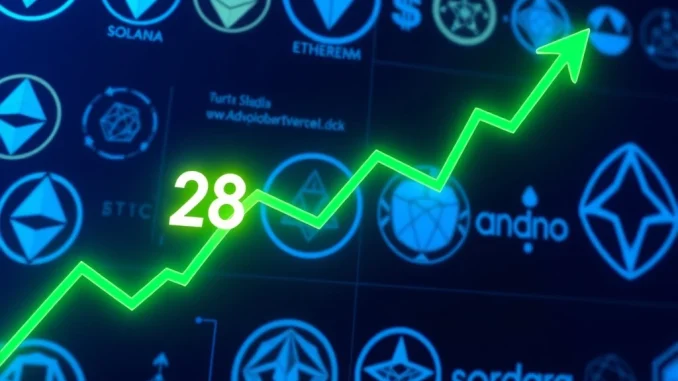
Global cryptocurrency markets are witnessing a subtle but significant shift, as evidenced by CoinMarketCap’s latest data. The Altcoin Season Index, a crucial barometer for market sentiment, has climbed to 28, marking a two-point increase from the previous day. This movement, while still far from the threshold that declares a full altcoin season, provides a vital data point for analysts and investors tracking the complex dynamics between Bitcoin and alternative cryptocurrencies. The index’s rise suggests a potential early-stage rotation of capital and interest, a phenomenon historically scrutinized for its predictive value in bull and bear market cycles.
Understanding the Altcoin Season Index and Its Rise to 28
CoinMarketCap’s Altcoin Season Index serves as a quantitative tool for measuring market cycles. Specifically, it tracks the performance of the top 100 cryptocurrencies, excluding stablecoins and wrapped tokens, against Bitcoin over a rolling 90-day window. The mechanism is straightforward yet powerful: if 75% of these altcoins outperform Bitcoin during that period, the market officially enters an “altcoin season.” Consequently, the index score reflects this percentage, with a score of 100 indicating a confirmed season. The recent move to 28, therefore, signifies that approximately 28% of major altcoins have outperformed Bitcoin over the last quarter. This is a measurable, albeit early, signal of changing relative strength.
Historically, the index oscillates between prolonged periods of Bitcoin dominance, often called “Bitcoin seasons,” and explosive altcoin rallies. For instance, the last major altcoin season, declared in early 2021, saw the index sustain scores above 75 for several months, coinciding with massive rallies in assets like Ethereum, Binance Coin, and Solana. The current reading of 28 sits firmly in what analysts often term a “Bitcoin-dominant” phase, but the upward trajectory is noteworthy. Market data from previous cycles shows that sustained climbs in the index often precede broader altcoin momentum, making this two-point gain a point of focused observation for technical and on-chain analysts alike.
Decoding the Market Context Behind the Movement
The increase in the Altcoin Season Index does not occur in a vacuum. It coincides with several macroeconomic and sector-specific developments. Firstly, broader equity market stability and shifting expectations around central bank monetary policy have altered risk appetites. Secondly, within the crypto ecosystem, developments in layer-1 blockchain upgrades, the expansion of decentralized finance (DeFi) total value locked (TVL), and renewed interest in specific sectors like real-world assets (RWA) and decentralized physical infrastructure networks (DePIN) have provided fundamental support for select altcoins. This creates a fertile, albeit selective, environment for altcoins to begin demonstrating relative strength.
Furthermore, Bitcoin’s own price action plays a defining role. Periods of Bitcoin consolidation after significant rallies have historically been the launchpad for altcoin seasons. When Bitcoin’s volatility decreases and its price establishes a support level, investors and traders often seek higher-beta opportunities in the altcoin market to amplify returns. The current index movement suggests this search may be beginning in a measured way. On-chain analytics firms like Glassnode and CryptoQuant report subtle increases in altcoin exchange inflows and social dominance metrics, providing corroborating data points for the shift the index indicates.
Expert Analysis: Interpreting the Signal
Financial analysts and seasoned cryptocurrency researchers emphasize caution alongside curiosity. “An index reading of 28 is not a buy signal for altcoins, but it is a watch signal,” notes a market strategist from a major digital asset fund. “It tells us that the extreme Bitcoin dominance seen in late 2023 and early 2024 is potentially moderating. The key is sustainability. We need to see if this is a one-day blip or the start of a trend where the index consistently makes higher lows and higher highs.” This perspective underscores the importance of time-series analysis over single data points.
Another angle comes from behavioral finance experts. They point out that the very publication of this index data can become a self-reinforcing narrative. As traders monitor the Altcoin Season Index, a rising score can itself spur increased attention and capital allocation towards altcoins, creating a feedback loop. However, this effect is typically limited without strong underlying fundamentals, such as increased network usage, developer activity, or protocol revenue. Therefore, a holistic analysis combines the index data with fundamental on-chain metrics for individual assets.
The Historical Impact and Future Trajectory
Examining past cycles reveals patterns. The transition from a Bitcoin season to an altcoin season is rarely abrupt. It typically follows a sequence: Bitcoin leads a bull market, peaks, and enters a correction or consolidation phase. During this consolidation, capital begins rotating into large-capitalization altcoins (like Ethereum), followed by mid-cap and eventually small-cap tokens. The Altcoin Season Index effectively quantifies the early stages of this rotation. The move from 26 to 28, while small, could represent the initial stirrings of this process if supported by continued positive price action in major altcoins against a stable or slowly rising Bitcoin.
Key factors that could propel the index higher include:
- Ethereum ETF Developments: Regulatory progress on spot Ethereum ETFs would directly benefit the largest altcoin by market cap, pulling the entire index upward.
- Layer-1 Innovation: Successful major upgrades or technological breakthroughs in networks like Solana, Avalanche, or Cardano can drive isolated outperformance.
- DeFi and NFT Revival: A resurgence in decentralized application usage and non-fungible token trading volume often correlates with altcoin strength.
- Macroeconomic Tailwinds: A decline in interest rates or a weaker US dollar generally benefits risk assets, including cryptocurrencies, with altcoins often displaying higher sensitivity.
Conversely, a sharp downturn in Bitcoin’s price usually drags the entire market down, resetting any nascent altcoin strength. The index is a relative measure, not an absolute one; altcoins can fall in price but still “outperform” if Bitcoin falls more sharply.
Conclusion
The Altcoin Season Index’s rise to 28 offers a nuanced, data-driven snapshot of a cryptocurrency market in flux. It signals a tentative but measurable shift in relative performance away from sole Bitcoin dominance. For market participants, this index serves as a critical dashboard metric, highlighting the need for diversified analysis that includes on-chain data, macroeconomic factors, and sector-specific developments. While the market remains far from declaring a true altcoin season, the upward movement of the index provides a clear, objective prompt for investors to scrutinize altcoin fundamentals more closely. The journey from 28 to the season-defining threshold of 75 will depend on a confluence of sustained capital rotation, positive ecosystem developments, and a stable macro backdrop, making the index’s future trajectory a key storyline to monitor in the coming quarters.
FAQs
Q1: What exactly does an Altcoin Season Index score of 28 mean?
It means that over the past 90 days, approximately 28% of the top 100 cryptocurrencies (excluding stablecoins) have outperformed Bitcoin. The index measures relative performance, not absolute price gains.
Q2: At what score is an altcoin season officially declared?
An altcoin season is officially declared when the index reaches 75, indicating that 75% of the top altcoins have outperformed Bitcoin over the preceding 90-day period.
Q3: Does a rising index guarantee that altcoin prices will go up?
No. The index measures performance relative to Bitcoin. Altcoin prices could be falling, but if they are falling less sharply than Bitcoin’s price, the index can still rise. It is a measure of relative strength, not absolute bullishness.
Q4: How often is the Altcoin Season Index updated?
CoinMarketCap updates the Altcoin Season Index daily, providing a near-real-time view of the shifting dynamics between Bitcoin and the broader altcoin market.
Q5: What is the difference between a “Bitcoin season” and an “altcoin season”?
A Bitcoin season is characterized by Bitcoin significantly outperforming the majority of altcoins, often during periods of high macroeconomic uncertainty or when Bitcoin is driving a new bull market. An altcoin season occurs when the majority of altcoins outperform Bitcoin, typically during periods of market euphoria and sector-specific innovation within the blockchain ecosystem.