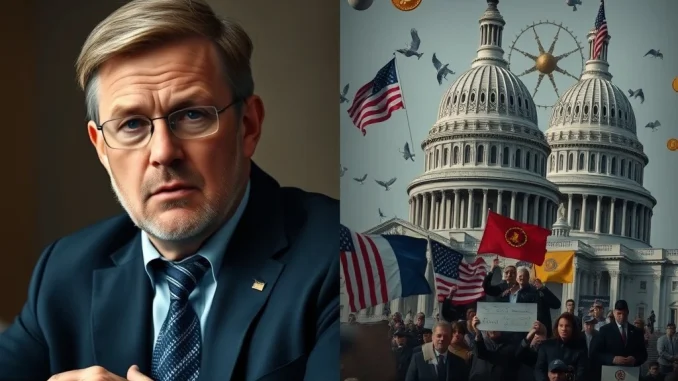
In a striking analysis that challenges prevailing political narratives, Cardano founder Charles Hoskinson has delivered a sobering assessment of U.S. cryptocurrency policy, asserting that actions under the Trump administration have proven more detrimental to the industry’s regulatory progress than those under President Biden. Speaking from his Colorado-based office in late March 2025, the blockchain pioneer provided exclusive insights to CoinDesk, detailing how a single event transformed the legislative landscape and halted critical bipartisan efforts.
Cardano Founder Details Policy Reversal Timeline
Charles Hoskinson, who founded the Cardano blockchain and its ADA cryptocurrency, possesses unique credibility in this debate. Consequently, his perspective carries significant weight within both technological and policy circles. Initially, the cryptocurrency sector welcomed President Trump’s 2024 election with substantial optimism. Many industry leaders anticipated a regulatory environment more favorable to digital asset innovation. However, Hoskinson argues this optimism proved remarkably fleeting.
The pivotal moment arrived in early February 2025. President Trump and First Lady Melania Trump launched official memecoins through a platform called the “Patriot Point Network.” This event created immediate and profound consequences. Subsequently, the bipartisan cooperation that had been carefully cultivated throughout late 2024 and January 2025 evaporated completely. The memecoin launch effectively recast cryptocurrency regulation as a fiercely partisan political issue.
The Legislative Fallout of the 2025 Memecoin Launch
Before February 2025, Congress had been making tangible progress on two landmark pieces of legislation. These bills enjoyed support from both Democratic and Republican lawmakers. The Generating New Innovations and Unleashing Securities (GENIUS) Act aimed to establish a clear federal framework for stablecoin issuance and oversight. Simultaneously, the Clarity for Lending, Assets, and Regulatory Innovation Technology Yield (CLARITY) Act sought to define jurisdictional boundaries between the SEC and CFTC for digital asset markets.
Hoskinson states unequivocally that both bills would likely have passed by mid-2025 without the political disruption caused by the presidential memecoin launch. The table below outlines the key legislative impacts:
| Legislation | Primary Goal | Status Pre-February 2025 | Status Post-February 2025 |
|---|---|---|---|
| GENIUS Act (Stablecoins) | Federal oversight framework | Bipartisan committee approval | Stalled in Senate |
| CLARITY Act (Market Structure) | SEC/CFTC jurisdiction clarity | House floor debate scheduled | Withdrawn from calendar |
This legislative paralysis has created tangible uncertainty for the entire U.S. crypto sector. Businesses now face continued regulatory ambiguity. Investors encounter persistent risks from unclear rules. Furthermore, innovation may migrate to jurisdictions with more predictable frameworks.
Expert Analysis on Political Polarization
Hoskinson’s critique extends beyond mere legislative tracking. He provides a deeper analysis of the political dynamics. The memecoin launch, he suggests, allowed critics to frame the entire cryptocurrency industry through a simplistic and partisan lens. Democratic lawmakers who previously engaged constructively now faced pressure to distance themselves from what opponents labeled “Trump coins.” Conversely, some Republican supporters began conflating support for specific political figures with support for sound technological policy.
This polarization damaged the nuanced, technical discussions required for effective regulation. Policy debates about consumer protection, financial stability, and innovation should transcend political tribalism. Unfortunately, the 2025 event made such reasoned discourse significantly more difficult. The industry now struggles to rebuild a consensus that recognizes cryptocurrency’s complex nature.
Comparing Administrative Approaches to Cryptocurrency
To understand Hoskinson’s claim, one must examine the policy trajectories of both administrations. The Biden administration, particularly through the SEC under Chair Gary Gensler, pursued a stringent enforcement-centric approach. This strategy focused heavily on applying existing securities laws to digital assets. While this created compliance challenges, it operated within a known legal paradigm.
The Trump administration’s approach initially signaled a shift toward legislative clarity. However, the memecoin launch introduced a new variable: direct executive branch entanglement with speculative crypto assets. This action, according to Hoskinson, created a different kind of harm. It poisoned the well of bipartisan political goodwill necessary for passing durable laws. The consequences include:
- Eroded Trust: Lawmakers became wary of appearing to endorse a politically charged asset class.
- Missed Opportunity: A historic chance for comprehensive U.S. crypto regulation was lost.
- Market Confusion: The line between political expression and financial instrument blurred dangerously.
The Path Forward for U.S. Crypto Regulation
The current impasse presents serious challenges for the United States’ role in the global digital economy. Other major jurisdictions, including the European Union with its MiCA framework and the United Kingdom with its phased regulatory plan, are advancing clear rules. U.S. leadership in financial technology risks erosion without legislative action.
Industry advocates now emphasize depoliticizing the conversation. They urge a return to first principles focusing on:
- Consumer and investor protection mechanisms
- Anti-money laundering and cybersecurity standards
- Clear definitions for different digital asset types
- Support for legitimate blockchain innovation
Rebuilding a bipartisan coalition will require diligent effort from industry leaders, policymakers, and advocates. The goal remains a regulatory environment that mitigates risk without stifling the transformative potential of blockchain technology.
Conclusion
Charles Hoskinson’s analysis provides a crucial, experience-driven perspective on the 2025 U.S. cryptocurrency policy landscape. His central argument is compelling: while the Biden administration’s regulatory stance created hurdles through enforcement, the Trump administration’s actions created a deeper, structural harm by derailing bipartisan legislative progress. The failed passage of the GENIUS and CLARITY Acts represents a significant setback for regulatory clarity. Ultimately, the Cardano founder Trump crypto policy assessment serves as a stark warning. The future health of the American crypto industry depends on separating technological policy from short-term political maneuvers and recommitting to substantive, collaborative lawmaking.
FAQs
Q1: What exactly did Charles Hoskinson claim about Trump and Biden’s crypto policies?
Charles Hoskinson claimed that while the Biden administration regulated through enforcement, the Trump administration’s 2025 memecoin launch caused greater damage by destroying bipartisan support for crucial crypto legislation, stalling regulatory progress entirely.
Q2: What were the GENIUS and CLARITY Acts?
The GENIUS Act was a proposed stablecoin regulation bill. The CLARITY Act aimed to clarify whether the SEC or CFTC had primary jurisdiction over various crypto assets. Both were bipartisan efforts stalled after February 2025.
Q3: Why did the memecoin launch have such a big impact?
The launch by political figures turned cryptocurrency into a partisan symbol. Consequently, lawmakers withdrew from collaborative efforts to avoid association with a politically charged asset class, killing the bipartisan consensus needed for lawmaking.
Q4: Is Charles Hoskinson supporting one political party over another?
No. His analysis is policy-focused, not partisan. He criticizes a specific action’s consequence—the derailment of legislation—rather than endorsing either administration’s overall philosophy.
Q5: What is the current state of U.S. crypto regulation after this event?
As of mid-2025, comprehensive federal regulation remains stalled. The industry operates under a patchwork of state laws and existing federal enforcement, creating significant uncertainty for businesses and investors.