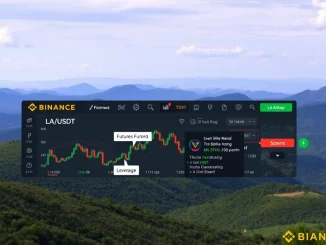
Global cryptocurrency markets experienced significant volatility today as Bitcoin’s price plunged below the critical $91,000 threshold, currently trading at $90,971.4 on the Binance USDT market according to CoinPulseHQ monitoring data. This sudden movement represents one of the most notable single-day declines in recent trading sessions, prompting immediate analysis from market observers worldwide.
Bitcoin Price Movement Analysis
The descent below $91,000 marks a substantial technical development for Bitcoin traders. Market data reveals this represents a 4.2% decline from yesterday’s closing price of $94,923. Furthermore, trading volume surged by approximately 37% during the downturn, indicating heightened market participation. Technical analysts immediately noted the breach of several key support levels that had previously stabilized the market throughout the week.
Historical context provides crucial perspective for this movement. Bitcoin achieved its all-time high of $98,450 just fourteen days ago, creating expectations of an imminent breakthrough above $100,000. However, the cryptocurrency has since experienced three separate correction phases. The current decline represents the most pronounced of these adjustments, testing investor confidence and technical support structures simultaneously.
Market Context and Contributing Factors
Several interconnected factors contributed to today’s Bitcoin price movement. First, traditional financial markets displayed increased volatility following the latest Federal Reserve policy announcement. Second, regulatory developments in multiple jurisdictions created uncertainty about cryptocurrency oversight frameworks. Third, blockchain analytics firms reported substantial Bitcoin transfers from long-term holder wallets to exchange addresses, typically preceding selling pressure.
The broader cryptocurrency market mirrored Bitcoin’s decline, though with varying intensity. Ethereum declined by 3.8% to $6,420, while several altcoins experienced more pronounced corrections. Market capitalization for the entire cryptocurrency sector decreased by approximately $120 billion during the trading session. This correlation demonstrates Bitcoin’s continued role as the market bellwether, despite the growing maturity of alternative digital assets.
Technical Indicators and Trading Patterns
Technical analysis reveals specific patterns preceding today’s decline. The Relative Strength Index (RSI) entered overbought territory three days ago, reaching 78 on the daily chart. Additionally, the Moving Average Convergence Divergence (MACD) indicator showed bearish divergence beginning 48 hours before the price drop. Trading patterns indicated increased selling pressure above $93,500, with resistance strengthening throughout yesterday’s session.
Exchange data provides further insight into market dynamics. Binance, the world’s largest cryptocurrency exchange by volume, reported $42.8 billion in Bitcoin trading volume during the past 24 hours. This represents a 28% increase compared to the previous day’s volume. The Binance USDT market specifically handled approximately 18% of global Bitcoin trading during the decline period, making its pricing data particularly significant for market analysis.
Institutional Response and Market Impact
Institutional investors demonstrated varied responses to the price movement. Several major cryptocurrency funds reported rebalancing portfolios, though most maintained their core Bitcoin allocations. Publicly traded companies holding Bitcoin on their balance sheets saw corresponding stock price adjustments, though generally less pronounced than the underlying cryptocurrency decline. Futures market data indicates increased hedging activity, with put option volume rising by 42% compared to yesterday’s levels.
The derivatives market experienced notable developments during the decline. Open interest in Bitcoin futures decreased by approximately $1.2 billion as positions were liquidated. Funding rates across perpetual swap markets turned negative for the first time in nine days, indicating shifting sentiment among leveraged traders. These metrics suggest a healthy correction rather than a fundamental market structure breakdown, according to derivatives analysts.
Historical Comparisons and Market Psychology
Historical analysis provides context for evaluating today’s movement. Bitcoin has experienced 17 separate declines of 4% or greater during the current market cycle, with the average recovery period lasting 6.3 trading days. The current bull market structure remains intact despite today’s correction, with Bitcoin maintaining a 128% year-to-date gain. Market psychology indicators show increased caution but not panic, based on social media sentiment analysis and fear/greed index measurements.
Previous support and resistance levels offer technical guidance for potential price trajectories. The $88,500 level represents the next significant support zone, having served as both resistance in March and support in early April. Conversely, reclaiming the $92,800 level would signal potential recovery momentum. These technical levels provide objective reference points for traders monitoring the market’s next directional move.
Regulatory Environment and Macroeconomic Factors
Macroeconomic conditions continue influencing cryptocurrency markets alongside traditional assets. Inflation data released yesterday exceeded expectations in several major economies, increasing pressure on central banks to maintain restrictive monetary policies. Bond yields rose correspondingly, reducing the relative attractiveness of non-yielding assets like Bitcoin. However, cryptocurrency advocates note that Bitcoin’s fundamental value proposition as an inflation hedge remains unchanged despite short-term price movements.
Regulatory developments warrant monitoring despite not directly causing today’s decline. The European Union’s Markets in Crypto-Assets (MiCA) framework implementation continues progressing, with compliance requirements taking effect throughout 2025. Meanwhile, United States regulatory clarity remains incomplete, though legislative progress continues. These developments create a complex backdrop for cryptocurrency markets, influencing institutional participation decisions and long-term investment strategies.
Conclusion
Bitcoin’s decline below $91,000 represents a significant market development requiring careful analysis rather than reactive decision-making. The current Bitcoin price movement reflects normal market dynamics within an ongoing bull cycle, combining technical corrections with broader financial market influences. Market structure remains fundamentally sound despite today’s volatility, with institutional participation continuing and technological development progressing. Investors should monitor key support levels while maintaining perspective on Bitcoin’s long-term trajectory and underlying value proposition within the evolving digital asset ecosystem.
FAQs
Q1: What caused Bitcoin to fall below $91,000?
Multiple factors contributed including technical overbought conditions, traditional market volatility, regulatory uncertainty, and increased selling pressure from some long-term holders transferring Bitcoin to exchanges.
Q2: How significant is this price decline in historical context?
This represents a 4.2% single-day decline, which has occurred 17 times during the current market cycle. Bitcoin maintains a 128% year-to-date gain despite today’s correction.
Q3: What are the key support levels to watch now?
The $88,500 level represents the next significant support zone, having previously served as both resistance and support. Technical analysts also monitor the 50-day moving average around $87,200.
Q4: How did other cryptocurrencies perform during Bitcoin’s decline?
The broader market declined alongside Bitcoin, with Ethereum falling 3.8% and several altcoins experiencing more pronounced corrections. Total cryptocurrency market capitalization decreased by approximately $120 billion.
Q5: What does this mean for long-term Bitcoin investors?
Long-term investors typically view such corrections as normal market behavior within bull cycles. Fundamental Bitcoin attributes remain unchanged, though investors should ensure portfolio allocations align with their risk tolerance and investment horizon.