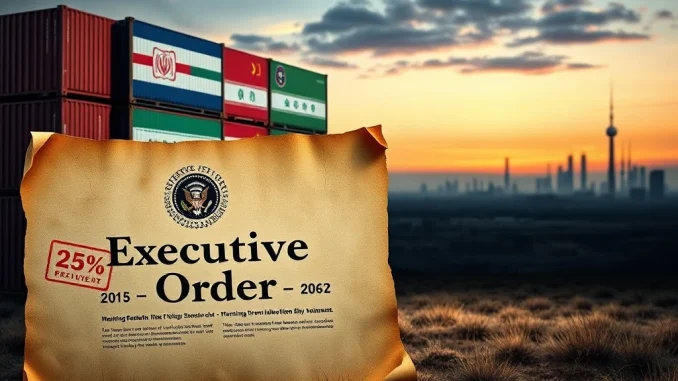
WASHINGTON, D.C. – In a decisive move that sent immediate shockwaves through global financial and diplomatic circles, U.S. President Donald Trump issued a sweeping executive order on Monday, imposing a formidable 25% tariff on any nation that engages in trade with Iran. This aggressive policy, first reported by Walter Bloomberg, represents a significant escalation in the United States’ maximum pressure campaign against Tehran, fundamentally altering the calculus for international businesses and allied governments. Consequently, the order forces a stark choice between access to the American market and economic ties with the Islamic Republic.
Decoding the Trump Iran Tariff Executive Order
The executive order mandates a blanket 25% tariff on all goods imported into the United States from countries that continue substantive trade with Iran. Importantly, the White House defines ‘trade’ broadly, encompassing energy purchases, non-humanitarian goods, and financial transactions. Administration officials clarified the policy’s intent is to economically isolate Iran by leveraging the immense purchasing power of the U.S. market. Therefore, nations must now conduct a rigorous cost-benefit analysis of their Iranian engagements.
This action follows years of escalating tensions. Previously, the U.S. reinstated stringent nuclear-related sanctions after withdrawing from the Joint Comprehensive Plan of Action (JCPOA) in 2018. However, the new tariff mechanism represents a more direct and punitive tool, targeting third countries rather than solely Iranian entities. The Treasury and Commerce Departments will jointly enforce the order, with a 90-day grace period for compliance assessments.
Global Economic Repercussions and Market Turbulence
Financial markets reacted with pronounced volatility following the announcement. Brent crude futures surged over 4% on fears of renewed supply disruptions, while major Asian and European stock indices dipped. Analysts predict several immediate impacts:
- Supply Chain Realignment: Multinational corporations with exposure to both the U.S. and Iranian markets face urgent supply chain restructuring.
- Alliance Strain: Key U.S. allies in Europe and Asia, who have sought to maintain the Iran nuclear deal, now confront a severe economic dilemma.
- Inflationary Pressure: The potential reduction in global trade flows and higher energy costs could contribute to inflationary trends worldwide.
Furthermore, the policy introduces unprecedented complexity into global shipping and insurance. For instance, a container ship carrying goods from a country trading with Iran to the U.S. may now render its entire cargo subject to the steep tariff, regardless of the goods’ origin.
Expert Analysis: A Calculated Geopolitical Gambit
Dr. Anya Petrova, a Senior Fellow at the Center for Strategic and International Studies, provided context. “This is not merely a trade policy,” she stated. “It is a geopolitical instrument designed to fracture international unity on Iran. The 25% figure is strategically chosen—it is high enough to be prohibitive for most trade but allows for potential future negotiation. The administration is betting that the economic pain for U.S. allies will be less than the pain of confronting Washington.”
Historical precedent offers limited guidance. While the U.S. has used secondary sanctions before, a blanket tariff of this scale on allied nations for trading with a third country is largely unprecedented in the modern era. A comparative analysis reveals its unique nature:
| Policy Tool | Target | Mechanism | Example |
|---|---|---|---|
| Primary Sanctions | Iranian Entities | Asset freezes, transaction bans | Sanctions on Central Bank of Iran |
| Secondary Sanctions | Non-U.S. Entities | Cutting off from U.S. financial system | Sanctions on EU companies in 2018 |
| Trump Iran Tariff (2025) | Entire Countries | 25% levy on all U.S.-bound goods | New Executive Order |
Regional Stability and Diplomatic Fallout
The order’s implications extend far beyond economics, directly affecting Middle Eastern security dynamics. Regional powers are recalibrating their positions. Saudi Arabia and the United Arab Emirates, long-time adversaries of Iran, have cautiously welcomed the move as strengthening a pressure-based approach. Conversely, Qatar and Oman, which maintain channels with Tehran, face difficult decisions.
Simultaneously, European Union foreign ministers convened an emergency session. The EU’s INSTEX mechanism, designed to facilitate non-dollar trade with Iran, now faces its most severe test. A spokesperson for the German Ministry for Economic Affairs noted, “We are analyzing the legal and practical implications of this order. Our commitment to the JCPOA and European strategic autonomy remains, but we must also protect our critical economic interests.”
Meanwhile, Iran’s response was swift and defiant. Foreign Minister Javad Zarif condemned the action as “international piracy” and “economic terrorism,” vowing that Iran would expand trade ties with “independent nations.” However, the rial hit a new record low against the dollar on the unofficial market, indicating severe internal economic anxiety.
The Legal and Enforcement Landscape
Legal scholars anticipate immediate challenges. The executive order relies on the International Emergency Economic Powers Act (IEEPA) and the Trading With the Enemy Act, authorities previous presidents have used broadly. However, applying tariffs specifically to punish third-country trade may invite litigation on grounds of overreach. “The courts have traditionally granted wide latitude in matters of national security and foreign policy,” explained constitutional law professor Michael Chen. “Yet, the direct, blanket imposition of tariffs on allies as a foreign policy tool pushes into novel legal territory that will likely be contested.”
Enforcement will hinge on a complex monitoring apparatus. The U.S. will likely utilize financial intelligence, shipping manifests, and energy tracking data to determine which countries are ‘trading with Iran.’ This process itself may become a source of diplomatic friction if findings are disputed.
Conclusion
President Trump’s executive order imposing a 25% tariff on countries trading with Iran marks a pivotal moment in international economic statecraft. This Trump Iran tariff policy transcends traditional sanctions, weaponizing access to the U.S. consumer market to compel global isolation of Tehran. Its success hinges on whether allied nations capitulate to U.S. pressure or form a cohesive bloc to resist it. The coming months will reveal the order’s durability, its impact on global inflation and supply chains, and its ultimate effect on Iran’s regional behavior. One outcome is certain: the rules of economic engagement in U.S. foreign policy have been dramatically and unilaterally rewritten.
FAQs
Q1: What exactly does the Trump executive order on Iran tariffs do?
The order imposes a 25% tariff on all goods imported into the United States from any country that continues to engage in trade with Iran, as defined by the U.S. government. It is designed to economically pressure Iran by compelling other nations to choose between trading with Tehran or having tariff-free access to the U.S. market.
Q2: Which countries are most affected by this 25% tariff?
Countries with significant economic ties to both the U.S. and Iran are most affected. This includes key U.S. allies like Germany, Japan, South Korea, and India, as well as nations like China, Turkey, and Iraq, which have maintained stronger trade relationships with Iran despite previous U.S. sanctions.
Q3: How is ‘trade with Iran’ defined under this executive order?
While full guidelines are pending, U.S. officials indicate it includes purchases of Iranian oil and gas, exports of non-humanitarian goods to Iran, and significant financial transactions that benefit the Iranian government. Humanitarian trade, such as food and medicine, is reportedly exempted.
Q4: Can the European Union’s INSTEX system bypass this Trump Iran tariff?
Potentially, but with great difficulty. INSTEX is designed to facilitate non-dollar, barter-like trade between Europe and Iran. If European companies use INSTEX for transactions that the U.S. defines as ‘trade,’ the EU as a whole or individual member states could still be subject to the 25% tariff on their exports to America.
Q5: What are the potential consequences for global energy markets?
The immediate consequence is higher oil prices due to fears of reduced Iranian exports and general market volatility. If the tariff successfully forces major importers like China or India to stop buying Iranian oil, global supply could tighten significantly, leading to sustained higher prices at the pump worldwide.
Q6: Is there a grace period before the tariff is enforced?
Yes. The executive order includes a 90-day grace period for the U.S. Treasury and Commerce Departments to establish implementation guidelines and for countries to adjust their policies. This window allows for diplomatic consultations and potential compliance before tariffs are applied.