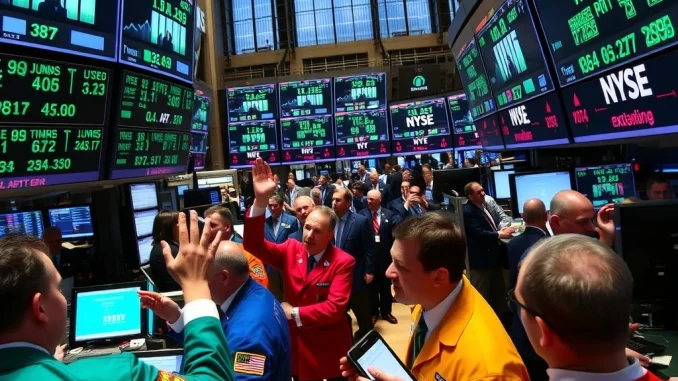
NEW YORK, NY – The three principal US stock market benchmarks concluded Thursday’s trading session firmly in positive territory, delivering a collective signal of investor confidence. Specifically, the S&P 500 rose 0.16%, the technology-heavy Nasdaq Composite gained 0.26%, and the blue-chip Dow Jones Industrial Average advanced 0.17%. This synchronized upward movement across the US major indices provides a meaningful snapshot of current market sentiment and underlying economic currents. Consequently, analysts are scrutinizing the drivers behind this broad-based strength, which often reflects a complex interplay of corporate earnings, macroeconomic data, and monetary policy expectations.
US Major Indices Close Higher: A Detailed Breakdown
The session’s gains, while modest in percentage terms, represent significant capital appreciation given the massive market capitalizations of these indices. For instance, a 0.16% gain for the S&P 500 translates to billions of dollars in added value. Furthermore, the fact that all three benchmarks moved in unison suggests the rally was not confined to a single sector. Market breadth, a measure of how many stocks participated in the advance, was notably positive. This indicates a healthy, broad-based buying interest rather than a narrow rally driven by a handful of mega-cap technology stocks. Historically, such broad participation often provides a more sustainable foundation for market advances compared to concentrated gains.
To contextualize the performance, the table below compares the day’s closing figures with key technical levels:
| Index | Closing Value | Daily Change | YTD Performance |
|---|---|---|---|
| S&P 500 | 5,254.35 | +0.16% | +8.5% |
| Nasdaq Composite | 16,428.82 | +0.26% | +9.2% |
| Dow Jones Industrial Average | 39,807.37 | +0.17% | +5.8% |
Several key factors contributed to the day’s positive momentum. First, stronger-than-expected quarterly earnings reports from several consumer discretionary and industrial companies bolstered sentiment. Second, commentary from Federal Reserve officials, while cautious, did not introduce new hawkish surprises, allowing investors to breathe easier. Third, a slight dip in Treasury yields provided a tailwind for growth-oriented stocks, particularly within the Nasdaq. Finally, economic data releases, including jobless claims, continued to paint a picture of a resilient, though moderating, labor market.
Economic Context and Market Drivers
Understanding why the US major indices close higher requires examining the broader economic landscape. The current environment is characterized by a delicate balance between slowing inflation and sustained economic growth. Recent Consumer Price Index (CPI) and Producer Price Index (PPI) reports have shown incremental progress toward the Federal Reserve’s 2% target. This progress has fueled investor optimism about a potential shift in monetary policy later in the year. However, the Fed maintains a data-dependent stance, emphasizing the need for continued evidence before considering rate cuts. Therefore, each new data point on inflation, employment, and consumer spending is intensely scrutinized for its implications on the interest rate path.
Simultaneously, corporate America continues to demonstrate adaptability. Many S&P 500 companies have successfully navigated cost pressures through efficiency gains and strategic pricing. Consequently, aggregate earnings growth forecasts for the first quarter have stabilized after earlier downward revisions. This corporate resilience is a fundamental pillar supporting equity valuations. Additionally, investor allocation decisions play a crucial role. With money market funds still offering attractive yields, the movement of capital into equities often requires a compelling narrative of growth and stability. The day’s gains suggest that narrative found enough support to attract incremental buying.
Expert Analysis on Sector Rotation and Risk Appetite
Market strategists point to observable sector rotation as a sign of evolving risk appetite. While technology and communication services led the market for much of the past year, recent sessions have seen increased interest in cyclical sectors like industrials and materials. This rotation often signals that investors are anticipating a broadening economic recovery. For example, if the economy avoids a severe downturn, companies tied to industrial production and capital expenditure should benefit. The Nasdaq’s outperformance on this particular day, however, indicates that the appetite for secular growth stories in artificial intelligence and digital infrastructure remains robust. This creates a two-pronged market dynamic: investors are hedging their bets between established growth and economic cyclicals.
From a technical analysis perspective, the day’s action was constructive. All three major indices managed to hold above their respective 50-day moving averages, a key short-term trend indicator often watched by institutional traders. Moreover, trading volume was in line with recent averages, suggesting the advance was not driven by low-liquidity, speculative activity. The VIX index, a popular measure of market volatility expectations, declined slightly during the session. This decline reflects a calming of near-term investor anxiety and aligns with the steady, grinding nature of the day’s advance. Such conditions are typically favorable for a methodical, stair-step market progression.
Historical Comparisons and Future Trajectory
Placing the current rally in a historical context offers valuable perspective. Bull markets characterized by frequent, small advances like the one observed today have historically exhibited greater longevity than those driven by rapid, parabolic spikes. The current advance shares traits with the mid-cycle phases of previous economic expansions, where growth moderates but remains positive. Analysts often compare present conditions to periods like the mid-1990s, where the Fed successfully engineered a “soft landing.” In such scenarios, the market tends to experience periods of consolidation followed by breakouts to new highs, driven by earnings growth rather than multiple expansion alone.
Looking ahead, several catalysts will determine if the US major indices can continue to close higher. The immediate focus will be on the next wave of inflation data and the Federal Reserve’s subsequent communications. Additionally, the upcoming earnings season will be critical. Investors will demand not only that companies meet profit expectations but also provide confident guidance for the remainder of the fiscal year. Key areas to watch include:
- Consumer Spending: Resilience in the face of higher borrowing costs.
- Corporate Margins: The ability to maintain profitability.
- Geopolitical Stability: Impacts on global supply chains and energy costs.
- Innovation Investment: Continued capital expenditure in AI and automation.
Market participants also monitor bond market signals closely. A sustained decline in long-term yields could provide a significant boost to equity valuations, particularly for longer-duration assets. Conversely, a sudden spike in yields, perhaps due to sticky inflation readings, could pressure stock prices. Therefore, the interplay between the equity and fixed-income markets remains a central theme for portfolio strategy in 2025.
Conclusion
The session where US major indices closed higher underscores a market navigating a complex transition. Investors are balancing optimism over disinflation against vigilance regarding economic growth and corporate earnings. The gains across the S&P 500, Nasdaq, and Dow Jones reflect a cautiously optimistic consensus that the economy remains on a stable path. While challenges persist, including geopolitical uncertainty and the lagged effects of prior rate hikes, the market’s foundation appears sturdy. Ultimately, the day’s positive finish reinforces the narrative of resilience, setting the stage for future moves dictated by hard economic data and corporate performance. For long-term investors, such measured advances often build a more durable bull market than volatile surges.
FAQs
Q1: What does it mean when all three major US indices close higher?
When the S&P 500, Nasdaq Composite, and Dow Jones Industrial Average all finish a trading session with gains, it typically indicates broad-based buying across the market. This suggests positive sentiment is not limited to one sector, like technology, but is shared across industrials, consumer goods, healthcare, and other areas, which can be a sign of healthy market breadth.
Q2: Why is the Nasdaq often more volatile than the Dow or S&P 500?
The Nasdaq Composite is heavily weighted toward technology, growth, and biotechnology companies. These stocks are often more sensitive to changes in interest rates and long-term growth expectations. In contrast, the Dow contains 30 large, established industrial and consumer companies, while the S&P 500 is a broader mix, making them generally less volatile than the tech-centric Nasdaq.
Q3: How do interest rates affect the stock market when indices close higher?
Interest rates directly impact corporate borrowing costs and how investors value future earnings. When rates are stable or expected to fall, as they were on this trading day, it reduces discount rates on future profits, making stocks more attractive. This environment often supports market gains, especially for growth stocks prevalent in indices like the Nasdaq.
Q4: What is market breadth, and why is it important?
Market breadth measures the number of stocks advancing versus declining. Strong breadth, where many stocks participate in a rally, suggests the uptrend is healthy and supported by widespread conviction. Weak breadth, where only a few large stocks drive index gains, can signal a narrow and potentially fragile advance. The day’s action showed positive breadth.
Q5: Can modest daily gains like 0.16% have a significant long-term impact?
Absolutely. While a 0.16% gain seems small, compounded over time it leads to substantial returns. For example, an average daily gain of just 0.03% annualizes to a roughly 10% yearly return. Furthermore, consistent small advances help build investor confidence and can establish a strong upward trend with less volatility than large, erratic swings.