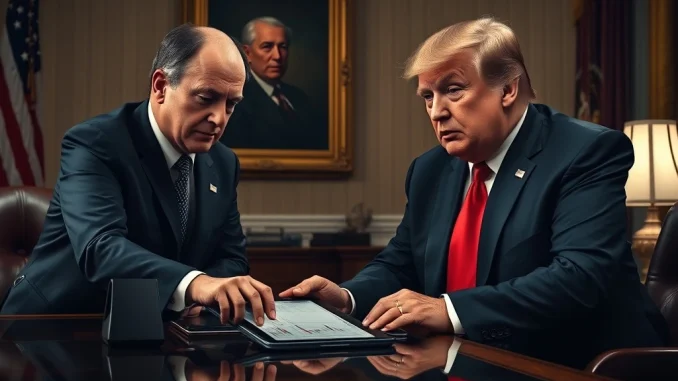
WASHINGTON, D.C. – In a high-stakes intervention with significant implications for global financial stability, U.S. Treasury Secretary Scott Bessent has delivered a stark warning to President Donald Trump. According to an exclusive report from Axios, Secretary Bessent cautioned that any political investigation into Federal Reserve Chair Jerome Powell could trigger severe market volatility and erode investor confidence at a critical economic juncture in early 2025.
Federal Reserve Investigation Sparks Immediate Market Concerns
Secretary Bessent’s private counsel to the President represents a pivotal moment in the often-fraught relationship between the White House and the nation’s central bank. The Treasury chief specifically highlighted that launching a probe into Chair Powell’s conduct or decisions would introduce profound uncertainty into financial markets. Consequently, this uncertainty could undermine the very confidence that supports asset prices, lending, and economic growth. Market analysts immediately noted the potential for such an action to reverse the recent stability in Treasury yields and equity valuations.
Furthermore, the Federal Reserve maintains a delicate balance between its Congressional mandate and operational independence. Historically, perceived political interference has prompted adverse reactions from investors who prize policy predictability. For instance, past episodes of presidential criticism toward the Fed have correlated with short-term spikes in market volatility indices like the VIX. This context makes Bessent’s warning both timely and grounded in observable market mechanics.
The Delicate Balance of Central Bank Independence
Central bank independence serves as a cornerstone of modern economic policy in most developed nations. The Federal Reserve, in particular, operates under a dual mandate from Congress to maximize employment and stabilize prices. Political investigations into its leadership’s policy decisions are exceptionally rare. Such actions risk conflating monetary policy with short-term political objectives, a scenario that international investors typically view with deep skepticism.
Several former Fed officials and academic economists have consistently argued that this independence shields interest-rate decisions from electoral cycles. This shield allows for necessary, albeit sometimes unpopular, measures like raising rates to combat inflation. A probe could signal a weakening of this institutional norm. Therefore, Secretary Bessent’s warning aligns with a broad consensus among policy veterans about the risks of blurring these established lines.
Historical Precedents and Economic Impacts
Examining historical parallels provides crucial context. While no direct precedent exists for a presidential investigation of a sitting Fed Chair, periods of overt political pressure have yielded measurable consequences. For example, public disputes between previous administrations and the Fed have often led to:
- Increased Bond Market Volatility: Uncertainty about future interest rate paths causes wild swings in Treasury prices.
- Currency Depreciation Pressures: The U.S. dollar can weaken on fears of compromised institutional integrity.
- Corporate Investment Delay: Businesses may postpone capital expenditures amid unclear policy outlooks.
- Credit Market Tightening: Lenders may demand higher risk premiums, raising borrowing costs economy-wide.
These potential impacts underscore the substantive nature of the Treasury Secretary’s caution. His role inherently involves monitoring these exact channels of financial transmission.
Analyzing the Treasury Secretary’s Rationale and Role
As the head of the Treasury Department, Scott Bessent’s primary responsibilities include managing federal finance, overseeing economic sanctions, and most relevantly, serving as a key liaison to financial markets. His warning to President Trump, therefore, stems directly from this mandate. The Secretary’s analysis likely incorporates real-time data from Treasury markets, foreign exchange reactions, and feedback from major institutional investors.
Market confidence is not an abstract concept but a functional requirement for government operations. It affects the interest rates the U.S. pays on its massive debt and influences global capital flows. A probe perceived as politically motivated could quickly translate into higher borrowing costs for the government, corporations, and consumers. This chain reaction exemplifies the “real-world context” Bessent would have presented, grounding his warning in tangible fiscal and economic outcomes.
The 2025 Economic Landscape and Systemic Risks
The warning arrives during a period of nuanced economic challenges in 2025. While inflation may have moderated from previous peaks, growth prospects remain uneven, and global geopolitical tensions persist. In this environment, the Federal Reserve’s communications and policy signals are critical tools for anchoring expectations. Any investigation that questions the Chair’s authority or motives could fragment those signals, leading to divergent interpretations by market participants.
Such fragmentation can cause inefficient capital allocation and increased systemic risk. Financial stability, a key area of focus for both the Fed and the Treasury’s Financial Stability Oversight Council (FSOC), depends heavily on clear and credible policy frameworks. Undermining the Fed’s credibility could inadvertently trigger the very instability both institutions work to prevent, creating a paradoxical and self-defeating outcome.
Potential Pathways and Institutional Safeguards
The Axios report does not specify the exact nature of a potential probe, but legal and political avenues are constrained. The Federal Reserve Chair can be removed by the President only “for cause,” a high legal standard established to protect independence. Investigations by Congressional committees are more common but differ significantly from executive branch inquiries. A White House-driven investigation would represent a novel and aggressive approach, likely testing untested legal boundaries.
Institutional safeguards exist but rely on norms as much as laws. The Federal Reserve’s credibility, built over decades, acts as its primary defense. The market’s reaction, as hinted at by Bessent, serves as an immediate feedback mechanism. A sharp, negative market response could itself become a deterrent, demonstrating the financial world’s role as a check on political overreach.
Conclusion
Treasury Secretary Scott Bessent’s warning to President Trump about the risks of a Federal Reserve investigation highlights a fundamental tension in economic governance. The independence of the central bank is not merely a bureaucratic formality but a critical component of market stability and economic confidence. As 2025 unfolds, the administration’s handling of this issue will send powerful signals to global investors about its commitment to institutional norms and financial predictability. The potential for a Powell probe to harm markets, as clearly articulated by the Treasury chief, rests on decades of economic evidence showing that political certainty and monetary policy credibility are indispensable pillars of a functioning financial system.
FAQs
Q1: What was Treasury Secretary Scott Bessent’s specific warning to President Trump?
Secretary Bessent warned that a political investigation into Federal Reserve Chair Jerome Powell could create significant market uncertainty, undermine investor confidence, and potentially harm financial stability, according to an Axios report.
Q2: Why would an investigation into the Fed Chair affect financial markets?
Markets highly value the predictability and perceived independence of central bank policy. An investigation seen as political interference could make future interest rate decisions less predictable, increasing risk premiums, volatility, and borrowing costs across the economy.
Q3: Has a U.S. President ever investigated a sitting Federal Reserve Chair before?
There is no modern precedent for a President initiating an investigation into a sitting Fed Chair. While Presidents have publicly criticized the Fed, direct executive branch investigations into its leadership for policy decisions are unprecedented in the post-war era.
Q4: What is the legal basis for Federal Reserve independence?
The Fed’s independence is not explicitly stated in a single statute but is derived from its structure. The Chair serves a four-year term, and members of the Board of Governors can only be removed “for cause” by the President, a provision interpreted by courts as insulation from political pressure over policy.
Q5: How have financial markets reacted to past political pressure on the Fed?
Historical instances of strong public criticism from the White House have often been followed by short-term increases in market volatility, a weakening of the U.S. dollar, and a steepening of the yield curve as investors price in higher uncertainty.