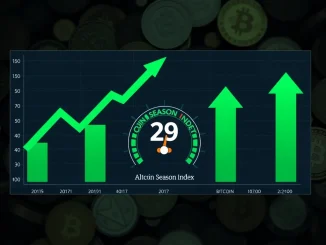
In a definitive signal for cryptocurrency market structure, CoinMarketCap’s pivotal Altcoin Season Index currently registers a score of 26, firmly indicating a sustained Bitcoin season as of early 2025. This critical metric, which quantifies the relative performance of major digital assets, provides investors with a data-driven snapshot of capital flows and risk appetite across the blockchain ecosystem. Consequently, understanding this index’s position is essential for navigating the complex dynamics between the flagship cryptocurrency and its numerous alternatives.
Decoding the Altcoin Season Index and Its Current Reading
The Altcoin Season Index serves as a crucial barometer for the broader digital asset market. Specifically, analysts calculate this metric by comparing the 90-day price performance of the top 100 cryptocurrencies, excluding stablecoins and wrapped tokens, against Bitcoin’s performance during the same period. A score closer to 100 suggests a robust altcoin market where the majority of these assets outperform Bitcoin. Conversely, a score of 26, as observed currently, decisively signals a Bitcoin-dominant phase. The official threshold for an “altcoin season” is crossed when 75% of the top altcoins outperform Bitcoin, a condition far from the present reality.
This methodology offers a clear, quantitative lens on market cycles. Historically, periods of extreme Bitcoin outperformance, often called “Bitcoin seasons,” correlate with macroeconomic uncertainty or a flight to perceived quality within crypto. Alternatively, altcoin seasons typically emerge during periods of high risk appetite, technological innovation narratives, and expansive liquidity. The persistent low score underscores a market preference for the relative stability and established network effects of Bitcoin over the speculative potential of smaller-cap altcoins.
Historical Context and Market Cycle Analysis
Placing the current index value of 26 into historical context reveals significant insights. For instance, during the bull market climax of late 2021, the index frequently hovered above 75, confirming a powerful altcoin season. During that phase, capital rotated aggressively into decentralized finance (DeFi) tokens, non-fungible token (NFT) projects, and emerging layer-1 blockchains. However, the subsequent bear market saw the index plummet and remain low, reflecting a dramatic contraction in altcoin liquidity and a retreat to Bitcoin.
The index’s slow recovery trajectory mirrors past cycle behaviors. Analysts often observe that Bitcoin leads market recoveries, attracting initial institutional and macro-driven investment. Subsequently, as confidence builds, capital begins trickling down the risk curve into large-cap altcoins, and eventually into mid and small-cap projects. The prolonged low index score suggests this “trickle-down” process remains in its early stages, with Bitcoin continuing to capture the majority of incoming capital and market attention.
Expert Perspectives on Capital Rotation and Risk
Market strategists point to several factors sustaining this Bitcoin season. Firstly, the maturation of Bitcoin exchange-traded funds (ETFs) in key jurisdictions has created a structured, familiar entry point for traditional finance capital, which often flows primarily into Bitcoin. Secondly, macroeconomic conditions, including interest rate environments and geopolitical tensions, can favor Bitcoin’s narrative as “digital gold” over the utility-focused propositions of many altcoins. Finally, the regulatory landscape remains a pivotal factor; clearer frameworks for Bitcoin contrast with the ongoing uncertainty surrounding many altcoin projects.
Data from on-chain analytics firms supports this view. Metrics such as Bitcoin’s dominance chart—which measures its share of the total cryptocurrency market capitalization—have shown resilience. Furthermore, trading volume ratios and futures market data indicate that professional traders maintain a heavier weighting toward Bitcoin in their portfolios. This collective behavior by large-scale investors directly influences the Altcoin Season Index calculation, reinforcing the current trend.
The Mechanics and Calculation Behind the Metric
Understanding the precise calculation demystifies the “26” score. The process is systematic and transparent:
- Asset Selection: The index uses the top 100 cryptocurrencies by market capitalization, filtering out stablecoins (like USDT, USDC) and wrapped tokens (like WBTC) to ensure a pure performance comparison.
- Time Frame: It analyzes a rolling 90-day window, balancing short-term volatility with meaningful trend identification.
- Performance Comparison: Each altcoin’s percentage price change over the period is compared directly to Bitcoin’s percentage change.
- Scoring: The index reflects the percentage of altcoins that outperformed Bitcoin. A score of 26 means only 26% of the top altcoins beat Bitcoin’s returns in the last quarter.
This table illustrates hypothetical performance scenarios and their corresponding index readings:
| Scenario | % of Top 100 Altcoins Outperforming Bitcoin | Altcoin Season Index Score | Market Phase Indication |
|---|---|---|---|
| Extreme Bitcoin Dominance | Less than 25% | 0-24 | Strong Bitcoin Season |
| Current Market State | 26% | 26 | Bitcoin Season |
| Transition Phase | 50% | 50 | Neutral / Mixed |
| Altcoin Season Threshold | 75% or more | 75-100 | Altcoin Season |
Implications for Investors and Traders
The index provides actionable intelligence for different market participants. For long-term investors, a low score may signal a period to accumulate high-conviction altcoin projects at relatively depressed valuations compared to Bitcoin, anticipating a future rotation. However, it also underscores the continued strength and defensive characteristics of Bitcoin within a portfolio. For active traders, the index acts as a risk sentiment gauge; trading strategies might favor Bitcoin-centric pairs or be more selective with altcoin exposures until the index shows sustained improvement.
Moreover, sector-specific performance within the altcoin universe becomes crucial during Bitcoin seasons. While the broad index is low, certain blockchain sectors—such as decentralized physical infrastructure networks (DePIN) or real-world asset (RWA) tokenization—might demonstrate relative strength. Therefore, savvy market observers use the broad index as a starting point, then drill down into sectoral and individual token metrics to identify early leaders for the next cycle phase.
Monitoring for a Potential Phase Shift
Key indicators that could foreshadow a shift from Bitcoin season include a sustained rise in the index above 50, a breakout in Bitcoin dominance chart resistance levels, and increased altcoin trading volumes relative to Bitcoin. Additionally, catalyst events like successful major protocol upgrades, favorable regulatory clarity for specific altcoin sectors, or a surge in decentralized application user activity could drive capital rotation. Market analysts recommend monitoring the index on a weekly basis, watching for a consecutive four-to-six-week upward trend as a potential early signal of changing conditions.
Conclusion
The Altcoin Season Index, standing firmly at 26, delivers a clear and unambiguous message about the current cryptocurrency market structure: Bitcoin dominance persists. This metric, rooted in comparative performance data, offers an objective framework for understanding capital allocation and risk sentiment across the digital asset landscape. While the index confirms the present is a Bitcoin season, it also provides a vital benchmark for identifying the inflection point when capital begins rotating in earnest toward altcoins. For investors seeking to navigate the volatile crypto markets, this index remains an indispensable tool for strategic decision-making and timing.
FAQs
Q1: What does an Altcoin Season Index score of 26 mean?
An index score of 26 means that only 26% of the top 100 cryptocurrencies (excluding stablecoins) have outperformed Bitcoin over the past 90 days. This firmly indicates a “Bitcoin season,” where Bitcoin is the dominant performer in the market.
Q2: How is the Altcoin Season Index calculated?
The index is calculated by CoinMarketCap. It compares the 90-day price performance of each of the top 100 cryptocurrencies against Bitcoin’s performance. The final score is the simple percentage of those altcoins that outperformed Bitcoin.
Q3: What threshold signals the start of an altcoin season?
An official altcoin season is declared when the index reaches 75 or higher. This means at least 75% of the top altcoins have outperformed Bitcoin over the measurement period.
Q4: Why is the index important for crypto investors?
The index provides a quick, data-driven snapshot of market cycles and risk sentiment. It helps investors understand whether capital is flowing into Bitcoin (a perceived safe haven) or rotating into higher-risk, higher-potential-return altcoins.
Q5: Can certain altcoins perform well during a Bitcoin season?
Yes, absolutely. A low aggregate index score does not preclude individual altcoins or specific sectors from performing exceptionally well. It indicates that outperformance is not a broad-based trend, making selective research and investment even more critical during such phases.
Q6: How often should I check the Altcoin Season Index?
For long-term investors, a monthly check is sufficient to gauge the overarching trend. Active traders might monitor it weekly or even daily alongside other market indicators to spot potential trend changes in capital rotation.