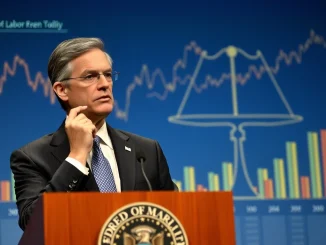
Global financial markets face a pivotal week of critical financial events that will test investor sentiment and shape monetary policy expectations for early 2025. From January 12-16, traders and policymakers will scrutinize multiple Federal Reserve speeches alongside crucial inflation data releases that collectively determine the trajectory of interest rates and economic stability. This concentrated schedule of monetary policy signals arrives as markets seek clarity on whether central banks can successfully navigate persistent inflation concerns while avoiding economic contraction.
Critical Financial Events Calendar: A Week of Monetary Policy Signals
The upcoming week presents an unusually dense concentration of monetary policy communication and economic data releases. Market participants globally will monitor these critical financial events for signals about the Federal Reserve’s next moves. The schedule includes speeches from nine different Federal Reserve officials across five days, creating multiple opportunities for policy signals to emerge. Simultaneously, the release of December’s Consumer Price Index and Producer Price Index data will provide essential evidence about inflation trends. These reports collectively represent the most significant concentration of policy-relevant information since the Federal Reserve’s December meeting.
Financial institutions typically prepare extensively for such event-heavy weeks. Trading desks increase staffing levels, risk management teams implement additional controls, and research departments produce comprehensive preview materials. The clustering of events creates both opportunity and risk for market participants. Clear, consistent messaging from Federal Reserve officials could reinforce market expectations, while contradictory signals or surprising data could trigger significant volatility. Historical analysis shows that weeks with similar event density have produced above-average market movements in recent years.
Federal Reserve Communication Strategy and Market Impact
The Federal Reserve employs a deliberate communication strategy to guide market expectations and reduce policy surprises. This week’s extensive speaking schedule represents a coordinated effort to shape understanding of recent economic developments. Atlanta Fed President Raphael Bostic appears three times, Richmond Fed President Thomas Barkin speaks on four occasions, and FOMC members John Williams and Michelle Bowman each have scheduled remarks. This distribution ensures multiple perspectives reach market participants while maintaining overall policy coherence.
Understanding the Fed’s Beige Book Release
The Federal Reserve’s Beige Book, scheduled for release on January 14 at 7:00 p.m. UTC, provides qualitative economic intelligence gathered from business contacts across all twelve Federal Reserve districts. This document offers crucial context for interpreting quantitative data like CPI and PPI figures. Analysts will scrutinize the Beige Book for evidence of wage pressures, pricing power, consumer spending patterns, and supply chain conditions. The report’s anecdotal evidence often reveals economic trends before they appear in official statistics, making it particularly valuable for forward-looking market analysis.
Previous Beige Book releases have highlighted regional economic variations that national data might obscure. For instance, while national employment figures might show strength, the Beige Book could reveal specific industries or regions experiencing weakness. This granular perspective helps policymakers make more nuanced decisions about interest rates and other monetary tools. Market participants will pay particular attention to any mentions of inflation expectations, labor market tightness, or credit conditions in the upcoming edition.
Inflation Data Analysis: CPI and PPI Significance
The December Consumer Price Index release on January 13 represents the most anticipated economic data point of the week. This inflation gauge measures price changes for a basket of consumer goods and services, providing the broadest view of inflationary pressures facing households. The Federal Reserve specifically targets 2% inflation as measured by the Personal Consumption Expenditures index, but CPI remains the most widely recognized and immediately market-moving inflation indicator. Analysts will examine both headline and core CPI figures, with particular attention to shelter costs, energy prices, and services inflation.
Following the CPI release, the December Producer Price Index on January 14 offers complementary information about inflationary pressures earlier in the production chain. PPI measures price changes received by domestic producers for their output, providing leading indicators about future consumer price movements. When producers face higher input costs, they typically attempt to pass these increases along to consumers, making PPI a valuable predictor of future CPI trends. The relationship between these two indices helps economists distinguish between temporary price spikes and more persistent inflationary trends.
| Metric | Release Time | Primary Focus | Market Significance |
|---|---|---|---|
| Consumer Price Index | Jan 13, 1:30 p.m. UTC | Consumer inflation | High – Direct Fed policy impact |
| Producer Price Index | Jan 14, 1:30 p.m. UTC | Producer inflation | Medium – Leading indicator |
Global Context: South Korea’s Interest Rate Decision
While U.S. events dominate the calendar, South Korea’s interest rate announcement on January 15 at 1:00 a.m. UTC provides important international context. The Bank of Korea’s decision will signal how Asian central banks are responding to similar global economic challenges. As an export-oriented economy with close ties to both China and the United States, South Korea’s monetary policy decisions often reflect broader regional trends. Market analysts will compare the Bank of Korea’s approach to that of the Federal Reserve, looking for divergences or convergences in policy direction.
International monetary policy coordination has become increasingly important in recent years. When major central banks move in different directions, significant currency fluctuations and capital flow disruptions can occur. The timing of South Korea’s announcement, coming between U.S. inflation data and additional Fed speeches, creates a natural comparison point for global investors. Those monitoring the won-dollar exchange rate will pay particular attention to any policy divergence between the two central banks.
Labor Market Indicators: Initial Jobless Claims
The weekly initial jobless claims report on January 15 provides high-frequency data about U.S. labor market conditions. While less comprehensive than monthly employment reports, this data point offers timely insights into employment trends. Persistent increases in jobless claims could signal weakening labor market conditions, potentially influencing Federal Reserve policy decisions. Conversely, consistently low claims would support arguments for maintaining restrictive monetary policy to combat inflation. This report’s proximity to inflation data creates a comprehensive picture of the Fed’s dual mandate concerns.
Market Preparation and Risk Management Strategies
Sophisticated market participants implement specific strategies for event-heavy weeks like this one. Common approaches include reducing position sizes ahead of major announcements, implementing option strategies to hedge against volatility, and establishing clear contingency plans for various data outcomes. The concentration of Federal Reserve speeches requires particular attention to potential message coordination or divergence. When multiple officials speak on the same day, as occurs several times this week, markets must synthesize potentially conflicting perspectives into coherent policy expectations.
Historical volatility patterns show that certain event sequences produce predictable market reactions. For example, when inflation data precedes multiple Fed speeches, officials often use their remarks to contextualize the numbers for markets. This pattern allows for more measured market reactions than when data releases occur in isolation. The sequencing this week appears designed to facilitate this type of measured response, with CPI data arriving before most Fed communications and the Beige Book providing qualitative context for quantitative figures.
Conclusion
This week’s critical financial events calendar presents a comprehensive test of current economic conditions and policy directions. The combination of inflation data, Federal Reserve communications, and international policy decisions will collectively shape market expectations for early 2025. Investors should prepare for potential volatility while recognizing the Federal Reserve’s apparent effort to provide clear guidance through multiple communication channels. The data and speeches will ultimately determine whether current monetary policy remains appropriate or requires adjustment in response to evolving economic conditions.
FAQs
Q1: Why are there so many Federal Reserve speeches scheduled this week?
The Federal Reserve coordinates multiple speeches to ensure clear communication of complex policy positions. Different officials can emphasize various aspects of the economic outlook, providing markets with a more complete picture than any single speaker could offer alone.
Q2: How does the Beige Book differ from official economic statistics?
The Beige Book provides qualitative, anecdotal evidence from business contacts across the country, while official statistics offer quantitative measurements. This combination helps policymakers understand both the numbers and the stories behind them.
Q3: Why do markets pay more attention to CPI than PPI?
CPI directly measures consumer inflation, which affects household purchasing power and drives Federal Reserve policy decisions. PPI serves as a leading indicator but doesn’t directly capture consumer experience.
Q4: How do international rate decisions affect U.S. markets?
Global monetary policy differences influence currency exchange rates, capital flows, and trade competitiveness. When other central banks move differently than the Fed, it affects multinational corporate earnings and international investment patterns.
Q5: What’s the significance of having multiple Fed presidents speaking on the same topics?
Multiple perspectives help markets understand committee consensus and potential disagreements. When officials emphasize similar points, it signals policy cohesion. Divergent emphasis might indicate ongoing debate about appropriate policy direction.