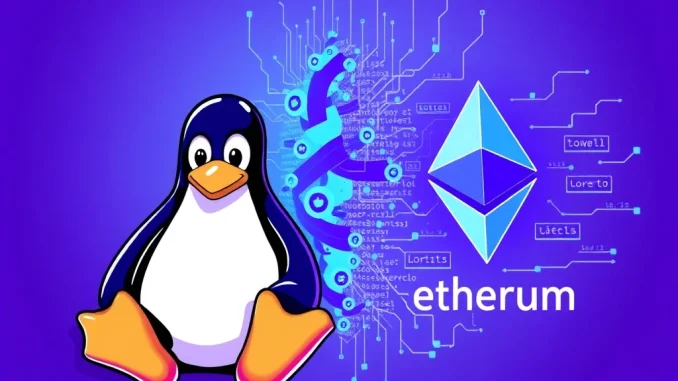
In a landmark statement that could reshape blockchain development, Ethereum co-founder Vitalik Buterin has positioned his creation as the “Linux of the blockchain world.” This powerful comparison, made during a recent industry conference in Zurich, Switzerland on January 10, 2026, signals Ethereum’s ambitious transformation from a smart contract platform into the foundational operating system for Web3. Buterin’s declaration arrives at a critical juncture for decentralized technology, as the network approaches its next major protocol upgrade and faces unprecedented scaling challenges.
Ethereum’s Linux Ambition: Building Web3’s Universal Foundation
Vitalik Buterin’s Linux comparison represents more than mere metaphor. It encapsulates Ethereum’s strategic direction toward becoming open-source infrastructure that empowers developers globally. Linux revolutionized computing by providing free, modifiable software that challenged proprietary systems. Similarly, Ethereum aims to democratize financial systems, governance models, and digital identity verification. The network’s core philosophy mirrors Linux’s foundational principles: transparency, community governance, and permissionless innovation.
Industry analysts immediately recognized the significance of Buterin’s statement. Dr. Elena Martinez, blockchain researcher at Stanford University, explains: “This comparison reveals Ethereum’s maturation from a cryptocurrency platform to infrastructure-grade technology. Just as Linux became the backbone of servers, Android, and embedded systems, Ethereum positions itself as the settlement layer for countless decentralized applications.” This strategic positioning addresses growing concerns about centralized control in digital ecosystems while offering developers standardized building blocks for Web3 applications.
The Technical Parallels: Open-Source Architecture
Ethereum shares several architectural similarities with Linux that justify Buterin’s comparison. Both systems feature:
- Modular Design: Ethereum’s execution, consensus, and data availability layers mirror Linux’s kernel, shell, and applications separation
- Forking Freedom: Developers can create customized implementations, similar to Linux distributions
- Community Governance: Both ecosystems evolve through transparent proposal systems (EIPs for Ethereum, RFCs for Linux)
- Security Through Transparency: Open-source code allows global auditing and vulnerability detection
These characteristics enable Ethereum to serve diverse use cases while maintaining core protocol stability. The network currently processes over 2.2 million daily transactions and hosts more than 4,000 active decentralized applications, demonstrating its infrastructure capacity.
Layer 2 Proliferation: Innovation Versus Fragmentation
Ethereum’s scaling strategy heavily relies on Layer 2 solutions, which now number over 127 active implementations according to L2Beat data. These secondary networks, including Optimistic Rollups and Zero-Knowledge Rollups, process transactions off the main chain while periodically settling on Ethereum. This approach reduces gas fees by 90-99% and increases throughput to thousands of transactions per second. However, this modular architecture creates significant interoperability challenges that threaten network cohesion.
The fragmentation problem manifests in several critical areas:
| Challenge | Impact | Current Solutions |
|---|---|---|
| Liquidity Fragmentation | Capital trapped in isolated Layer 2 ecosystems reduces market efficiency | Cross-chain bridges, shared liquidity protocols |
| Developer Complexity | Building across multiple Layer 2s requires specialized knowledge for each | Unified SDKs, abstraction layers |
| User Experience Issues | Managing assets across chains confuses mainstream adoption | Account abstraction, unified wallets |
| Security Variance | Different Layer 2s implement varying security models | Standardized security frameworks |
Despite these challenges, Layer 2 networks have collectively secured over $45 billion in total value locked, demonstrating strong market validation. Polygon, Arbitrum, and Optimism lead this ecosystem expansion, each developing distinctive approaches to scaling while maintaining Ethereum compatibility.
The Interoperability Imperative
Ethereum’s response to fragmentation centers on developing robust interoperability standards. The Ethereum Foundation’s roadmap includes several key initiatives:
- EIP-4844 Implementation: Proto-danksharding reduces data availability costs for Layer 2s
- Cross-Chain Messaging Standards: CCIP and other protocols enable secure communication between Layer 2s
- Shared Sequencing: Coordinated transaction ordering across multiple rollups
- Unified State Proofs: Verifiable computation across different execution environments
These technical developments aim to create what Buterin calls a “multi-chain, not cross-chain” future, where users experience seamless interaction regardless of which Layer 2 they utilize. This vision requires unprecedented coordination across hundreds of development teams and represents one of blockchain’s most complex engineering challenges.
Web3 Operating System: Ethereum’s Strategic Positioning
Buterin’s Linux analogy extends beyond technical architecture to encompass Ethereum’s role in the emerging Web3 ecosystem. As an operating system provides fundamental services to applications—file management, memory allocation, process scheduling—Ethereum offers decentralized infrastructure services:
- Decentralized Finance (DeFi): Trustless lending, trading, and asset management protocols
- Digital Identity: Self-sovereign identity solutions like Ethereum-based verifiable credentials
- Decentralized Governance: DAO frameworks for community-led decision making
- Digital Ownership: NFT standards for representing unique digital and physical assets
This comprehensive service layer distinguishes Ethereum from narrower blockchain platforms. According to ConsenSys research, over 70% of Web3 developers currently build on Ethereum or its Layer 2 networks, creating powerful network effects. The platform’s first-mover advantage in smart contracts, combined with its extensive tooling and documentation, establishes significant barriers to competition.
Market Validation and Adoption Metrics
Ethereum’s infrastructure positioning receives validation from multiple indicators:
- Institutional adoption through Ethereum-based ETFs and corporate treasury allocations
- Government experimentation with Ethereum for digital identity and supply chain tracking
- Academic research focusing on Ethereum’s consensus mechanisms and scalability solutions
- Enterprise blockchain implementations using Ethereum-compatible private networks
These developments suggest Ethereum is transitioning from speculative asset to foundational technology. The network’s recent protocol upgrades, particularly The Merge’s transition to proof-of-stake, reduced energy consumption by 99.95%, addressing environmental concerns that previously limited institutional participation.
Historical Context: From Niche Technology to Global Infrastructure
Ethereum’s journey toward Linux-like status follows a decade-long evolution. Launched in 2015 with a simple virtual machine for executing smart contracts, the network has undergone multiple transformations:
2015-2017: Early adoption phase focused on ICOs and basic decentralized applications. The DAO hack and subsequent hard fork demonstrated both vulnerability and resilience.
2018-2020: Enterprise exploration through the Enterprise Ethereum Alliance. Growing recognition of Ethereum’s potential beyond cryptocurrency.
2021-2023: DeFi and NFT explosions revealed scaling limitations. Layer 2 solutions gained traction as essential scaling components.
2024-2026: Infrastructure maturation with protocol upgrades and institutional adoption. Buterin’s Linux comparison crystallizes this evolution.
This trajectory mirrors Linux’s own development path from hobbyist operating system to backbone of internet infrastructure. Both technologies overcame early skepticism through relentless community development and demonstrated utility in increasingly critical applications.
The Governance Challenge
Ethereum’s decentralized governance presents both strength and complexity. Unlike corporate-controlled platforms, Ethereum evolves through community consensus via Ethereum Improvement Proposals (EIPs). This process involves:
- Technical discussion across forums and developer calls
- Implementation by multiple client teams (Geth, Nethermind, Besu, Erigon)
- Testing on multiple test networks before mainnet deployment
- Coordinated activation through network upgrades
This distributed decision-making process ensures no single entity controls Ethereum’s development but requires extensive coordination. Recent successful upgrades demonstrate the effectiveness of this model, though critics note slower decision cycles compared to centralized alternatives.
Competitive Landscape: Ethereum’s Position Among Blockchain Platforms
Ethereum faces competition from alternative smart contract platforms pursuing different architectural approaches:
| Platform | Architecture | Differentiation | Market Position |
|---|---|---|---|
| Solana | Monolithic chain | High throughput, low latency | Performance-focused applications |
| Cardano | Research-driven | Formal verification, academic rigor | Institutional and government use |
| Avalanche | Subnet model | Customizable blockchain networks | Enterprise and institutional adoption |
| Polkadot | Parachain model | Cross-chain interoperability | Multi-chain applications |
Ethereum’s Linux comparison strategically positions it as infrastructure rather than application platform. This framing acknowledges competition while emphasizing Ethereum’s role as foundational layer. The network’s substantial developer community, extensive documentation, and first-mover advantage in decentralized applications create significant competitive moats.
Technical Roadmap and Future Development
Ethereum’s development roadmap focuses on several key areas through 2026:
- The Surge: Complete rollup-centric scaling through full danksharding implementation
- The Scourge: Address centralization risks in MEV and stake pooling
- The Verge: Implement Verkle trees for stateless clients and improved verification
- The Purge: Simplify protocol by removing historical data and technical debt
- The Splurge: Address miscellaneous improvements and optimizations
This comprehensive upgrade path addresses Ethereum’s most pressing limitations while maintaining backward compatibility. The roadmap’s execution requires coordinated effort across hundreds of developers and represents one of the most ambitious software engineering projects in decentralized systems.
Conclusion
Vitalik Buterin’s characterization of Ethereum as the Linux of blockchain captures the network’s evolution from experimental platform to foundational infrastructure. This Ethereum Linux vision represents a strategic positioning that emphasizes openness, community governance, and universal accessibility. The comparison highlights both Ethereum’s achievements in creating decentralized financial systems and its challenges in maintaining cohesion amid Layer 2 proliferation. As Web3 development accelerates, Ethereum’s success in balancing innovation with interoperability will determine whether it becomes the dominant operating system for decentralized applications or fragments into specialized niches. The network’s technical roadmap, developer community, and institutional adoption suggest it possesses the necessary components for infrastructure-grade status, but execution across complex protocol upgrades remains the critical test.
FAQs
Q1: What exactly does Vitalik Buterin mean by calling Ethereum the “Linux of blockchain”?
Buterin draws a parallel between Ethereum and Linux as foundational, open-source infrastructure. Both systems provide transparent building blocks that developers can modify and build upon without centralized control. Ethereum aims to serve as the basic operating layer for Web3 applications, similar to how Linux underpins servers, Android devices, and embedded systems.
Q2: How does Ethereum’s Layer 2 ecosystem relate to the Linux comparison?
The proliferation of Layer 2 solutions mirrors Linux’s distribution model. Just as different Linux distributions (Ubuntu, Fedora, Debian) cater to specific use cases while sharing the same kernel, Ethereum’s Layer 2 networks (Arbitrum, Optimism, Polygon) offer specialized scaling solutions while relying on Ethereum for security and settlement. This modular approach enables innovation but creates interoperability challenges.
Q3: What are the main challenges Ethereum faces in becoming Web3’s operating system?
Ethereum must overcome several significant challenges: achieving seamless interoperability between Layer 2 networks, maintaining decentralization amid scaling pressures, simplifying user experience across complex multi-chain environments, and executing its technical roadmap while preserving backward compatibility for existing applications.
Q4: How does Ethereum’s governance model compare to Linux’s development process?
Both systems employ community-driven governance through transparent proposal systems—Ethereum Improvement Proposals (EIPs) for Ethereum and Request for Comments (RFCs) for Linux. However, Ethereum’s governance includes additional complexity from economic stakeholders (ETH holders) and requires coordination across multiple independent client implementations, whereas Linux development centers more directly on technical contributors.
Q5: What timeframe does Buterin envision for Ethereum achieving Linux-like status?
While Buterin didn’t specify exact timelines, Ethereum’s development roadmap extends through 2026 with major upgrades planned annually. The network’s infrastructure maturity depends on successful implementation of scaling solutions, particularly full danksharding, and resolution of interoperability challenges between Layer 2 networks. Most analysts suggest Ethereum will reach infrastructure-grade status within 3-5 years if current development trajectories continue.